

Full Day Sukhothai Historical Park Tour
Our full day historical park tour is for travelers that would like to get in touch with local lifestyle, culture, history and…
See More Details →Travel Guide Destination Hub
Explore Sukhothai with our guides, itineraries, and tips. Plan your trip to see ancient ruins, festivals, and Northern Thailand’s rich culture.
Use our Sukhothai travel planners to build your route, compare itinerary ideas and find practical travel tips for your trip.
Browse our latest Sukhothai itineraries and destination planning guides.
Browse our latest articles, hotel guides, food guides and practical travel tips for Sukhothai.
Tours & Activities
I still remember my first morning in Sukhothai, watching mist settle over 700-year-old brick stupas before the heat of the day took hold. This isn’t a destination that announces itself with neon or noise. Instead, it asks you to slow down. Sukhothai, Thailand’s first capital, rewards that patience with something increasingly rare: a historical landscape that feels lived-in rather than roped off.
I’ve returned to Sukhothai three times now, and each visit reveals another layer. What follows is my honest overview of what’s worth your time, your attention, and your respect.
Sukhothai Historical Park forms the heart of any visit here, and for good reason. Spanning roughly 70 square kilometers, this UNESCO World Heritage Site contains the ruins of what was once the political and spiritual center of the Sukhothai Kingdom. Walking through it, I’m struck by how the Khmer-influenced architecture gradually gives way to distinctly Thai forms — you can literally watch an artistic identity emerging in brick and stone.
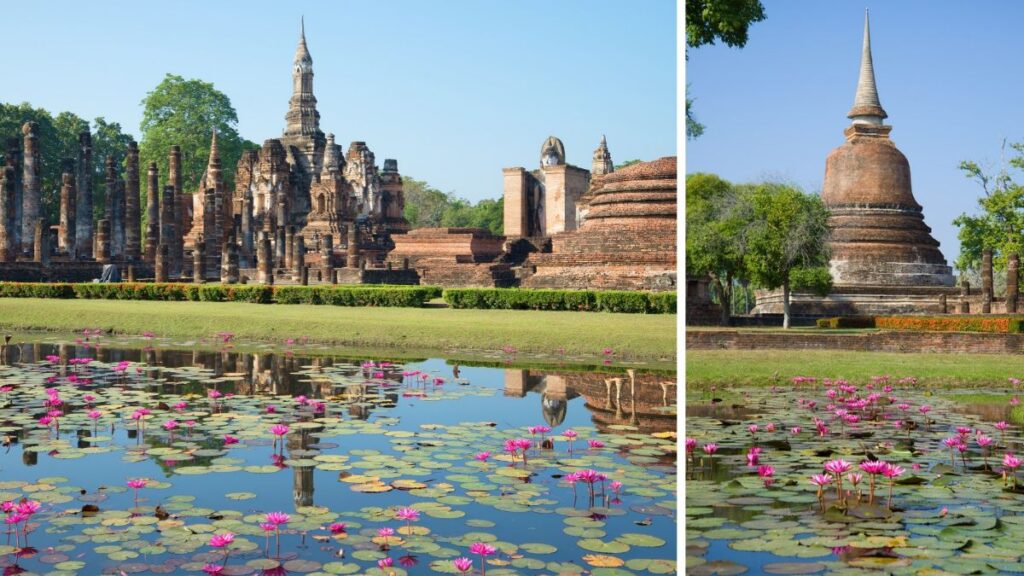
Wat Mahathat anchors the park, and it should be your first stop. The central lotus-bud chedi rises above smaller stupas and seated Buddha images, many still showing traces of their original stucco work.
Afterward, I always make time for Wat Si Chum, home to a 15-meter seated Buddha that peers out through a narrow opening in its enclosure — the effect is startling the first time you see those eyes looking back at you. Consequently, photographers often linger here longest, though the real reward comes from simply sitting nearby and absorbing the scale of it.
Renting a bicycle remains the best way to cover the park’s distances. Not only does cycling let you move at your own pace between sites, but it also keeps your visit low-impact, since the park authorities have worked to limit vehicle traffic across these fragile grounds.
Therefore, if mobility is a concern, electric tricycles are available for hire and provide a comfortable, accessible alternative without sacrificing the experience.
While the historical park draws most visitors, Sukhothai offers plenty beyond its ancient boundaries. The Ramkhamhaeng National Museum, located just outside the park, provides essential context before or after your ruins exploration. Here, you’ll find artifacts recovered from excavations, including the famous Sukhothai-style ceramics known as Sangkhalok ware.
Understanding this pottery tradition matters because it represents one of Southeast Asia’s most significant historical trade exports, and local artisans still produce similar work using traditional techniques.
Speaking of ceramics, I recommend visiting one of the pottery workshops in the area, where craftspeople demonstrate techniques passed down through generations. These visits support local livelihoods directly, which matters in a region where tourism revenue doesn’t always reach the communities maintaining these traditions.
The nearby Si Satchanalai Historical Park deserves mention too, even though it sits about an hour from the main Sukhothai site. Fewer tourists make the trip here, which means you’ll likely explore its temple ruins and ancient kiln sites in relative solitude.
This satellite park illustrates how the Sukhothai Kingdom extended its influence through a network of satellite cities, giving you a broader understanding of this civilization’s reach and organization.
Getting the timing right transforms a Sukhothai visit from merely interesting to genuinely memorable.
I always advise visiting during early morning hours, ideally before 8 AM, when temperatures remain bearable and golden light hits the chedis at their most striking angles.
Late afternoon offers similar lighting benefits, plus the added bonus of watching local families and monks move through the grounds as part of daily life rather than tourist performance.
The dry season, running from November through February, provides the most comfortable conditions for walking or cycling through the park’s extensive grounds.
However, visiting during the rainy season has its own appeal — fewer crowds, dramatic skies, and a lush green backdrop that contrasts beautifully with the aged brick structures.
Finally, I’d be remiss not to mention Loy Krathong, Thailand’s festival of light, which Sukhothai celebrates with particular significance since many historians trace the tradition’s origins to this very kingdom.
If your travel dates align with this November festival, witnessing thousands of floating krathongs against the illuminated ruins creates an experience that connects contemporary celebration directly to historical continuity. It’s not just sightseeing — it’s participating in a tradition that has outlasted empires.
Sukhothai doesn’t grab your attention the way more commercialized Thai destinations might. Instead, it offers something way more lasting: an encounter with history. Its a good reminder about why this part of Thailand earned its UNESCO recognition in the first place.
Showing tours and activities related to sukhothai.
Our full day historical park tour is for travelers that would like to get in touch with local lifestyle, culture, history and…
See More Details →
We're the local Thai's family business run, If you would like to see the real Thailand and would like to have the…
See More Details →
Thailand is a land deeply rooted in agriculture, with around 70% of its population involved in farming. In Sukhothai, this connection is…
See More Details →
This cycling tour starts at 08:00 till 15:00. This lovely tour along little canals that zigzag and swing passing small authentic communities…
See More Details →
This countryside tour in Sukhothai offers an immersive cultural experience, perfect for adventure seekers and those curious about local traditions. Beginning at…
See More Details →
La Scala Restaurant warmly invites you to savor the vibrant soul of Italian cuisine, where every dish is thoughtfully crafted by your…
See More Details →
We will show you about the local culture like the local morning market where you can see the local life. The historical…
See More Details →
This tour let you experience the Thai capital and gives you a unique impression of the city. We visit some of the…
See More Details →
Cycle through the small villages and rice paddies in the rural countryside outside of Sukhothai. Meet friendly locals along the way and…
See More Details →
Muangboran is an outdoor museum covering a whopping 96 hectares, or 240 acres. The creator has painstakingly built scaled models or replicas…
See More Details →
Discover Muangboran – The Ancient City, an extraordinary outdoor museum spread across 96 hectares (240 acres). Here, you’ll find beautifully crafted replicas…
See More Details →
Experience Bangkok by night on this unique tour that reveals a magical side of the city. After dark, landmarks are beautifully illuminated,…
See More Details →