Mountains that scrape the sky, a harbor full of the world’s smallest dolphins, whales off the coast, one of the darkest night skies on Earth, and a city with a traumatic history, now reborn with local spirit. This is Cantabrian pride, born of a city full of world famous gardens and rivers, Ōtautahi Christchurch. It and the wider Canterbury region pack all of those features into an area you can explore on trains, buses, bikes and your own two feet.
This Christchurch and Canterbury Travel guide is for those travelers who want to see more while leaving a lighter footprint: how to get around without a car if you want to, where to spend your money so it stays local, what things really cost in 2026, as well as what has changed recently.
A note on prices. All prices are in New Zealand dollars (NZD) and were checked against operator, government and booking-platform listings in October 2026. Operators change fares often (Whale Watch Kaikōura, for example, raised its adult price on 1 October 2026), so treat every number as a planning estimate and confirm before you pay. Where I couldn’t verify a current price, I say so.

Know Before You Go: What’s Changed in Christchurch and Canterbury in 2026?
- Canterbury Museum is closed. The Rolleston Avenue building is being rebuilt, with reopening expected around 2029. A free pop-up museum (donations welcome) is open on the first floor of the CoCA building at 66 Gloucester Street.
- The Air Force Museum now charges international visitors. Entry is NZ$15 for international visitors aged over 18, and free for people living in New Zealand.
- International Visitor Levy is NZ$100. Most international visitors pay this when they apply for a visa or NZeTA. Australian citizens and permanent residents, and visitors from most Pacific islands, are exempt. The levy funds conservation and tourism infrastructure.
- Hooker Valley Track is fully open. A new second swing bridge opened in July 2026, so you can reach Hooker Lake again.
- Paid parking at White Horse Hill (Aoraki/Mt Cook). DOC introduced car-park charges here in December 2025 and they continue. The pilot rates were NZ$5 an hour or NZ$25 a day, with the first 20 minutes free. Check DOC for current rates.
- Christchurch bus payment is changing. Standard adult fares can be paid by contactless card or phone. Concession fares still need a Metrocard. Metrocard and cash are due to be phased out, so check Metro for the current position.
- TranzAlpine timetable. Great Journeys’ own timetable page describes daily service from late May 2026. Check the operator’s website for your exact date before building plans around it.


1. Christchurch city travel guide
Christchurch holds fond memories for me. I attended university here, established my career, and bought my first and second house. Growing up in Nelson, made moving to Christchurch an exciting adventure. We all thought the city was enormous, my grandparents equated that to danger and warned me about having to lock car doors at traffic lights to avoid being hijacked?! Turns out it was not massive, but I suppose coming from a village of 800 people it was big. And the tales if carjacking – well I didn’t experience anything like that either. In fact, it was a great place to attend university and live. The next city I would live in would be London. Now that, is a big city!
After many years abroad I made my way back to New Zealand, and decided to base myself in Christchurch. I didn’t know what to expect. Before I left, Christchurch never had earthquakes. It certainly hadn’t in the 10 years I had lived there. However, while I was in London the city was devastated by earthquakes, one in 2010 and a second in 2011. Christchurch Ōtautahi has spent since then rebuilding itself.
What I found was a city I didn’t recognize. Every building and landmark I remembered had gone. But you can’t kill the famous Cantabrian spirit and while Christchurch’s appearance was different, her energy was not. I think I fell in love with the new Christchurch the first time I walked through the car-container-mall (now, sadly gone having made way for the new build). That mall was when I realized Christchurch was the same city I knew. Brave, honest and refusing to hide her scars. She not only shows them, she builds something better with them and next to them.
Canterbury, the region wraps around Christchurch, works the same way. It doesn’t perform for tourists. It just exists honestly, stubbornly beautifully. This guide covers the Canterbury region, Christchurch, as well as where to go, what to see, what it costs, and why it rewards travelers who take their time.
Christchurch and its Red Zone
Because of its history, many people arrive in Christchurch expecting either a disaster story or sanitized tourist loop. They get neither. The 2011 earthquakes leveled massive sections of the suburbs and central city. You’ll see, if you travel beyond the city, the ghost neighborhoods. Large areas of land with driveways, gardens, but not a house in site. These liquefaction areas may never be safe to return to. However it had to be different in the city center.

This is where Christchurch shines. Instead of papering over the cracks and ignoring its history, Christchurch turned the recovery into its own kind of attraction. The Transitional Cardboard Cathedral, which truly was constructed using cardboard tubes and timber, still stands as a working church. It’s also a message as well as a quiet rebuke to the idea that temporary can’t be meaningful.
Walk the Red Zone memorial along the Te Ara Ōtākaro Avon River Trail or the City to Sea Pathway and you’ll understand the scale of what happened here. Then walk two blocks over to the Riverside Market, where local producers sell everything from fresh Akaroa salmon to small-batch kombucha. This place is what recovery actually looks like. The city doesn’t ask you to forget the earthquakes. It asks you to remember them, and come see what came after.
Botanic Gardens and Hagley Park.
These gardens are about 21 hectares of themed plantings, conservatories and river paths, free to wander. Allow at least two hours. Spring (September–November) is spectacular. Christchurch Botanic Garden, located within Hagley Park, is famous for its magnificent trees and was established in the early 1860s with its first plantings. The garden is level and easy to walk around, offering an information center, tea kiosk, and full visitor facilities.
Although its carefully maintained, mature trees are a key highlight. You’ll also find rhododendron and shrub borders, a long herbaceous border, and an impressive rose garden. The mainly hybrid tea roses are particularly beautiful in December. Beside the rose garden are the “houses.” The draw card is the tropical plant conservatory, but you have a fern house, and cacti house as well. The native plant collection is centered around the Cockayne Memorial Garden. It is well worth visiting.

Close the city is the Primula Garden displaying….drum roll please….primulas. It also has other Asian plants. Formal bedding is largely limited to the eastern edge along Rolleston Avenue. Here you’ll find the Peacock Fountain. Pack a lunch from the Market or walk to the potager garden behind the former curator’s house, now operating as a café.
Punting on the Avon.
A 30-minute punt through the botanic gardens and park leaving from the Antigua Boat Sheds costs around NZ$35 for adults and NZ$15 for children. Combined passes with the Tram and Gondola saves a little cash. Punting on the Avon is one of Christchurch’s most iconic experiences.
It was a favorite attraction when I lived there and remains so today. It is the perfect activity to just sit back and unwind. Your punter, dressed in traditional Edwardian clothing, will guide you along the river and give the commentary. Punting offers a different view of the Botanic Gardens. It is also very eco-friendly. With no tour vans carbon footprint to worry about, you deserve a reward, so take the time to chill out and relax while exploring the city from a punt.

Christchurch Gondola.
Head east and you can visit the Christchurch Gondola. This proves panoramic views across Christchurch and Canterbury as well as Lyttleton and Banks Peninsula. At the summit station, you can explore some easy walking tracks as well as experiencing the Christchurch Discovery Ride to learn about the area’s history. Grab a cuppa at the licensed café or browse the gift shop. Easy to get to, the Gondola is a mere 15-minute drive from Christchurch city center and a fantastic way to get some amazing photos of the city, Lyttelton Harbor and the Southern Alps. Adult tickets were listed at around NZ$45 in mid-2026.
Christchurch Art Gallery Te Puna o Waiwhetū.
This free public gallery features an impressive collection of New Zealand and international art exhibitions. Opened in 2003, it is recognised for its striking modern architecture and replaced the Robert McDougall Art Gallery. Its Māori name, Te Puna o Waiwhetū, refers to the artesian spring beneath the building and a nearby tributary of the Avon River / Ōtākaro.
General entry is free. Major touring exhibitions usually cost extra, in the NZ$15–25 range. A good rainy-day pick.

A food scene nobody warns you about
Christchurch’s food culture may surprise you. It did me. The city’s dining scene rebuilt itself alongside everything else, and the result is a cluster of restaurants and bars that are elegant, unique, delicious, and focused on sustainability.
Little High Eatery, a converted warehouse space downtown, pulls together a dozen or so vendors under one roof. You can choose from dumplings, poke bowls, or craft beer. And all sourced from regional producers. It’s not fine dining, and it doesn’t pretend to be. It’s a fun and affordable way to sample Canterbury’s food identity in one sitting. Expect to spend NZD $15–25 per meal.
If you want fine dining or something slower, head to one of the restaurants along the Christchurch Arts Centre precinct. They stand alongside Te Matatiki Toi Ora Arts Centre, New Zealand’s largest group of Category 1 Gothic Revival heritage buildings. This is worth the visit even if you don’t eat. The Arts center occupies a full city block in central Christchurch running in-between Worcester Street, Rolleston Avenue, Hereford Street, and Montreal Street.

Other Christchurch Attractions and Options
- Canterbury Museum pop-up. Free, with collection highlights and temporary exhibitions in a small space. Open 9am–5.30pm October to March.
- Tūranga library and the Arts Centre grounds. Both are free to explore. You can walk between the gallery, the pop-up museum, Tūranga and the Arts Centre in an afternoon.
- Air Force Museum of New Zealand (Wigram). One of the world’s premier military aviation collections, about 15 minutes from the city centre. Open 9.30am–4.30pm daily.
- International Antarctic Centre. Next to the airport, with a simulated Antarctic storm, an Antarctic gallery and more. Open daily 9am–4.30pm. I found adult tickets listed from roughly NZ$39 to NZ$59 depending on the package and seller, so confirm on the official site.
- Orana Wildlife Park. New Zealand’s only open-range zoo, run by a not-for-profit charitable trust, with critically endangered species. Adult tickets were listed from about NZ$29 to NZ$40.
- New Brighton and the Port Hills. Beach, pier and cafés on one side, and city views from marked hill tracks on the other. Check conditions and pick a route that matches your fitness.

Lyttelton Shore Excursion: Christchurch Sightseeing with Antarctic Center
Combine the International Antarctic Centre with its little Blue Penguins, Antarctic Storm in the Ice and Snow room, 4-D Movie and Hagglund ride over…

Christchurch Hop-On Hop-Off Tram
Welcome aboard the Christchurch Tram! Travel on our newly extended track & enjoy this unique and historic way to view the inner city. Drivers…

Lyttelton Shore Excursion City Highlights with 3 best Attractions
Discover the best of Christchurch on this unforgettable highlights tour, featuring three of the city's most iconic attractions. Step aboard the heritage Tram, glide…
2. What should I see and do in the wider Canterbury region?
Banks Peninsula and Akaroa (about 90 minutes from the city by road)
Drive an hour and a half southeast of Christchurch and you’ll reach Akaroa, a small harbor town sitting inside the collapsed crater of an extinct volcano. Banks Peninsula, the landmass it sits on, was formed because of volcanic activity millions of years ago. The harbor itself is the flooded caldera. Few visitors realize as they pass through the tunnel from Christchurch that they’re actually driving into a volcano.


Akaroa is one of several settlements on the peninsula, and the most famous. It was the landing point of French colonists, so its French colonial history gives Akaroa a different vibe to Christchurch. It has European style narrow streets, quaint cottages, and a slower pace. You will also find French street names, French inspired buildings, and French bakeries. The rest of the peninsula and mainland maintains it Māori or English colonial history.
I’d skip the bus tours if you can. Rent a car, take Highway 75 at your own pace, and stop at the lookout points along the Summit Road. The views over the harbor are worth the extra twenty minutes and you’ll avoid the crowds that hit Akaroa when cruise ships visit. Check the Akaroa cruise ship schedule online before you go — it’s a small town, and a single ship can double its population for an afternoon.
Akaroa based wildlife or outdoor activities
- Hector’s dolphin cruises. Hector’s dolphins are the world’s smallest and rarest marine dolphins. They are only found around Akaroa, nowhere else in the world. Two long-running Akaroa operators run roughly two-hour cruises; list prices are about NZ$125–130 for adults. Akaroa Dolphins is family-owned and does not swim with the dolphins as a conservation measure. Black Cat Cruises describes itself as New Zealand’s original eco-tourism operator and works within the Banks Peninsula Marine Mammal Sanctuary. Dolphins are wild, so sightings aren’t guaranteed. Akaroa Dolphins offers a free repeat cruise if you don’t see any.
- Pōhatu Penguins. Evening tours to Pōhatu (Flea Bay), home to the largest mainland colony of little blue penguins, led by the people credited with protecting them. Book ahead and check the current price direct.
- Little River Rail Trail. A grade 1 cycle trail from Hornby to Little River, roughly 46–50 km, beside Lake Ellesmere/Te Waihora (one of the South Island’s most important bird habitats). Bike hire and shuttles are available from Christchurch operators including Natural High and Action Bicycle Club. Sit-down cafés and an art gallery at Little River make a lovely lunch stop.
- Walking tours of the crater rim. Guided walks explore the peninsula the old-fashioned way, on foot.


Kaikōura (about 2.5 hours north of Christchurch)
Kaikōura is a major marine-wildlife destination on the east coast of New Zealand’s South Island. Located off State Highway 1 between Christchurch and Picton, Kaikoura is one of New Zealand’s best destinations for those seeking adventure and wildlife.
It is known for its resident sperm whales, as well as dusky dolphins, fur seals and numerous seabirds. The reason for this is the nearby Kaikōura Canyon which creates unusually productive marine habitat, allowing sperm whales to be seen close to the mainland throughout the year.
Other highlights are the Kaikōura Peninsula Walkway, scenic flights and eating local crayfish (lobster). That’s heaps to pack into an itinerary, and a lot for a town of only around 2000 people that is still recovering from severe earthquake damage.
- Whale Watch Kaikōura. This is probably the most well known activity in Kaikoura. And before you visit, have a look at the dates and decide which whale you want to see. Kaikōura’s sperm whales are present year-round. Humpback whales are more seen during the June–July migration period while the orcas are seen from December to March. Tours operate by boat and from the air, subject to weather and marine conditions, in a purpose-built catamaran. From 1 October 2026 the adult Ocean Cabin price is NZ$185 (child 3–15 years NZ$60). They quote a 95% sighting rate and refund 80% of the fare if you don’t see a whale. Book early, and take seasickness precautions.
- Dusky dolphins. The Dusky dolphins are found in Kaikōura’s coastal waters, and Dolphin Encounter is the organization that runs watching and swimming trips. Recent listings showed roughly NZ$115–135 to watch and NZ$230–245 to swim. Swim places are limited to 16 per boat. Watching from the boat is the lowest-impact option; if you do swim, choose a permitted operator and follow their instructions.
- Walk the Kaikōura Peninsula Walkway: The full route is approximately 11–11.7 km and takes about three hours, although shorter sections are possible. It follows clifftops between the peninsula and South Bay, with views of the Pacific Ocean, Seaward Kaikōura Range, tidal platforms and marine wildlife.
- See New Zealand fur seals: Seal colonies can be viewed around the peninsula, particularly near Point Kean and along the walkway.
- Visit Point Kean and the peninsula lookouts: These viewpoints combine expansive mountain-and-ocean scenery with opportunities to see seals, seabirds, fishing boats and—occasionally—whales from shore.
- Explore the coastline by kayak: Guided kayaking trips provide views of the peninsula, seals and seabirds from the water.
- Go birdwatching: Kaikōura’s waters attract albatross, petrels, shearwaters and other seabirds. DOC notes a colony of Hutton’s shearwaters near the peninsula walkway.
- Try a scenic flight: Fixed-wing aircraft and helicopter tours offer an aerial perspective of sperm whales, the peninsula, Pacific coastline and Seaward Kaikōura Range.
- Stargaze: Kaikōura is an accredited International Dark Sky Sanctuary, making a self-guided or organised night-sky experience a worthwhile evening activity.
- Eat local crayfish: Kaikōura is famous for crayfish, reflecting the region’s strong connection with the sea and fishing culture.
- Getting there by rail or bus. The Coastal Pacific train runs between Christchurch and Picton via Kaikōura. InterCity buses also run daily, leaving from the Bus Interchange on Lichfield Street in Christchurch. It is a very easy drive, so if you have a rental car that’s the best way to get there.

Seal Kayaking Adventure in Kaikoura
This tour offers 2 different kayaking options for you to choose from: Seal Kayak tour and the Sunset Kayak Tour. It is the first…

Seal Swimming Tour from Kaikoura
Swim with wild New Zealand Fur Seals in the pristine waters of the beautiful Kaikoura Peninsula. This is an experience that you do not…

Half Day Zipline Adventure in Kaikoura
A half day of adventure in nature awaits you in Kaikōura, with five zipline flights, totalling 2.2km, above lush rolling farmland, native forest, an…

A good one-day itinerary
- Morning: Walk the Kaikōura Peninsula Walkway, beginning near Point Kean or another convenient access point.
- Late morning: Stop at a lookout and observe the seal colonies.
- Lunch: Try locally sourced seafood or crayfish in town.
- Afternoon: Join a whale-watching, dolphin, kayak or scenic-flight experience.
- Evening: Visit a viewpoint or join a dark-sky stargazing experience.
Hanmer Springs
Set in the alpine village of Hanmer Springs you’ll find the major drawcard, the Hanmer Springs Thermal Pools. The thermal water is all natural and truly thermal, however it is now piped into concrete pools. The pools range from 34 to 42 degrees and come in a variety of shapes and sizes. Over the years I visited Hanmer Springs about 5 times (that I can remember) and I’m never quite sure if I like it or not.
It is very relaxing, it is very refreshing, but its a bit like spas. after an hour or two I’m done and wanting something to do. I also visited during the school holidays, so I think the whole towns kid population and their friends were there, so wasn’t quite as relaxing as I’d hoped. The trick here I learned and verified later, is during the school holidays, don’t go to the pools until later in the day. The pools are open until 9 pm and most kids have gone by 3pm. If you don’t mind hands, feet and rouge soccer balls flying past your face – go anytime you like.

If you have the choice of when you visit I recommend winter. There is something very satisfying about sitting in hot thermal waters on a freezing cold day. Worth a mention is that some of the pools are natural Sulphur water pools. Very therapeutic but be prepared for the smell. You’ll also want to remember to remove any silver jewelry. The sulphur water will cause it to tarnish. The Sulphur pools offer several benefits, including boosting collagen production, soothing eczema and psoriasis, and relieving dry skin!
Castle Hill Rocks
About an hour west of Christchurch, limestone boulders rise out of open farmland in formations that look almost deliberately placed. Castle Hill, known to Māori as Kura Tāwhiti, was a historic tribal food-gathering site so there are some rock formations off limit because of the cultural importance.


These massive limestone formations are estimated to be over 20 million years, taking shape because of erosion and uplift. The site is open-access and draws rock climbers from around the world, as well as families and hikers who simply want to wander around the genuinely strange terrain.
There’s no entry fee, and regardless of its name, the walking paths are flat enough for most people to cope with. Climbers need to be mindful about which rock they scale, several have cultural restrictions but they are clearly sign posted.
I usually combine Castle Hill with a stop in Springfield. It breaks up the drive and gives an easy coffee stop before heading through Arthur’s Pass. If you’re building a full day loop from Christchurch, this works well costing only fuel and time.
Arthur’s Pass and the TranzAlpine
The TranzAlpine covers 223 km coast to coast in just under five hours, climbing over the Southern Alps through gorges, the Otira Tunnel and beech forest. Check out Great Journeys New Zealand’s carbon calculator showing you the difference in emissions compared to driving.
- Adult one-way fares are listed from roughly NZ$199 to NZ$249 (child NZ$139–174), subject to availability.
- Arthur’s Pass National Park is the stop to get off at if you like walking. The DOC visitor centre is at 104 West Coast Road.
- If you lack time and have only a day, train to Arthurs pass, walk the beech forest tracks for a few hours, and then get the afternoon train back to Christchurch.
- If you have time, this is a brilliant picturesque journey to the West Coast. After exploring the West coast you have easy access north to Nelson and Tasman. You can also head to Otago for Queenstown and Wānaka, or Southland for Te Anau and Milford Sound.
- Serviced DOC huts around Arthur’s Pass and Craigieburn are an affordable way to extend the trip. Costs are currently advertised as NZ$25 per adult per night for serviced huts and NZ$10 for standard huts.


Lake Tekapo (about 3 hours from Christchurch)
Lake Tekapo is one of Canterbury’s most stunning destinations, renowned for its vivid turquoise waters, striking alpine scenery, and some of the clearest night skies on Earth. As the gateway to the Aoraki Mackenzie International Dark Sky Reserve, Tekapo is a rare “gold-tier” destination for stargazing.
To experience the very best the Lake Tekapo township has to offer, I recommend planning your itinerary around the spectacular scenery and celestial views that you find here. Growing up we often traveled to Tekapo for the long easter weekends staying in one of the local NZ RSA holiday homes. The area is now far more developed with the infrastructure to match.
As well as gaining access to one of the most photographed spots in New Zealand, the lakeside Church of the Good Shepherd, other notable Tekapo activities are:
- The Dark Sky Project: The dark sky project provides an exceptional experience with guided tours at Mount John Observatory. View distant galaxies and planets through professional research telescopes while learning fascinating facts about astronomy and Māori star lore.
- Tekapo stargazing in hot springs: My favorite way to unwind is to combine stargazing with a relaxing soak. Based at Tekapo Springs, Tekapo Stargazing begins with a guided tour of the constellations using high-powered telescopes. The experience ends with floating on inflatable hammocks (called Lilo’s in NZ) in a 38°C hot pool while listening to soothing music and commentary about the night sky.
- Church of the Good Shepherd: Built in 1935 to commemorate the region’s early high-country pioneers, this small stone church is among Canterbury and New Zealand’s most photographed landmarks. Located directly beside the lakefront, it offers a beautifully framed view of the blue water and mountains through its altar window. Local tip: Tour buses make the site extremely crowded around midday. If your visit includes a photo opportunity, arrive at sunrise for peaceful, clear light, sunset for dramatic skies, or visit late at night to watch the Milky Way stretch above the roof.
- Mount John Summit: For sweeping 360-degree views across the lake, Mackenzie Basin, and the distant Southern Alps, hike to the summit of Mount John. Follow the Mt John Summit Track from the Tekapo Springs car park. It’s a gradual climb and takes between 1.5 to 2 hours, passing through pine forest before reaching the open summit. for those not inclined for a hike, you can also drive to the top during daylight hours. But that will cost you $14 in road toll.
- Tekapo Springs: Even without joining the nighttime stargazing tour, an afternoon at Tekapo Springs is restorative. Surrounded by pine trees, the tiered hot pools are heated to between 36.5°C and 38.5°C and filled with pure glacial water. You get amazing views of the lake and Two Thumb Mountain Range. Perfect following the Mount John summit hike. And, if you hiked you saved $14 which can go towards your entry fees!

Aoraki/Mount Cook (about 4 hours from Christchurch, or one hour from Tekapo)
Aoraki / Mount Cook National Park is the at the center of Canterbury’s alpine landscape. It contains the country’s highest mountain, Mount Cook / Aoraki, which rises to 3,724 metres, along with its longest glaciers. Tekapo is known for expansive lake views, whereas Aoraki Mount Cook brings you sheer cliffs, massive ice fields, and powerful glacial rivers. A visit to the park offers exceptional walks, glacier scenery, and if you have large pockets, those famous alpine flights.
Getting there. InterCity connects Christchurch with Tekapo (around 4 hours 10 minutes) and Mt Cook (around 5 hours 30 minutes), and there’s a service between Tekapo and Mt Cook. Tekapo to Mt Cook village is about 96 km. While I usually advise using green methods of travel, this is a destination that is much easier and gives you better flexibility with a rental car.
Before setting out on any of the trails below, visit the DOC Aoraki/Mount Cook National Park Visitor Centre. The center is a free, multi-level museum featuring displays about early mountaineering, the Māori legend of Aoraki, local plants and wildlife, and interactive climate models that illustrate how the glaciers are changing. You should also visit the Sir Edmund Hillary Alpine Centre.
Located inside the Hermitage Hotel, it commemorates New Zealand’s most famous explorer. As well as featuring Sir Edmund and his mountaineering conquests the historical museum also features an interactive 3D theatre, and a digital planetarium.
- Aoraki Mackenzie International Dark Sky Reserve. Designated in 2012 and covering Tekapo and Aoraki/Mt Cook, it’s one of the world’s best places to see the Milky Way. In Aoraki Mt Cook, a 75-minute guided stargazing tour costs NZ$119 for adults (NZ$99 for children aged 3–15) from April 2026.
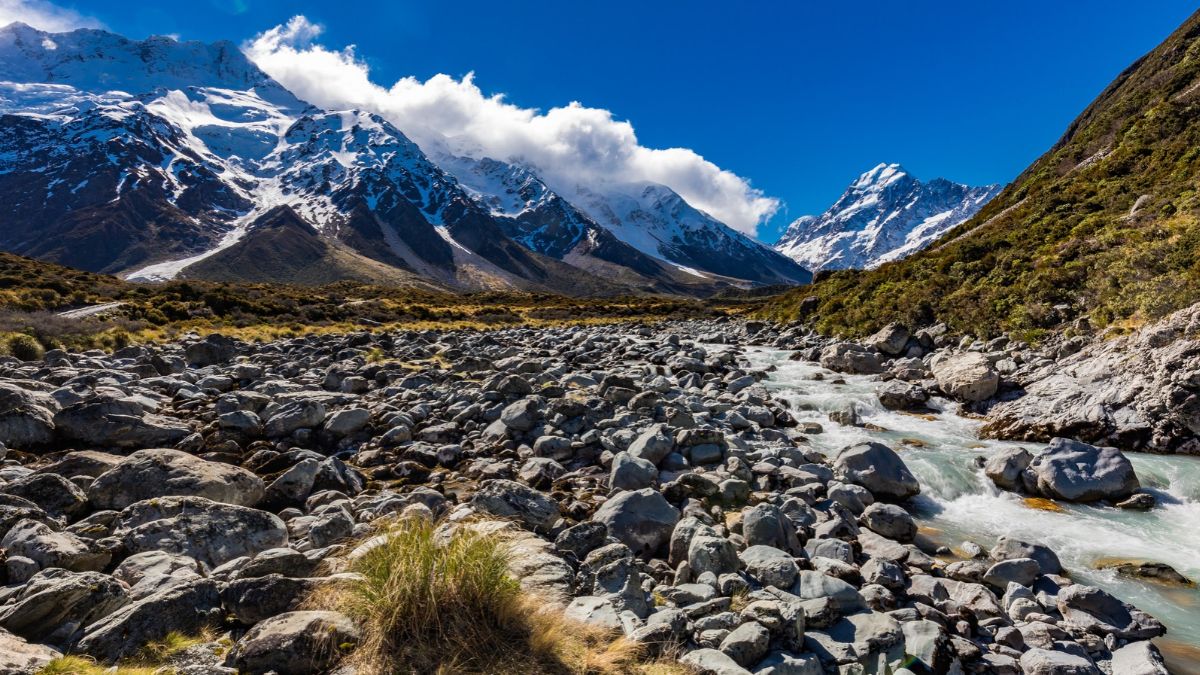
- Hooker Valley Track. If you can only fit in one walk, make the Hooker Valley track your top choice. The mostly flat, 10-kilometre return trail takes roughly three hours to complete. Along the way, you’ll cross three impressive swing bridges spanning fast-flowing rivers and huge boulder fields, before reaching the shores of Hooker Lake. This lake is different to most as you’ll find actual icebergs drifting across the water, and Aoraki / Mount Cook rising dramatically in the distance.
- Tasman Glacier Track: A short but steep 15 to 20 minutes climb up rocky steps will reward you with sweeping views of New Zealand’s largest ice sheet. From there, you can see the sculpted gray moraine walls and look down on icebergs floating across the vast terminal lake.
- Sealy Tarns Viewpoint: Often known as the “Stairway to Heaven,” this is a demanding, steep trail that climbs the valley wall via 2,200 uninterrupted steps. The round trip takes 3–4 hours, offering you stunning panoramic views of the Hooker Valley, Mueller Glacier, and the Mount Cook Aoraki village below.
- Mueller Hut: If you are an experienced hiker and equipped for an overnight alpine adventure, you can continue beyond Sealy Tarns for another two hours and reach the iconic bright-orange Mueller Hut. Make sure you’ve booked your stay in the hut before you arrive. Its a long walk home if you don’t. The Mueller Hut Booking link is here.
- Glacier Explorers Boat Tour: Running from late spring to autumn, Glacier Explorers takes you across the terminal lake at the foot of the Tasman Glacier. You will travel alongside towering ancient ice walls, close enough to touch the ice. Some of these ice sheets are 300 to 500 years old, and have broken away from the glacier. It’s one of the few places in the world where a glacial lake is so easily accessible.
- Scenic Flights and Ski-Plane Landings: If your budget allows, a heli-hike or scenic flight will offer you an unforgettable perspective. Operators such as The Helicopter Line and Mt Cook Ski Planes & Helicopters will take you alongside jagged mountain walls. And for the ultimate adventure seekers, you can land on the pristine snowfields of the upper Tasman Glacier, surrounded by the towering alpine peaks.


3. How to stay safe in Christchurch and Canterbury.
New Zealand is very safe for travelers, but the landscape is wild and the weather moves quickly.
Earthquakes and tsunami. New Zealand is seismically active, and Christchurch knows this better than most. In a quake, Drop, Cover and Hold under sturdy furniture. If you are near the coast and feel a strong quake (one that makes it hard to stand) or a long one (more than a minute), go to high ground or as far inland as you can straight away without waiting for an official warning. The slogan is “Long or strong, get gone.” Hotels and attractions usually display emergency instructions, so read them on arrival.
Weather and the outdoors. Weather can change in minutes in the Port Hills, on the coast and in the Southern Alps.
- Check MetService and the track or park page on the DOC website on the day.
- Carry water, warm layers, a rain jacket, sun protection and a charged phone.
- Tell someone your route and return time, and use the DOC visitor centre for track and hut conditions before you set off.
- Don’t cross flooded rivers. Canterbury’s braided rivers can rise quickly.
- UV is strong even on cool days. Cover up and use sunscreen.
Roads. Drive on the left. Allow extra time on narrow and winding roads and don’t drive tired, especially after a long flight. Check NZTA road conditions before setting off for the Alps, Lewis or Arthur’s Pass, or Kaikōura, because closures from snow, slips or flooding happen.
Wildlife. Stay well back from seals and penguins, never feed wildlife, and keep dogs away. Kea at alpine sites are cheeky and will target bags and car rubber. Don’t feed them.
City safety. Normal precautions apply: keep valuables out of sight, use marked crossings and stay on well-lit routes at night.
Emergencies. Call 111 for police, fire or ambulance. Get travel insurance that covers medical care and the activities you plan to do, since New Zealand’s ACC scheme doesn’t remove the need for cover when you’re visiting.

Timaru Shore Excursions, Private Tour, Aoraki Adventure
On your scenic drive to Aoraki/Mount Cook National Park you will pass the famous cool aid looking Lake Pukaki and enjoy the view on…

Arthurs Pass and Southern Alps Day Excursion from Port Lyttelton or Christchurch
This day excursion takes us across the Canterbury Plains around 50 miles to Porters Pass (just under 1000 m and higher than Arthurs Pass)…

Akaroa Lavender Seasonal Guided Tour Experience
Experience a seasonal one-hour guided tour of the lavender fields from late November to mid-February. The story of our lavender farm is shared as…

4. Where should I stay in Christchurch and Canterbury?
| Area | Best for | Trade-off |
|---|---|---|
| City centre | Car-free travel, museums, food, buses and trains | Higher rates; limited parking |
| Riccarton | Restaurants, shops, bus links, near the university | Less atmosphere |
| New Brighton / Sumner | Beach time and a relaxed pace | Farther from central attractions |
| Airport area | Early flights, Antarctic Centre, Orana | Not a central city feel |
| Akaroa / Little River | Wildlife, rail trail, slow travel | Limited transport; book ahead |
| Hanmer Springs | Hot pools and forest walks | Can feel busy at weekends and school holidays |
| Tekapo / Aoraki Mt Cook Village | Stargazing and alpine walks | Pricey and often fully booked; plan early |
Indicative 2026 prices (per night, NZD, approximate):
- Hostel dorm beds: roughly NZ$40–70 in the city.
- Budget private rooms and simple motels: about NZ$90–150.
- Mid-range hotels and apartments: about NZ$150–260.
- Upscale hotels: NZ$300 and up.
- Lake Tekapo and Mt Cook: motel and hostel private rooms were listed from about NZ$150 to NZ$210 for an autumn night, and are higher in peak season.
Choosing greener stays
- Hostels such as Drifter and Haka House put many travellers under one roof and are practical, social bases for car-free trips.
- Hotel Give in the city centre (the former YMCA) is a charity-model hotel and worth checking if you want your bed to support a good cause.
- Look for third-party sustainability signals such as Qualmark sustainability awards, B Corp status or Toitū carbon certification, and ask what a property does on energy, water and waste.
- For backcountry stays, DOC huts and campsites are low-impact and good value. Book ahead for popular serviced huts in summer.
- Always check what’s included (breakfast, taxes, parking) and the cancellation terms.

5. Typical and True Costs 2026
Christchurch is moderate to high compared with many destinations, but there’s a lot you can do cheaply or for free. The big swings come from accommodation, car hire, paid tours and restaurants.
What are the everyday costs in Christchurch? (per person, per day)
| Expense | Budget | Mid-range | Higher-end |
|---|---|---|---|
| Accommodation | NZ$45–90 | NZ$150–260 | NZ$300+ |
| Breakfast | NZ$8–15 | NZ$18–30 | NZ$35+ |
| Lunch | NZ$12–20 | NZ$22–35 | NZ$40+ |
| Dinner | NZ$18–30 | NZ$35–65 | NZ$80+ |
| Local transport | NZ$5–15 | NZ$20–45 | NZ$50+ |
What are the costs I need to know? 2026 Christchurch and Canterbury listings
| Item | Approximate cost |
|---|---|
| Metro bus, standard adult (contactless/Metrocard) | NZ$3.00 |
| Metro bus, cash | around NZ$4 |
| Diamond Harbour ferry, adult | NZ$5.00 |
| Punting on the Avon, adult | NZ$35 |
| Christchurch Gondola, adult | about NZ$45 |
| International Antarctic Centre, adult | roughly NZ$39–59 (varies by package and seller) |
| Air Force Museum, international visitor | NZ$15 (free for NZ residents) |
| Canterbury Museum pop-up | Free (donation suggested) |
| Akaroa Hector’s dolphin cruise, adult | about NZ$125–130 list price |
| Whale Watch Kaikōura, adult | NZ$185 (from 1 Oct 2026) |
| Dusky dolphins, watch / swim, adult | roughly NZ$115–135 / NZ$230–245 |
| TranzAlpine, adult one way | roughly NZ$199–249 |
| Hanmer Springs pools, adult | roughly NZ$24–32 (reseller; gate may differ) |
| Mt Cook stargazing, adult | NZ$119 |
| DOC parking, White Horse Hill | pilot rates NZ$5/hour or NZ$25/day (check current) |
| International Visitor Levy | NZ$100 per person (most international visitors) |
A rental car adds fuel, insurance, parking and any one-way fees. Airport transfers vary: the bus is the cheapest option, and shuttle and taxi fares are higher (older sources put a taxi at around NZ$40, so get a quote).
6. Suggested Travel Budget
These estimates are for one traveler, excluding international flights and the International Visitor Levy. Couples sharing a room can cut the per-person accommodation cost. Summer weekends and event dates cost more.
| Travel style | Per day | What it covers |
|---|---|---|
| Budget | NZ$110–170 | Hostel dorm or simple room, supermarket and market food, buses, free attractions |
| Mid-range | NZ$220–360 | Private room or motel, mixed dining, local transport and one paid experience a day |
| Higher-end | NZ$450+ | Premium accommodation, frequent restaurant meals, taxis, tours and flexibility |
A Christchurch and Canterbury travel guide worked example: 7 days, car-free, budget-to-mid
Assumptions: one traveler, buses and trains, hostel or budget rooms, and a handful of the region’s best experiences.
| Item | Low | High |
|---|---|---|
| Accommodation (7 nights at NZ$45–90) | NZ$315 | NZ$630 |
| Food (7 days at NZ$40–65) | NZ$280 | NZ$455 |
| Local transport (7 days at NZ$5–15) | NZ$35 | NZ$105 |
| Experiences: Whale Watch, Akaroa cruise, Mt Cook stargazing, Gondola, Air Force Museum | about NZ$490 | about NZ$490 |
| Regional bus/rail (my estimate; fares vary by how early you book) | NZ$200 | NZ$400 |
| Subtotal | NZ$1,320 | NZ$2,080 |
| Add a 10–15% reserve | NZ$1,452 | NZ$2,392 |
So roughly NZ$1,450–2,400 per person for a week, plus flights and the NZ$100 levy if it applies to you. The reserve is there for weather changes, rescheduled tours and price movement.

7. Money-Saving Tips
- Use the NZ$3 bus. Metro buses charge a flat standard adult fare, which makes them the cheapest way around the city.
- Fill your itinerary with free things. The Botanic Gardens, Hagley Park, the Art Gallery’s permanent collection, the Canterbury Museum pop-up, Tūranga and the Arts Centre grounds cost nothing.
- Bundle Christchurch attractions. The Tram, Gondola and Punting combos are cheaper than buying each one separately.
- Travel in the shoulder seasons. Late spring and autumn have good weather, fewer crowds and often lower accommodation rates. Aggregator data generally shows the highest prices in summer (December–February) and the lowest in colder months.
- Book the big-ticket items early. Whale Watch, the TranzAlpine, Tekapo and Mt Cook stays, and popular DOC huts fill up in peak periods, and the cheapest fares go first.
- Choose accommodation with a kitchen. Self-catering a few meals, and picking up fruit, bakery items and market food, saves a lot. Christchurch tap water is generally safe to drink, so carry a refillable bottle.
- Skip the car where you can. Between buses, trains and shuttles you can reach Akaroa, Kaikōura, Hanmer, Tekapo and Mt Cook without driving. Parking at Mt Cook now costs money, which tips the balance further.
- Compare resellers with operator prices. Resellers sometimes undercut list prices, so check cancellation and refund terms. Our recommended reseller provides excellent prices and free cancellations (see below), or book direct if the operator offers a guarantee (such as Whale Watch’s refund or Akaroa Dolphins’ free repeat cruise).
- Share the cost. If you’re travelling in a group, a rental car or a small-group tour split four ways can undercut four individual bus tickets, but compare the full cost including fuel, parking and insurance.
- Don’t save money in the wrong places. Skimping on travel insurance, driving tired or heading out on a track you’re not equipped for will cost far more than you save.


Akaroa Dolphins ~ Harbour Nature Cruise
At the core, we’re a family business with our management team being 6th & 7th generation Banks Peninsula locals. Alongside our family members, we…

Akaroa Harbour Nature Cruise
Cruise through the stunning Akaroa Harbour and encounter some of New Zealand’s most unique marine wildlife, including the rare Hector’s dolphin, NZ fur seals,…

Shamarra Alpaca Farm Tours
Alpacas Farm is an unparalleled opportunity to get up close and personal with alpacas, learn about this loving animal, and create some memories with…
8. How do I travel around Christchurch and Canterbury?
On foot and by bike
Christchurch central city is compact and flat, so walking and cycling are the best ways to see it. Wear a helmet, much of the city has cycle lanes so use them, and lock your bike. For longer rides, the Little River Rail Trail is an easy, mostly flat day out, and e-bikes are available to hire.
Metro buses and ferry
- The standard adult fare is NZ$3 (contactless card, phone or Metrocard); cash is higher at around NZ$4. Child, youth and other concession fares require a registered Metrocard.
- The Diamond Harbour ferry costs NZ$5 for adults.
- The bus interchange is at Colombo and Lichfield Streets.
- From the airport: Route 29 takes about 30 minutes to the city, and standard adult fares can be paid by contactless. Route 3 also runs to the city, but only every third bus enters the airport, so check your bus says “Airport”. Taxi, rideshare and shared shuttles are alternatives with luggage, but cost more.
Trains
- TranzAlpine (Christchurch–Greymouth via Arthur’s Pass): one of the world’s great train journeys. Free parking is available at Addington station.
- Coastal Pacific (Christchurch–Kaikōura–Picton): seasonal. Check timetables.
- Trains are seated only and must be booked in advance.
Long-distance buses and shuttles
InterCity connects Christchurch with Hanmer Springs, Kaikōura, Tekapo, Mt Cook and beyond, and a shuttle serves Little River and Akaroa (ask about bike trailers if you’re cycling). Buses depart from outside the Bus Interchange on Lichfield Street.
Hiring a car
A car gives much greater flexibility and will save time when accessing Banks Peninsula, the Alps and the dark-sky sites. If you do hire one:
- Ask about hybrid or electric options and plan your charging stops, especially for Tekapo, Mt Cook and Arthur’s Pass.
- Note that EVs parked in charging bays at DOC car parks still pay the parking charge.
- Allow generous driving time, take breaks and avoid driving long distances straight after a flight.
- Check road conditions before you set off.
9. When should I go to Christchurch and Canterbury?
| Season | What to expect | Good for |
|---|---|---|
| Summer (Dec–Feb) | Long daylight, warm days, highest prices | Beaches, hiking, road trips, Hooker Valley, Kaikōura |
| Autumn (Mar–May) | Cooler evenings, autumn colours, calmer city | Walking, cycling, shoulder-season value |
| Winter (Jun–Aug) | Short days, cold, snow in the Alps, lower prices | Museums, food, hot pools, stargazing (longer nights); check mountain roads and train timetables |
| Spring (Sep–Nov) | Changeable weather, blossom and gardens | Botanic Gardens, wildlife, quieter trails; pack layers |
Year-round highlights: Whale watching at Kaikōura and Hector’s dolphin cruises at Akaroa operate throughout the year, and the dark-sky reserve is spectacular any clear night (winter just gives you more hours of darkness).
Watch the timetables. Scenic trains can run on reduced schedules in some seasons, and the Coastal Pacific is seasonal, so check dates before you book the rest of your trip around them.

10. Best Places to Book Your Trip
Use the operator’s own site or our recommended booking platform, then compare the final total and the cancellation terms. The cheapest headline price can exclude baggage, parking, transfers, taxes or flexibility.
Official and direct bookings
Trains: Great Journeys New Zealand (greatjourneysnz.com) for the TranzAlpine and Coastal Pacific.
Long-distance buses: InterCity (intercity.co.nz).
City buses and ferry: Metro Christchurch (metroinfo.co.nz) for routes, fares and payment options.
National parks, huts and tracks: the Department of Conservation (doc.govt.nz) for track conditions, hut bookings and car-park fees.
Wildlife tours: book through our recommended tour operator or with Whale Watch Kaikōura, Akaroa Dolphins, Black Cat Cruises and Pōhatu Penguins. Both ways via our recommended tour operator or by booking direct means your money will get to the operator and you get their refund terms.
Attractions: the Christchurch Tram, Gondola and Punting (christchurchattractions.nz) for combos; check each museum’s own site for opening hours.
Planning inspiration and official listings: newzealand.com and christchurchnz.com.
Before you book
- Flights: compare airline websites and flight search platforms. For great prices on airfares try our own booking system. Check baggage, connection times and change fees, and save your booking reference.
- Accommodation: use a reputable platform or book direct. Check out our travel accommodation recommendations below. Check total price, taxes, parking, breakfast and cancellation deadlines.
- Entry requirements: apply for your NZeTA or visa through Immigration New Zealand, and expect to pay the NZ$100 International Visitor Levy if you’re not exempt.
- Insurance: choose cover that matches your medical needs and activities, and read the exclusions.
- Keep confirmations offline in case you lose signal in the mountains.

The Eco-Traveller’s Code for Canterbury
- Follow the Tiaki Promise. Care for New Zealand, for now and for the future.
- Stay on marked tracks and take all your rubbish with you.
- Keep your distance from wildlife and choose operators with conservation credentials and permits.
- Choose low-carbon transport where it works: train, bus, bike and walking. Use the TranzAlpine carbon calculator if you want to see the difference.
- Spend locally. Eat at independent cafés and markets, buy from local makers and book small operators.
- Respect Māori cultural sites. Places like the Hooker Valley are Tōpuni areas of special significance to Ngāi Tahu.
- Leave drones at home in national parks, where permits are generally not approved.
11. Christchurch and Canterbury Travel Planning.
A Sample Plan: Three Days in Christchurch
Day one: gardens and galleries. Botanic Gardens and Hagley Park, a punt on the Avon, Christchurch Art Gallery, and the Canterbury Museum pop-up. Finish with dinner in the centre.
Day two: wings and wildlife. The Air Force Museum in Wigram, then the International Antarctic Centre or Orana Wildlife Park. Return to the city for casual dining.
Day three: hills and coast. The Gondola or a marked Port Hills walk, then an afternoon at New Brighton or a market.
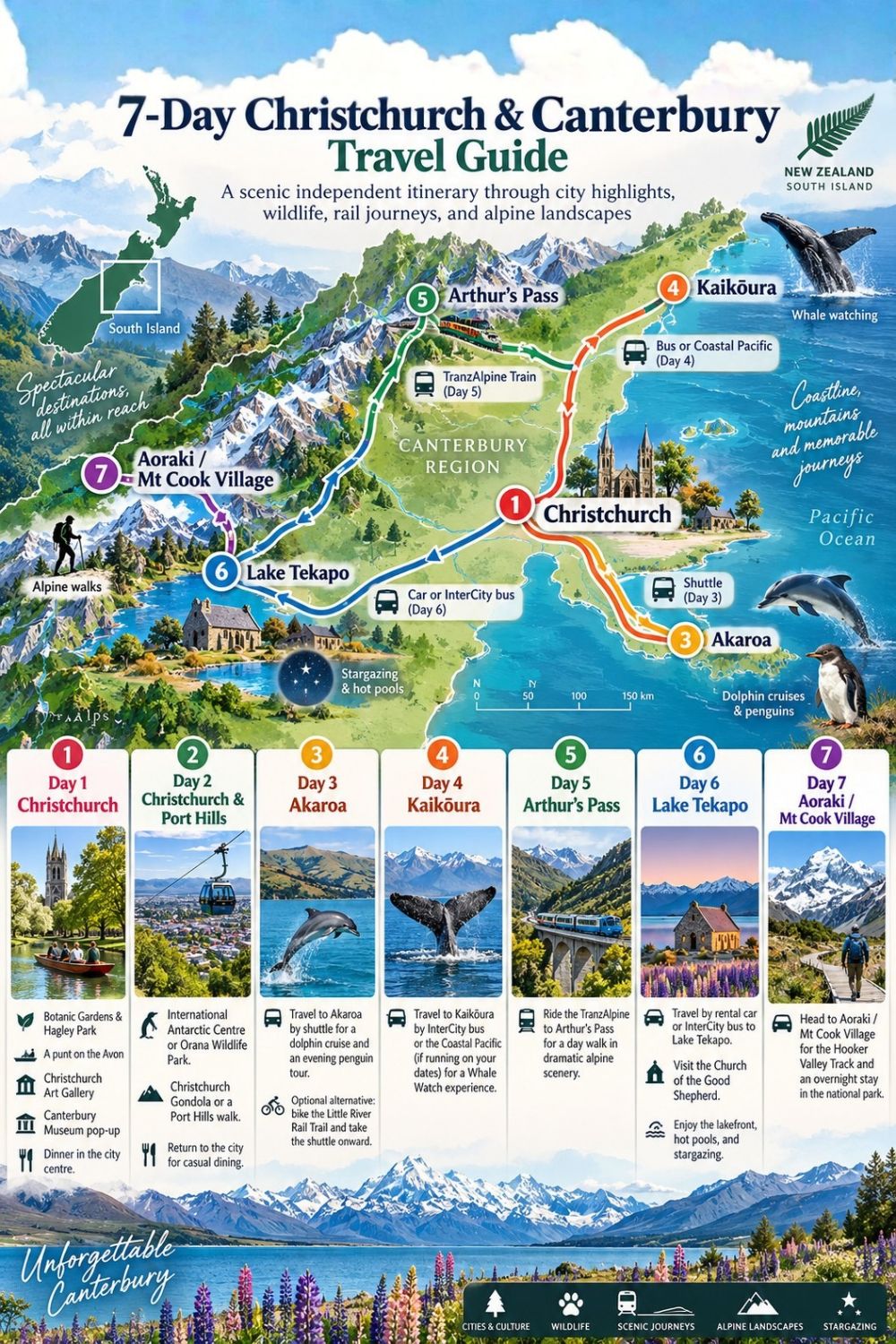
Sample Plan: One Week, Car-Free or Rental Car.
- Days 1–2: Christchurch as above.
- Day 3: Akaroa by shuttle for a dolphin cruise and an evening penguin tour (or bike the Little River Rail Trail and take the shuttle on).
- Day 4: Kaikōura by InterCity (or the Coastal Pacific, if it runs on your dates) for Whale Watch.
- Day 5: TranzAlpine to Arthur’s Pass for a day walk.
- Days 6–7: InterCity to Tekapo for stargazing and hot pools, then on to Aoraki/Mt Cook for the Hooker Valley Track.
12. Christchurch and Canterbury Travel Guide FAQs
How many days do I need?
Three full days covers the city’s highlights. Add four to seven more for Akaroa, Kaikōura, Arthur’s Pass, Tekapo and Mt Cook.
Do I need a car?
Not for Christchurch itself. Public transport and shuttles reach most regional highlights, though a car gives you more flexibility for the Alps and Banks Peninsula.
Is Christchurch a good first stop in New Zealand?
Yes. It has city services, gardens, museums, good transport links and quick access to the Southern Alps and coast.
What should I pack?
Layers, comfortable walking shoes, rain protection, sun protection, a warm hat and gloves for the mountains, and a reusable water bottle.
Is Christchurch expensive?
It can be moderate to high, especially for accommodation, restaurant meals, car hire and organised tours. Free attractions, the NZ$3 bus and self-catering bring the cost down considerably.
Christchurch and Canterbury reward travelers who slow down: a train through the Alps, an evening with penguins, a bike ride beside a lake alive with birds, and a night under a sky full of stars. Plan a little, leave room for the weather, and go with an open mind.
Who are the operators mentioned in the Christchurch and Canterbury Travel Guide?
NZ Transport Agency, Motu Move: nzta.govt.nz
Environment Canterbury / Metro, Christchurch bus fares: ecan.govt.nz, metroinfo.co.nz
Great Journeys New Zealand, TranzAlpine and timetables: greatjourneysnz.com
New Zealand Tourism / newzealand.com listings (TranzAlpine, Air Force Museum, Akaroa Dolphins, Dolphin Encounter)
Whale Watch Kaikōura: whalewatch.co.nz
Black Cat Cruises: blackcat.co.nz
Canterbury Museum pop-up: canterburymuseum.com
Department of Conservation, Hooker Valley Track, paid car parks and hut fees: doc.govt.nz
MBIE, International Visitor Conservation and Tourism Levy: mbie.govt.nz
Christchurch Attractions (punting, Gondola, Tram): christchurchattractions.nz
Little River Trail: newzealand.com and nzcycletrail.com
InterCity: intercity.co.nz
21 Works Cited
“Akaroa Dolphins – Luxury Dolphin & Nature Cruises.” Akaroa Dolphins, 2026, www.akaroadolphins.co.nz.
boatsheds. Antigua Boat Sheds. 2024, boatsheds.co.nz/.
ccc.govt.nz. Hagley Park and Gardens. 2024, ccc.govt.nz/parks-and-gardens/explore-parks/hagley-park-and-gardens.
Christchurch City Council. City to Sea Pathway An aspirational shared-use trail from the city to the sea following the Ōtākaro/Avon River. 2026, ccc.govt.nz/parks-and-gardens/explore-parks/waterways/avon-river/city-to-sea-pathway.
—. Te Ara Ōtākaro Avon River Trail. 2026, ccc.govt.nz/parks-and-gardens/explore-parks/waterways/avon-river/te-ara-trail.
christchurchnz.com. “Christchurch Gondola.” ChristchurchNZ.com, 2025, www.christchurchnz.com/visit/things-to-do/listing/christchurch-gondola-4014037.
Contributors to Wikimedia projects. “Canterbury (New Zealand).” Travel guide at Wikivoyage, Wikimedia Foundation, Inc., 10 Apr. 2004, en.wikivoyage.org/wiki/Canterbury_(New_Zealand).
DOC. Hutton's shearwater/Kaikōura tītī. 2026, www.doc.govt.nz/nature/native-animals/birds/birds-a-z/huttons-shearwater-kaikoura-titi/.
“Dolphin Encounter.” Dolphin Encounter, 2026, www.dolphinencounter.co.nz/.
Great Journeys NZ. “The TranzAlpine.” Great Journeys NZ | Official, 2026, www.greatjourneysnz.com/routes/tranzalpine/.
Half Light Studio. Christchurch Botanic Garden. New Zealand Garden Trust, 2023, www.gardens.org.nz/visit/christchurch-botanic-garden.
Himalayan Trust. About Sir Ed – The Himalayan Trust. 2025, himalayantrust.org/about/sir-edmund-hillary.
“Kaikōura Dark Sky Trust | International Dark Sky Sanctuary NZ.” Kaikōura Dark Sky Trust, 2026, kaikouradarksky.nz/.
“Kia Ora!” Whale Watch, 2026, whalewatch.co.nz/kia-ora/.
littlehigh. “Little High Eatery | International Cuisines | Christchurch.” littlehigheatery, 2026, www.littlehigh.co.nz.
Met Service. MetService – Te Ratonga Tirorangi. 2026, www.metservice.com/national.
NZTA. NZTA Journey Planner. 2026, www.journeys.nzta.govt.nz/highway-conditions/canterbury.
Pohatu. Pohatu Penguins, Nature, Sea Kayak & Penguin Tours in Akaroa. 2025, www.pohatu.co.nz.
Riverside. “Riverside Farmers Market and Shopping District.” Riverside, 2026, riverside.nz.
“Thermal Hot Pools & Spa Treatments.” Hanmer Springs, 2026, hanmersprings.co.nz.
Truman, Ania. “Black Cat your personal Dolphin Experience in NZ.” Black Cat Cruises, 11 Oct. 2017, www.blackcat.co.nz/.