Skip the Line: Franz Josef Wildlife Center Ticket with Optional Backstage Pass
Discover one of New Zealand’s most unforgettable wildlife experiences at the West Coast Wildlife Centre — voted one of Lonely Planet’s 12…
See More Details →Travel Guide Destination Hub
Plan your trip to West Coast with curated itineraries, travel guides, route ideas and practical trip planning resources.
Use our West Coast travel planners to build your route, compare itinerary ideas and find practical travel tips for your trip.
Browse our latest West Coast itineraries and destination planning guides.
Browse our latest articles, hotel guides, food guides and practical travel tips for West Coast.

Explore New Zealand’s West Coast independently in this 2026 travel guide, covering Karamea, Punakaiki, Hokitika, Glacier Country and Haast. Find practical advice on road-trip itineraries, transport, accommodation, seasonal conditions, safety, booking, and realistic NZD budgets, plus highlights including limestone landscapes, rainforest walks, glaciers, pounamu, wildlife and scenic cycling routes.
Read guide →
Discover the best international destinations for first-time solo travelers with practical, tested advice from a traveler who has visited 47 countries. This guide compares 10 beginner-friendly countries, including Portugal, Japan, New Zealand, Thailand, Scotland, Vietnam, Costa Rica, and Iceland, with safety ratings, budget breakdowns, navigation tips, and social travel advice.
Read guide →Tours & Activities
The West Coast of New Zealand’s South Island doesn’t ease you in gently. It confronts you with glaciers that spill down from the Southern Alps almost to sea level, rainforests that drip with moss and silence, and a coastline where the Tasman Sea throws itself against black sand beaches without apology.
I’ve traveled through plenty of regions that call themselves wild, but this one earns the title through sheer, unrelenting contrast. One moment you’re standing in temperate rainforest; the next, you’re staring at ice.
What makes this stretch of New Zealand different is how little it’s been smoothed over for mass tourism. Towns are small. Roads wind rather than rush. And the landscape still dictates the pace of travel, not the other way around. That’s precisely why it rewards visitors who come with curiosity rather than a checklist mentality.
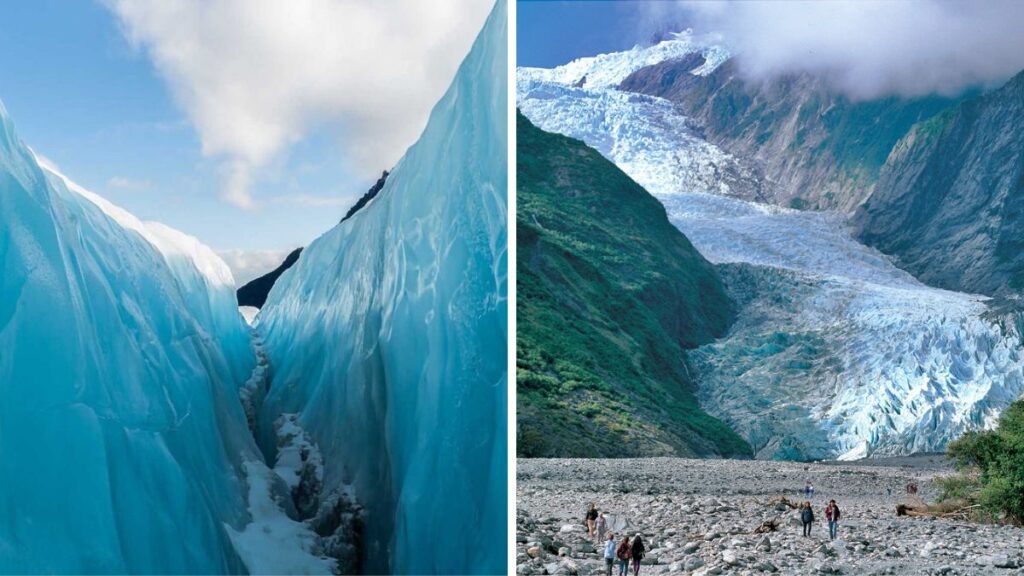
Franz Josef and Fox Glacier are the headline acts of the West Coast, and for good reason. These two glaciers descend from the alpine peaks through rainforest almost to the coastline, a combination that exists in very few places on Earth.
I remember standing at the Franz Josef lookout, rainforest canopy on one side and blue-white ice on the other, and feeling genuinely confused about which climate zone I was in. That disorientation is part of the appeal.
Guided glacier walks and helicopter flights give you the closest access, and I’d recommend at least one scenic flight if your budget allows it. From above, you see how the ice carves through rock, how crevasses open like fault lines, and how quickly these glaciers are retreating.
That last point matters. Both Franz Josef and Fox have lost significant mass over the past few decades, and local guides don’t shy away from explaining why. Visiting here isn’t just about photographs; it’s a direct, visible lesson in how climate change reshapes landscapes in real time.
Walking tracks near the glacier terminals include signage marking where the ice used to reach decades ago, and those markers tell a more urgent story than any statistic could on its own.
Moving north along the coast, the landscape shifts into dense, ancient rainforest that feels almost prehistoric. The Oparara Basin, tucked near Karamea, holds limestone arches and caves carved over millions of years, surrounded by native bush that’s home to rare birds like the great spotted kiwi.
Walking through this basin, you’ll notice how quiet it is—no road noise, no crowds, just birdsong and the occasional drip of water from the canopy above. It’s one of the few places on the West Coast where you can genuinely lose track of time.
Further south, the Pancake Rocks at Punakaiki demonstrate a completely different kind of natural engineering. These layered limestone formations look stacked, almost deliberately, and the blowholes nearby send seawater exploding upward during high tide and rough swells.
I’d suggest timing your visit around tide tables if you want to see the blowholes at their most dramatic. The short walkway here is accessible for most visitors, including those with mobility considerations, which makes it one of the more inclusive stops along the coast.
Nearby, the Paparoa National Park offers longer hikes through limestone karst country for those wanting to go deeper, and the contrast between the rugged coastline and the inland cave systems shows just how geologically active this entire region remains.
The West Coast isn’t just about geology and ice; it’s also a stronghold for some of New Zealand’s rarest wildlife. The region holds some of the last significant populations of the great spotted kiwi, and local conservation groups work continuously on predator control to protect ground-nesting birds from stoats and possums.
Visiting a sanctuary or supporting a guided night walk gives you a chance to see these efforts firsthand, and the money spent on these tours typically funds trapping programs directly. It’s a tangible way to connect your travel spending to measurable conservation outcomes.
Driving the coastal highway between Westport and Haast, you’ll pass through small towns that still rely heavily on fishing and whitebaiting, giving the region an authenticity that’s increasingly rare in heavily touristed parts of New Zealand.
Stop at Hokitika for greenstone carving demonstrations, a craft tied closely to Māori cultural heritage, and take time to understand the significance of pounamu beyond its appearance as jewelry. The drive itself, with its glimpses of empty beaches and driftwood-strewn coastline, offers constant reminders that this is a working landscape, not a staged one.
Locals here talk about the weather, the tides, and the seasons with a familiarity that comes from genuinely living alongside this environment, not just visiting it.
By the time you reach the southern end of the West Coast near Haast, you’ll have moved through glaciers, rainforest, limestone formations, and some of the last strongholds of endangered native birds, all within a few hours’ drive.
That density of contrasting ecosystems is rare, and it’s exactly why the West Coast deserves more time on any South Island itinerary than most visitors initially plan for it.
Showing tours and activities related to West Coast South Island.
Discover one of New Zealand’s most unforgettable wildlife experiences at the West Coast Wildlife Centre — voted one of Lonely Planet’s 12…
See More Details →
Travel from the wild beauty of the West Coast to the Garden City of Christchurch on this unforgettable small group, fully guided…
See More Details →
Explore the untamed beauty of New Zealand's Wild West Coast on this small group, fully-guided tour from Franz Josef to Queenstown. Your…
See More Details →
JOIN THE BEER EXPERIENCE TOUR The Monteith’s Brewing Co Beer Experience is a walking, talking and tasting tour through the original home…
See More Details →
Explore Franz Josef's Lake Mapourika on a personalised scenic cruise, where rainforest meets the Southern Alps in a calm setting within a…
See More Details →
Explore the stunning West Coast on this one-way small group tour from Greymouth to Franz Josef. Franz Josef sits in the heart…
See More Details →
Journey through the breathtaking Southern Alps aboard the iconic TranzAlpine train, one of the world’s most scenic rail journeys. Departing from Christchurch,…
See More Details →
See the beautiful countryside surrounding Dunedin when your cruise ship is in port, on a small-group tour of the Otago Peninsula. This…
See More Details →
Experience one of New Zealand’s most iconic alpine journeys combining scenic rail travel with a guided exploration of Arthur’s Pass National Park.…
See More Details →
Your tour operator is a local, family owned and operated company based in Franz Josef, on the West Coast of New Zealand.…
See More Details →
Discover New Zealand’s wild West Coast on this unforgettable small group, fully guided day tour from Christchurch to Franz Josef. Journey from…
See More Details →
Enjoy a Sightseeing tour to Akaroa through the spectacular scenery surrounding Banks Peninsula, formed following violent eruptions of two ancient volcanoes. The…
See More Details →