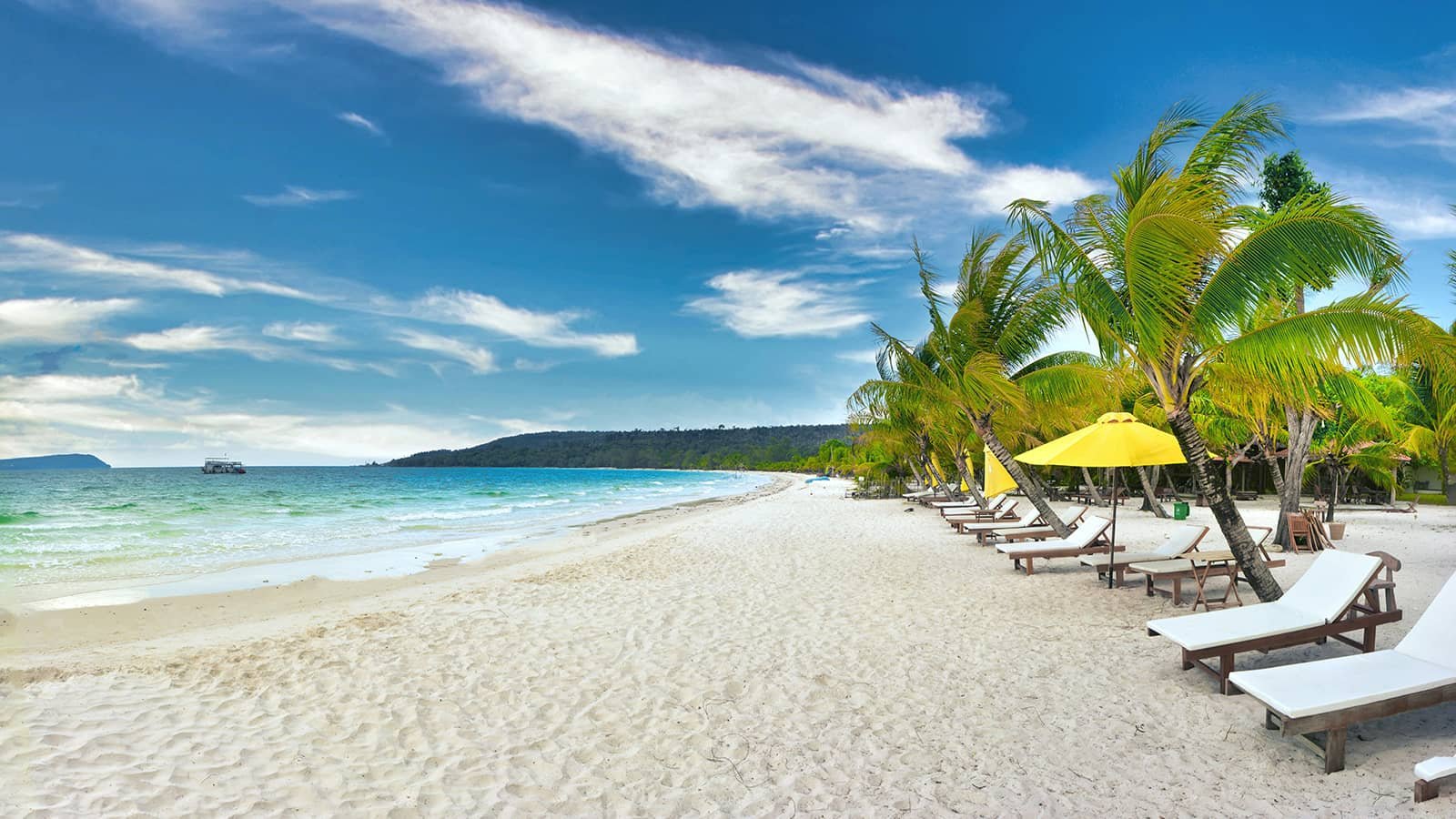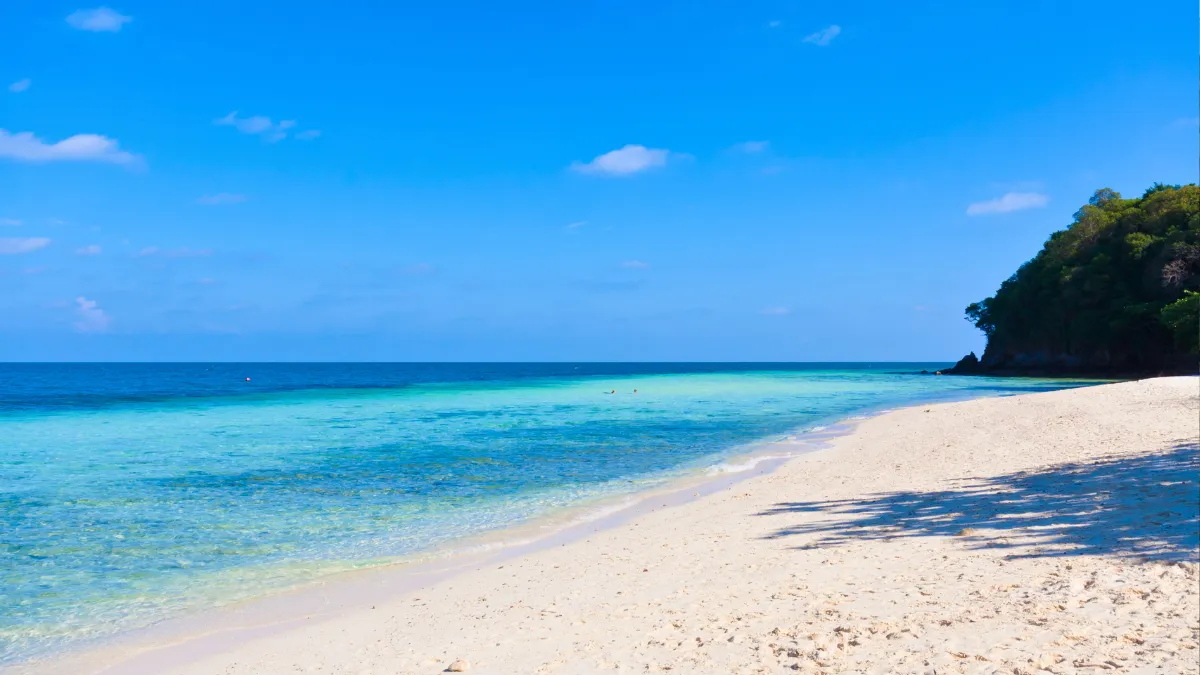
Thailand island hopping does not have to mean joining a whistle-stop tour from Phuket, photographing Maya Bay with several hundred other people, and sleeping somewhere different every night. The journeys I find most compelling move more slowly: a public ferry into the Trat archipelago, a wooden bungalow among Koh Phayam’s cashew trees, a few days eating in a Trang fishing village, or a local longtail boat arranged directly with a family on Koh Yao Noi.
Independent island hopping in Thailand is straightforward when the route follows one coast and the season suits it. Ferries, speedboats, catamarans, vehicle ferries, public vans, trains, and domestic flights form a surprisingly usable network. The difficult part is not finding islands. It is choosing islands that connect logically, understanding which boats run only in high season, and leaving enough time for weather to rewrite the plan.
This guide focuses on quieter islands and locally grounded experiences. It covers how to travel without a packaged tour, which beaches and villages make the best bases, what to eat, realistic costs, transport gateways, accommodation choices, seasonal closures, scooter risks, and route combinations that work. Phuket, Phi Phi, and Koh Samui appear where they are useful gateways, but they do not dominate the itinerary.
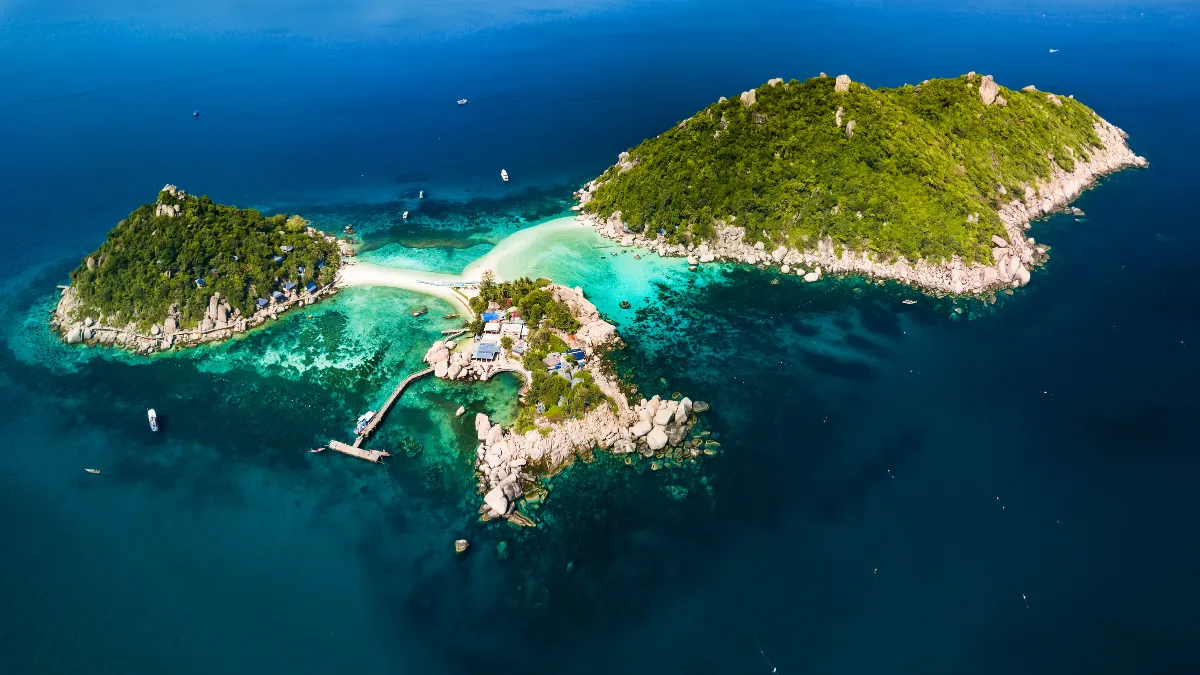
What is the best way to go island hopping in Thailand?
For most independent travelers, the best way to go island hopping in Thailand is to choose one coastal region, spend at least three nights on most inhabited islands, and travel by scheduled ferry or speedboat between nearby islands. From November to April, the widest choice is usually on the Andaman coast and in the Trat archipelago. From roughly January to August, Koh Samui, Koh Phangan, and Koh Tao can be a more reliable choice than the Andaman, although the two coasts have different weather patterns and no season is guaranteed.
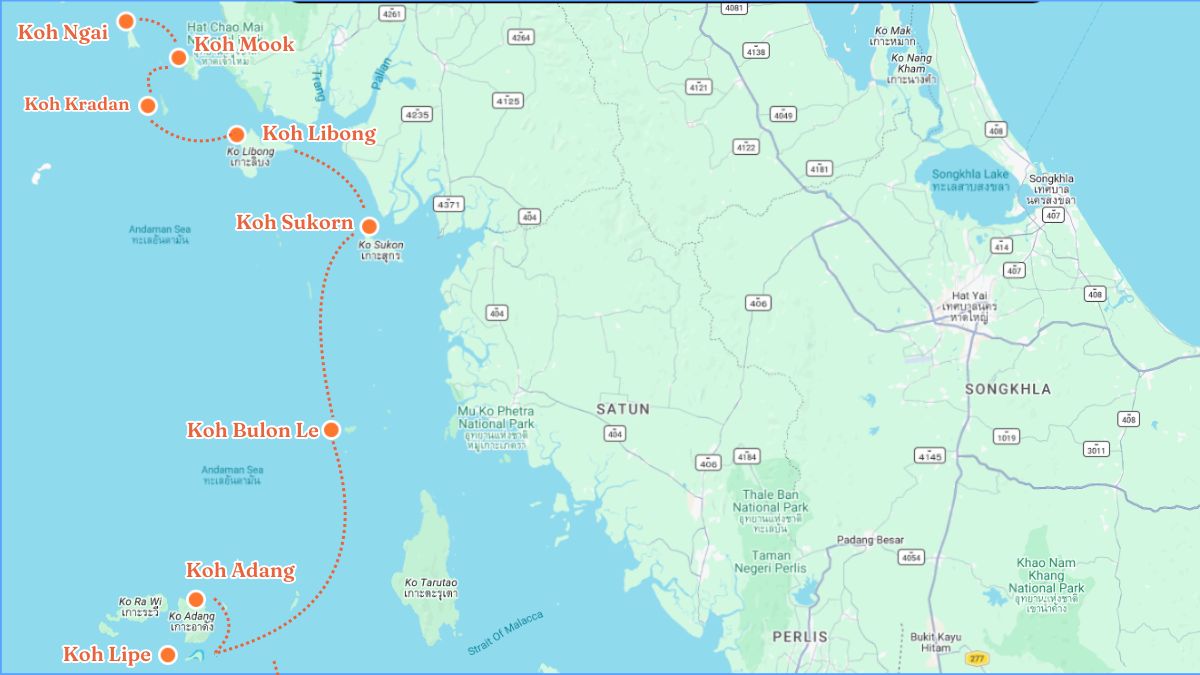
The strongest off-the-beaten-path routes are Koh Chang–Koh Mak–Koh Kood in the Eastern Gulf; Ranong–Koh Phayam in the northern Andaman; Koh Yao Noi–Koh Jum–Koh Lanta around Phang Nga and Krabi; and Koh Mook–Koh Kradan–Koh Libong or Koh Sukorn–Koh Bulon Le–Koh Lipe through Trang and Satun. Travelers with fewer than ten days should select only one of these clusters rather than losing two days crossing the country.
| Island-hopping route | Best for | Best general window | Minimum useful time | Main gateway |
|---|---|---|---|---|
| Koh Chang–Koh Mak–Koh Kood | First-time independent travelers, beaches, cycling, waterfalls, and a balance of comfort and quiet | November–April; reduced or rerouted services are possible in wetter months | 9–12 days | Trat and Laem Sok/Laem Ngop piers |
| Ranong–Koh Phayam | A slow, car-free-feeling island stay, simple bungalows, surfing, and genuine downtime | November–April | 4–6 days | Ranong |
| Koh Yao Noi–Koh Jum–Koh Lanta | Village life, limestone scenery, kayaking, local boats, and gradual southbound travel | November–April for the complete direct-boat chain | 10–14 days | Phuket or Krabi |
| Trang and Satun islands | The quietest multi-island journey, reefs, caves, fishing communities, and small resorts | November–April | 12–18 days | Trang, Hat Yai, or Pak Bara |
| Koh Phangan–Koh Tao with Samui as a gateway | Diving, long beach stays, wellness, and easier travel during parts of the European summer | January–August, with local variation | 8–11 days | Koh Samui, Surat Thani, or Chumphon |
My rule for a better island itinerary
I would rather spend four nights on three well-chosen islands than two nights on six. Every move consumes a checkout, transfer to the pier, check-in period, boat journey, luggage transfer, and another trip to the accommodation. On a small island, one canceled boat can remove an entire day. Slower travel costs less, creates more room for weather, and gives visitors time to use family restaurants, independent guides, and community businesses.
How Thailand’s islands fit together
Thailand’s islands sit in three broad coastal systems rather than one continuous chain. The Andaman Sea lies on the west coast and includes Phuket, the Phi Phi islands, Koh Yao, Koh Jum, Koh Lanta, the Trang islands, Koh Bulon Le, Koh Tarutao, and Koh Lipe. Farther north, Ranong provides access to Koh Phayam and the much quieter Koh Chang Noi, which must not be confused with the large Koh Chang in Trat.
The lower Gulf of Thailand includes Koh Samui, Koh Phangan, Koh Tao, and Mu Ko Ang Thong. On the eastern side of the Gulf, Trat is the gateway for Koh Chang, Koh Mak, Koh Kood, Koh Wai, and smaller islands around Mu Ko Chang National Park. These eastern islands use different transport gateways and weather patterns from the Samui archipelago.
Moving between the Andaman and the lower Gulf requires a flight or an overland transfer across southern Thailand, usually through Surat Thani, Krabi, or Phuket. That crossing is possible in a day when connections align, but it is not an island hop. It is a substantial travel day. Unless the trip lasts at least three weeks, I would normally choose one sea.
When is the best time for Thailand island hopping?
The Andaman coast generally has its calmest, driest, and most connected period from November to April. From May into October, the southwest monsoon brings a higher chance of rough seas, reduced schedules, closed resorts, and suspended routes. The 2026 seasonal closure of the Similan and Surin marine national parks ran from 15 May to 15 October, and smaller islands within Mu Ko Lanta and other marine parks also close or restrict access during the monsoon.
The Samui–Phangan–Tao side follows a different rhythm. It often remains useful through much of the northern-hemisphere summer, while the lower Gulf can become particularly wet and rough from October into December. The Trat islands have a pronounced wet season, commonly from May to October, although larger ferries to inhabited islands may continue with reduced frequency.
These are patterns, not promises. The Thai Meteorological Department issues marine warnings when wind and waves make small-boat travel unsafe. A calendar cannot overrule a current warning. If the forecast tells small craft to remain ashore, accept the delay and protect the next connection.
Can you island hop in Thailand without a tour?
Yes. Scheduled boats connect the principal inhabited islands, accommodation can arrange pier pickup, and many tickets can be bought directly from operators, at a pier, or through a comparison platform. Independent travel works especially well between Koh Chang, Koh Mak, and Koh Kood; around the developed Gulf islands; and along the high-season Andaman route.
Independent does not mean doing everything alone. A longtail boat still needs a competent local captain. Marine-park landing rules must be followed. Emerald Cave on Koh Mook is affected by tide, darkness, current, and boat traffic; it should not be attempted as an unsupervised swim. Remote reefs, caves, and uninhabited islands are places to arrange a licensed shared or private boat, not to improvise with a kayak beyond safe coastal range.
Route 1: Koh Chang, Koh Mak, and Koh Kood
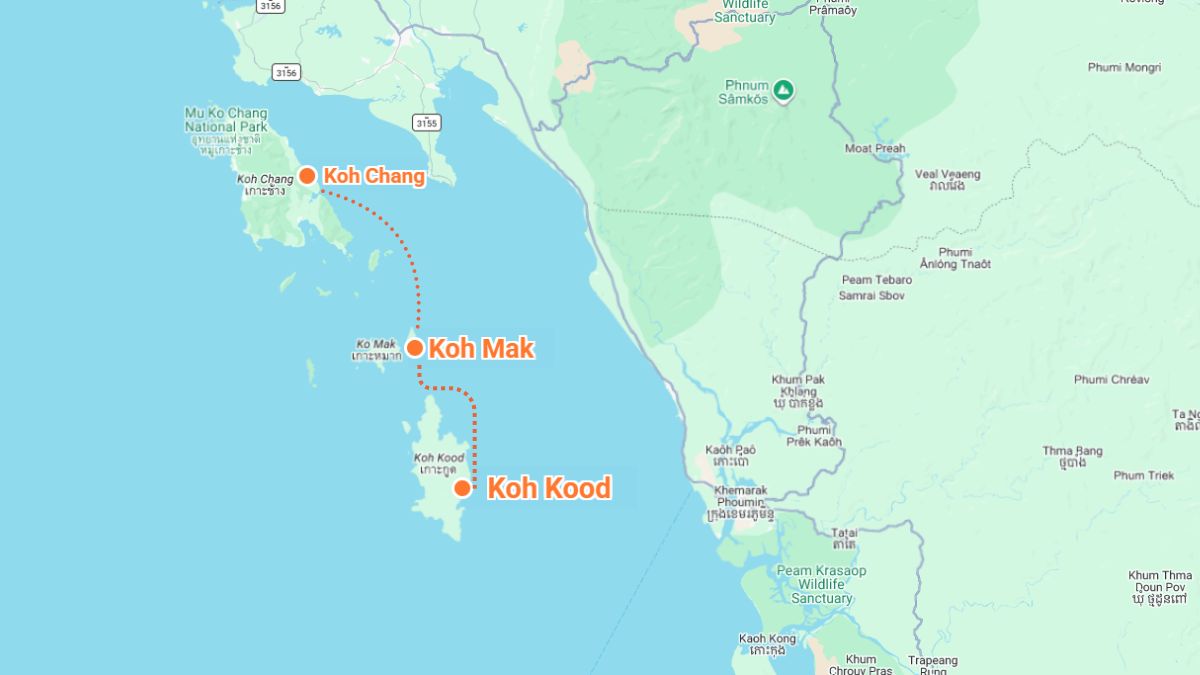
The Trat island chain is my first recommendation for travelers who want independent logistics without surrendering every day to mass tourism. Koh Chang supplies transport, clinics, a wide accommodation range, waterfalls, and rainforest. Koh Mak slows the pace with bicycles, rubber and coconut groves, and low-rise beaches. Koh Kood delivers the clearest sense of remoteness without requiring an expedition.
The classic route runs south from Koh Chang to Koh Mak and Koh Kood in high season. Current 2026 planning fares are approximately 600 THB from Koh Chang to Koh Mak, 900 THB from Koh Chang to Koh Kood, and 400 THB between Koh Mak and Koh Kood on selected catamaran services. Operators, piers, hotel transfers, and frequencies change with season. In wet months, the reliable solution may be to return to the mainland and travel through Laem Sok rather than waiting for a direct inter-island boat.
Koh Chang: use the big island to get beyond the obvious beaches
Koh Chang is Thailand’s second-largest island and the most developed base in the Trat archipelago. Many visitors stop at White Sand Beach, Klong Prao, Kai Bae, or Lonely Beach. Those areas are convenient, but the island becomes much more interesting toward its southern and eastern communities.
Salak Phet and Salak Khok offer mangroves, fishing villages, small homestays, quiet roads, and access to the island’s southeast. Salak Khok’s community tourism group has operated low-impact rowing trips through the mangroves. Bang Bao is useful for boats, diving, and onward transport, while nearby Klong Kloi provides a more relaxed beach base than the busiest west-coast strips.
Without a tour, travelers can walk the mangrove boardwalks, visit fishing communities respectfully, swim at approved waterfalls when conditions permit, use local taxis between settlements, kayak sheltered water, or arrange a boat through a village or accommodation. Jungle routes beyond established paths require local knowledge; waterfall rocks become dangerous after rain, and the forest is not a place to invent a shortcut from a map app.
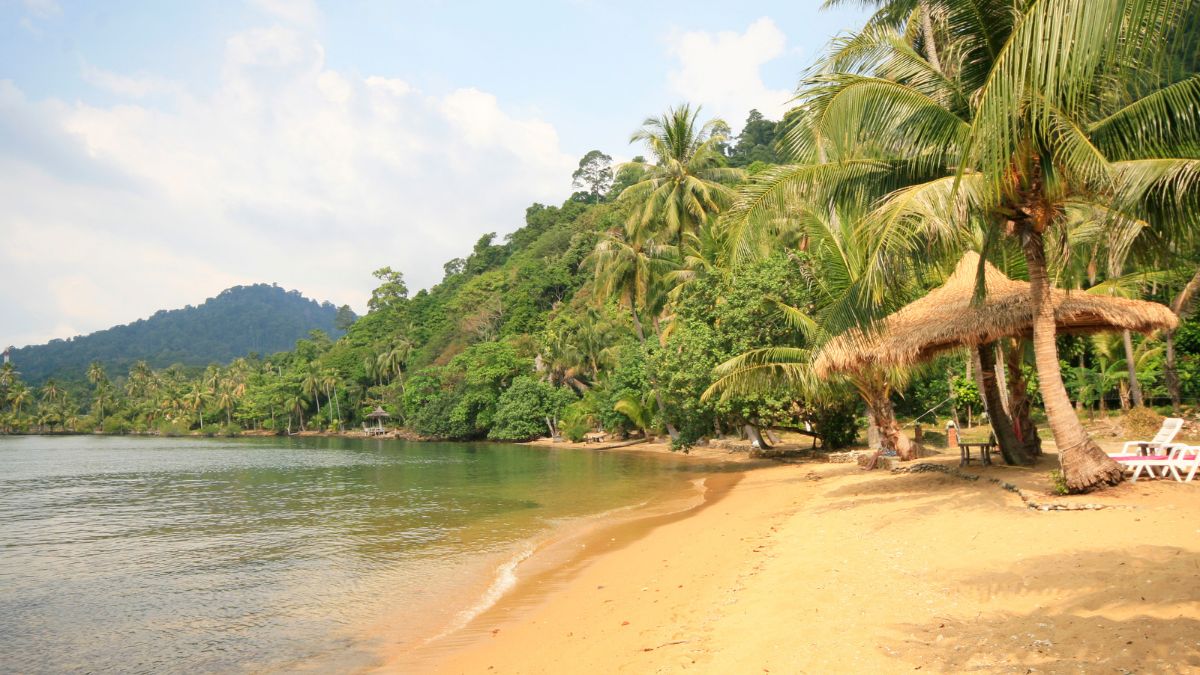
Where to stay on Koh Chang
- Klong Prao: the easiest all-round base for beaches, restaurants, and transport without the density of White Sand Beach.
- Kai Bae: useful for west-coast facilities and selected seasonal boats, but busier than the east.
- Bang Bao or Klong Kloi: best for onward boats, diving, and a slower southern atmosphere.
- Salak Phet or Salak Khok: best for community stays, mangroves, quiet roads, and travelers comfortable with limited evening transport.
Simple guesthouses and bungalows may begin around 600–1,200 THB outside peaks, while a comfortable air-conditioned room commonly costs 1,500–3,500 THB. Beachfront and holiday rates can be much higher. The cheapest room on the east coast is not economical if the traveler wants west-coast nightlife every evening, so choose the base around the actual trip.
What to eat on Koh Chang
Look beyond imported resort menus for grilled fish, squid, crab, prawns, seafood fried rice, southern and eastern curries, and dishes using local fruit and herbs. Trat is known for mu chamuang, pork cooked with sour chamuang leaves, as well as seafood, rambutan, mangosteen, durian, and products from coastal communities. In fishing villages, ask what arrived that day instead of demanding a specific fish every night.
Getting to Koh Chang
From Bangkok, scheduled buses and vans run toward Trat and the mainland ferry piers. The road journey usually takes five to seven hours depending on starting point and traffic. Trat Airport reduces the road distance but flights are limited and can cost substantially more. Vehicle ferries cross to Koh Chang, after which shared songthaews travel the west coast. Confirm whether a combined ticket continues to the hotel or stops at the island pier.
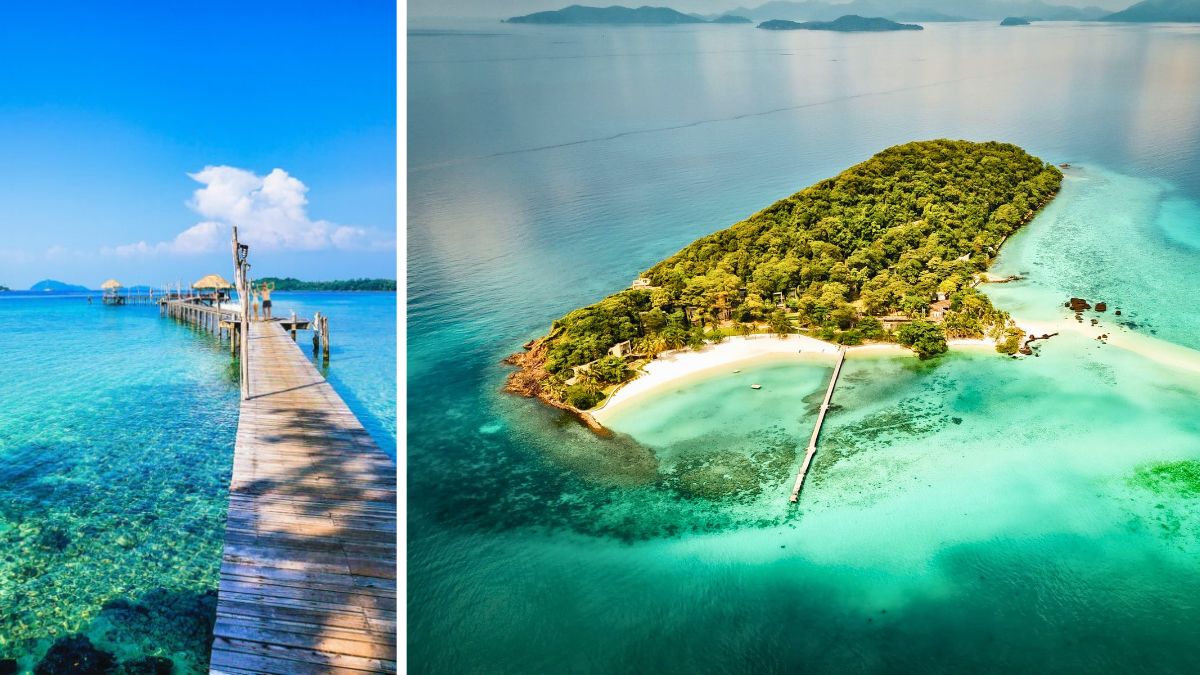
Koh Mak: the easiest quiet island to explore without a tour
Koh Mak is small, gently undulating, and suited to bicycles. It has enough restaurants and accommodation to be comfortable while retaining working coconut and rubber plantations. The island lacks the dramatic mountains of Koh Chang and the extensive waterfalls of Koh Kood; its reward is scale. A traveler can move slowly, return to the same family restaurant, and watch the landscape change through the day.
Ao Kao on the southwest has the broadest spread of accommodation and sunset views. Ao Suan Yai faces northwest toward Koh Kham and works well for travelers wanting a quieter beach with access to the pier. Inland lanes reveal plantations, local homes, temples, and art spaces. Koh Mak is one of the better places in Thailand to explore by bicycle, although midday heat and unlit roads still demand care.
Kayaks can be used close to shore in calm conditions. Koh Kham and nearby reefs are reached by local boat or kayak only when the sea, tide, ability, and rental rules make that sensible. Coral fragments should remain where they are, and access fees may apply to privately managed beach areas.
Where to stay and eat on Koh Mak
Stay around Ao Kao for the largest selection of food and bungalows, or Ao Suan Yai for a quieter beach and excellent sunsets. Budget rooms are fewer than on Koh Chang; plan around 900–1,800 THB for simple accommodation and 2,000–4,500 THB for a polished beachfront room in high season. Independent travelers should verify whether pier pickup is included because there is no extensive public-transport network.
Eat grilled seafood, coconut-based curries, stir-fries, noodles, fruit shakes, and cashew dishes. Resort dining can dominate isolated beaches, so a base within walking or cycling distance of several local restaurants protects both the budget and choice. Carry some cash; card acceptance and ATMs should never be assumed on a small island.
Koh Kood: waterfalls, fishing villages, and long empty intervals
Koh Kood—also written Koh Kut—is the southernmost large island in the chain. It is not undiscovered, and several expensive resorts occupy prime beaches, but development remains dispersed. Between them lie forest, rivers, rubber and coconut trees, waterfalls, fishing villages, and long road sections without shops.
Klong Chao is the most practical first-time base because it balances beach access, restaurants, rentals, and the route toward Klong Chao Waterfall. Ao Tapao is quieter and closer to a long beach, while Ao Phrao in the south suits travelers happy to remain near the resort or use arranged transport. Ao Salat and Ao Yai are fishing communities worth visiting for seafood and a different view of island life, but they are not conventional beach-resort bases.
Independent days can include Klong Chao Waterfall, kayaking the Klong Chao waterway, beach-hopping by legal transport, or arranging a local boat to snorkel around Koh Rang when park access and weather allow. Waterfalls are seasonal; the most photogenic online image does not guarantee the same water level in March.

Where to stay and what to eat on Koh Kood
Klong Chao is best without private transport. Ao Tapao works for a quieter beach with some access to facilities. Remote southern beaches are best for travelers who accept resort meals and paid transfers. Basic rooms can occasionally be found around 1,000–1,800 THB, but Koh Kood more commonly sits in the 2,000–5,000 THB mid-range and rises steeply for secluded beachfront resorts.
Fishing villages are the place for crab, prawns, squid, steamed fish, spicy seafood salad, and simple rice dishes. Prices are higher than mainland Trat because almost everything travels by boat. If a resort is isolated, check breakfast, drinking water, and transfer costs before booking rather than discovering that every meal requires an expensive taxi.
How to reach and leave Koh Kood
Mainland boats use Laem Sok, roughly 60–90 minutes from central Trat depending on transfer and traffic. Published 2026 passenger fares commonly sit around 400–600 THB from Laem Sok, with faster or bundled services costing more. Some tickets include an island-side shared transfer; others stop at Ao Salat or another pier.
High-season direct boats connect Koh Chang, Koh Mak, and Koh Kood. Frequencies reduce in the wet season, and an operator may substitute a mainland road transfer. Never book a flight from Trat or Bangkok around the last possible boat. Leave Koh Kood a day early before an irreplaceable international flight.
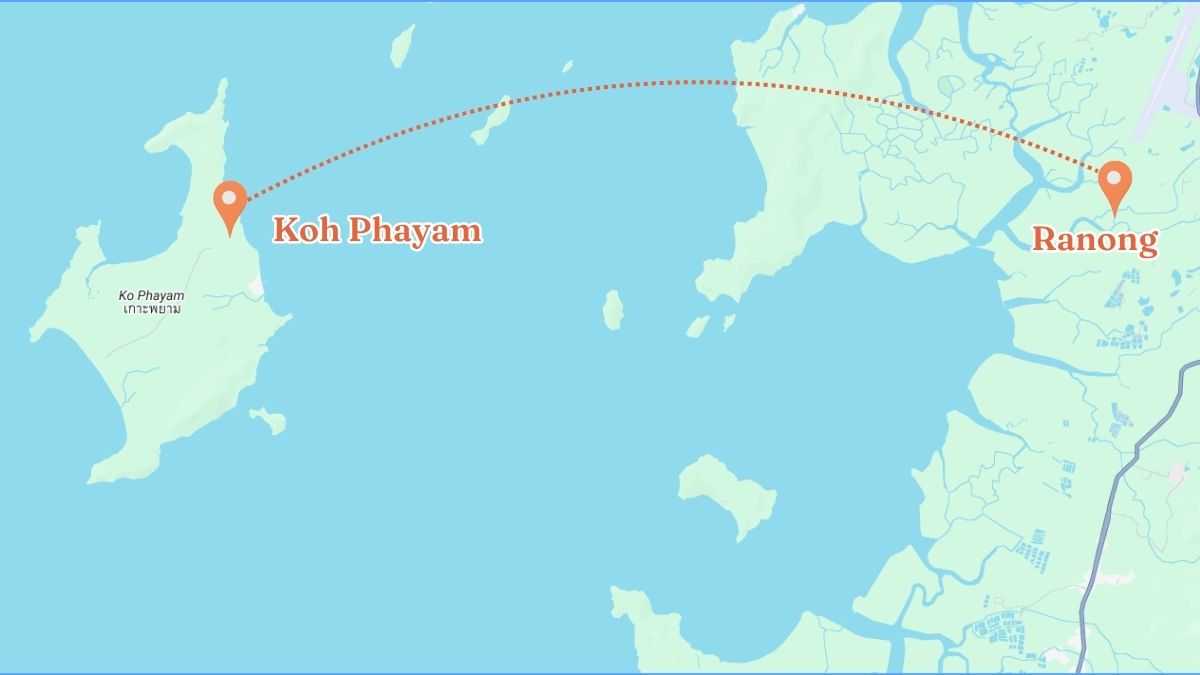
Route 2: Ranong and Koh Phayam
Koh Phayam is not a chain of rapid ferry hops. It is an antidote to them. The island lies off Ranong in Thailand’s wettest coastal province and has no private cars. Narrow concrete lanes run between the arrival village, cashew groves, forest, and long western bays. Travelers come for simple bungalows, hornbills, sunsets, surfing in the right season, and the permission to stop moving.
This route works as a focused island escape or as the northern beginning of a longer Andaman trip. It does not connect naturally by passenger ferry to Phuket or the Krabi islands. Return to Ranong and continue south by road or flight. Trying to force Koh Phayam into a one-week Phuket itinerary defeats its purpose.
What to do independently on Koh Phayam
Ao Yai is the island’s longest beach, with more space, surfable waves in parts of the season, budget bungalows, and dramatic sunsets. Ao Khao Kwai, often called Buffalo Bay, has a curved northern and southern section, calmer coves, mangroves, and unusual rock formations. The east-coast village near the pier is useful for supplies, bakeries, local food, and transport.
Travelers can cycle or ride between bays, kayak within sheltered mangrove water, watch hornbills without feeding them, walk the beaches at different tides, and visit small cafes and cashew producers. Distances are greater than they appear in tropical heat. Bicycles suit confident riders, but some lanes are steep or broken. Motorbikes are the main transport and introduce the usual licensing and insurance problem; a motorbike taxi is the safer answer for an inexperienced rider.
Where to stay on Koh Phayam
- Ao Yai: choose this for the longest beach, sunsets, a sociable but low-key bungalow scene, and seasonal surf.
- Ao Khao Kwai: choose this for calmer coves, hornbills, mangroves, and a more enclosed natural setting.
- Near the pier: useful for an early boat, supplies, and short stays, but not the island’s strongest beach experience.
Fan bungalows can still appear around 500–900 THB, while better rooms with air-conditioning, reliable power, or a polished beachfront setting commonly cost 1,200–3,500 THB. Some properties close for months during the monsoon. Confirm electricity hours, hot water, Wi-Fi expectations, and the transfer from the pier before paying.
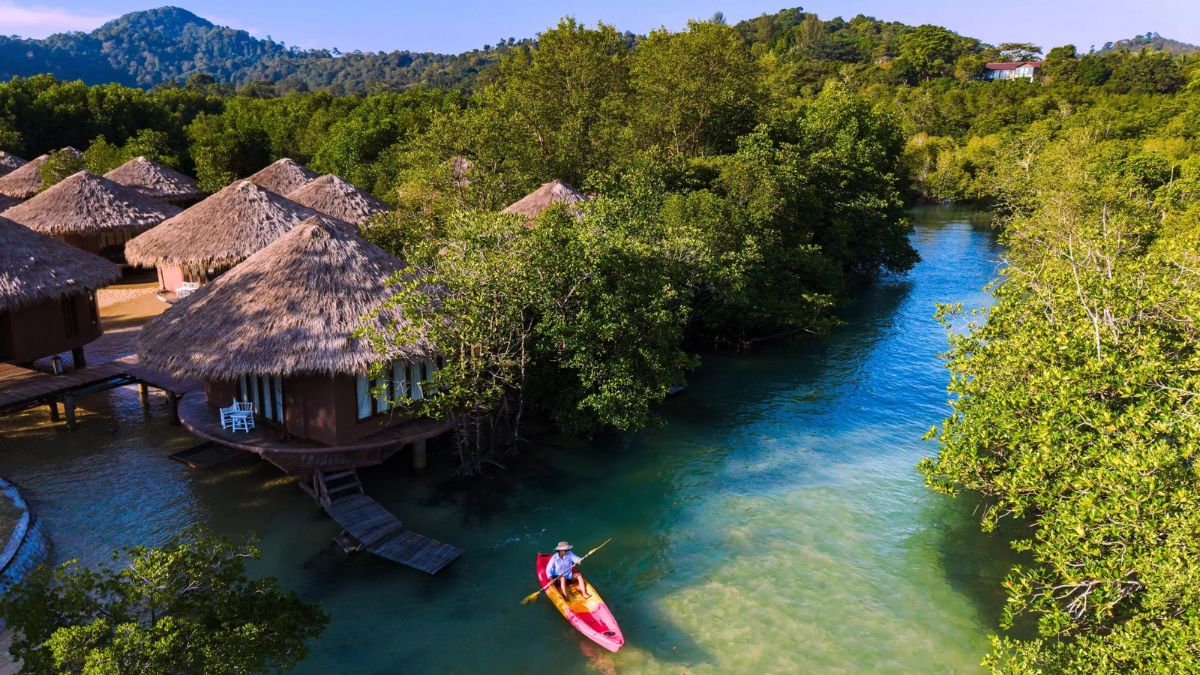
What to eat on Koh Phayam
Cashews are an island signature, and small businesses use them in snacks, curries, baked goods, and drinks. Add grilled fish, Burmese-influenced curries and salads from the Ranong border region, seafood fried rice, noodles, roti, and simple Thai dishes. The island’s restaurant scene is more varied than its size suggests, but isolated bungalows may have only one kitchen. Carry a snack and drinking water when crossing the island late in the day.
How to get to Koh Phayam
Ranong is reached by domestic flight, long-distance bus, or road from Chumphon, Khao Lak, and Phuket. Speedboats to Koh Phayam take about 40–45 minutes and commonly cost around 350–450 THB. The slower passenger boat takes roughly two hours and costs about 200–250 THB. They may use different mainland piers, so “Ranong pier” is not specific enough for a taxi driver.
Schedules reduce in the May–October wet season and may be canceled in rough weather. Ranong’s rain is part of its ecology, not a minor inconvenience. Anyone connecting to a flight should return to the mainland with a generous margin or sleep in Ranong the previous night.
What about Koh Chang Noi in Ranong?
A second, much quieter island named Koh Chang lies near Koh Phayam. It is commonly called Koh Chang Noi or Koh Chang Ranong to prevent confusion with Trat’s large resort island. Accommodation and boats are limited, facilities are basic, and direct information changes quickly. It can suit experienced slow travelers who confirm a bungalow and boat locally, carry cash, and do not need nightlife, strong connectivity, or a rapid exit. It should not be added as an unverified same-day connection.
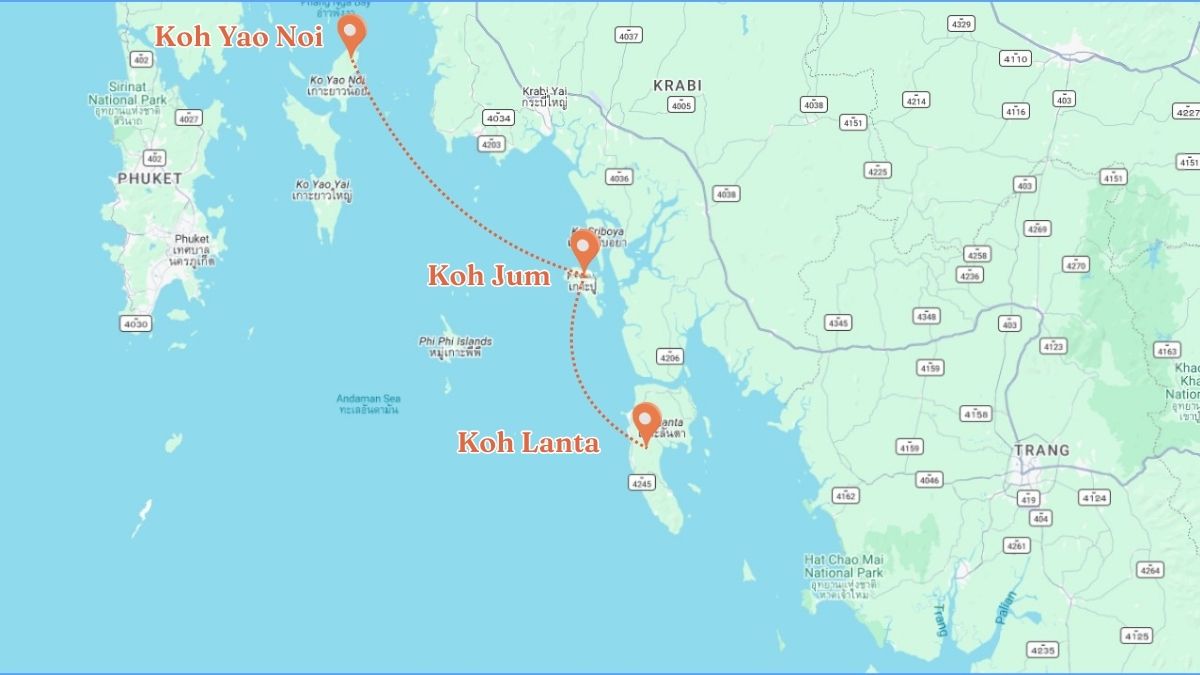
Route 3: Koh Yao Noi, Koh Jum, and Koh Lanta
This route passes through some of southern Thailand’s most recognizable limestone scenery while staying outside its most crowded centers. Koh Yao Noi looks across Phang Nga Bay; Koh Jum retains quiet beaches and Muslim fishing communities; Koh Lanta supplies enough infrastructure to reset, work, dive, or continue south.
Direct seasonal boats can connect parts of this chain, but timetables change. Koh Yao is reached most reliably from Phuket or Krabi. Koh Jum connects with Krabi and Koh Lanta in high season, sometimes through boat transfers that do not use a conventional pier. If the direct link is not running, return through Krabi rather than buying a suspicious “private transfer” from an unverified beach seller.
Koh Yao Noi: Phang Nga Bay without the day-trip timetable
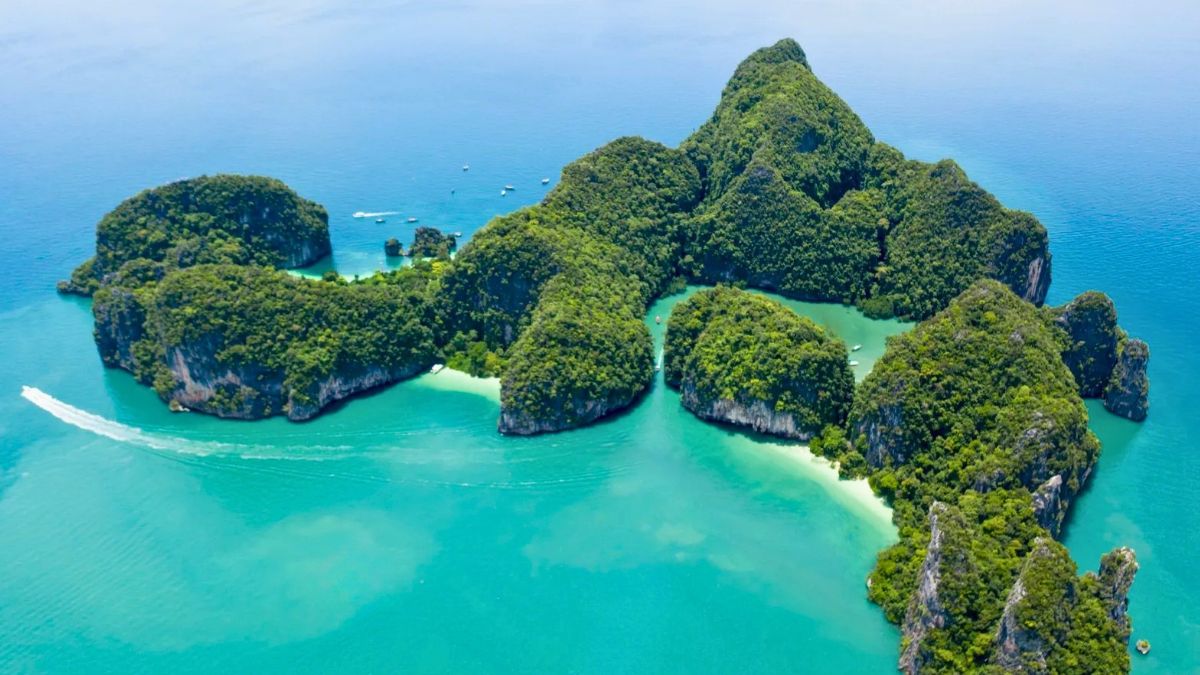
Koh Yao Noi sits between Phuket and Krabi but feels socially and visually separate from both. Rubber trees, rice fields, coconut palms, fishing boats, and Muslim villages occupy the interior and coast. The famous karst towers form the horizon rather than a rushed sightseeing stop.
Pasai Beach and nearby east-coast areas have the largest collection of guesthouses and restaurants. Tha Khao is quieter and faces small offshore islands. The west coast has mangroves, working communities, and sunsets rather than long swimming beaches. Tides matter: some east-coast beaches retreat across broad mud or rock flats at low water.
Independent travelers can cycle village roads, kayak close to shore, visit local markets, take a cooking class, or arrange a private longtail with a local captain for Hong Island and Phang Nga Bay. A private boat is not a guided package unless a guide is requested; it can be a direct community transaction and lets the day follow tide and weather. Confirm park fees, lunch, snorkelling gear, life jackets, and the route before departure.
Where to stay and eat on Koh Yao Noi
Pasai is easiest without transport. Tha Khao offers quiet views and local atmosphere but fewer evening choices. Inland homestays and community properties deepen the experience when the traveler accepts distance from a swimming beach. Rooms usually range from about 800–1,500 THB for a simple guesthouse to 2,000–5,000 THB for a boutique bungalow; luxury bay-view resorts sit far above that.
The island is predominantly Muslim. Dress respectfully away from resort beaches and expect alcohol to be limited or absent at local establishments. Seek roti, curry over rice, grilled chicken, fresh fish, spicy salads, seafood, and morning market snacks. Buying directly from a village shop or independent kitchen keeps more spending on the island.
Getting to Koh Yao Noi
Public boats and speedboats leave from piers in Phuket and Krabi/Phang Nga, including routes associated with Bang Rong, Tha Len, and other terminals. Journey times can range from roughly 30 minutes by direct speedboat to more than an hour on slower or multi-stop services. Public ferry prices can start around 250 THB on selected routes, while speedboat and bundled hotel transfers commonly cost 400–900 THB. Always record the exact pier.
Koh Yao Yai: more road, fewer visitors
Koh Yao Yai is the larger southern sister, connected to Koh Yao Noi by a very short local boat crossing. It has longer drives, scattered beaches, fishing communities, plantations, and fewer walkable clusters. Travelers seeking silence may prefer it, but the island is less convenient without a scooter or arranged driver.
Stay near Laem Haad for the photogenic sandbar and access toward the northern pier, or choose a central east- or west-coast property based on swimming tide and transport. A two- or three-night detour works for travelers prepared to arrange pickup. It is not necessary to include both Yao islands merely to count another island.
Koh Jum: the island to leave deliberately unplanned
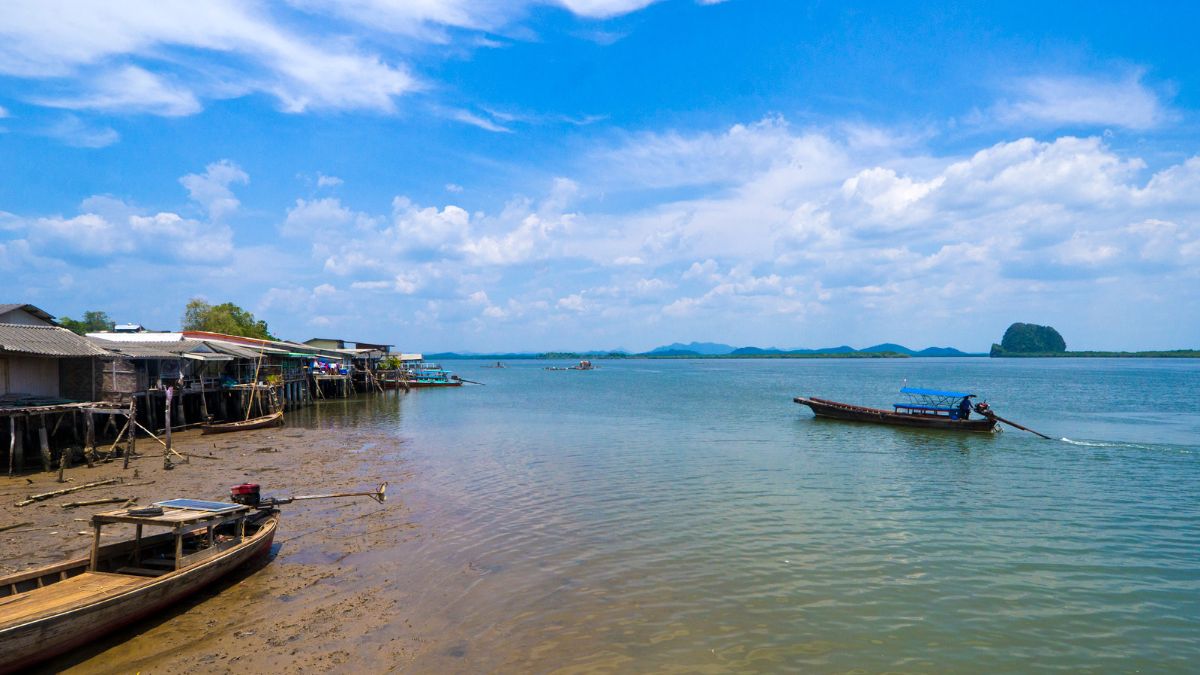
Koh Jum, also associated with the northern name Koh Pu, lies between Krabi and Koh Lanta. Its western beaches look toward Phi Phi, while villages and mangroves face the mainland. Development remains small-scale, with bungalow compounds separated by forest, rubber trees, and local roads.
Golden Pearl Beach and Andaman Beach offer a useful balance of accommodation and sunset. Ting Rai and northern areas feel quieter and more rugged. Ban Koh Jum and Mutu connect visitors with village shops, simple restaurants, and working island life. Swimming quality varies with tide, rocks, and season, so choose accommodation based on current beach conditions rather than a single aerial photograph.
There is no need to construct a packed activity list. Walk beaches, cycle or use local taxis, visit villages, kayak sheltered water, hike only with reliable local advice, and arrange a fishing or snorkelling boat when conditions are suitable. Koh Pu mountain routes are not standardized tourist trails; a local escort is wiser than following an old GPS track into dense vegetation.
Where to stay and eat on Koh Jum
Stay on the west coast for sunsets and beach access, or near a village for everyday food and transport. Basic fan bungalows may cost 500–1,000 THB, with comfortable beachfront rooms around 1,200–3,000 THB. Electricity, card payment, and Wi-Fi reliability vary. The phrase “eco bungalow” can mean thoughtful low-impact design or simply a very basic room; ask specific questions.
Eat at family kitchens for curries, fried fish, squid, som tam, stir-fried vegetables, noodles, and rice dishes. Koh Jum has a substantial Muslim community, so pork and alcohol are not universal. Respectful dress and behavior in villages matter, particularly away from the beach.
Getting to Koh Jum
In high season, passenger boats and speedboats connect Koh Jum with Krabi, Koh Lanta, and sometimes other Andaman islands. Some larger ferries historically stop offshore, with passengers transferring to longtail boats organized by accommodation. Other services use Mutu or Laem Kruat connections. Ask exactly how luggage changes boats and whether the final transfer is included.
Short high-season Koh Jum–Koh Lanta services can cost approximately 500–1,000 THB depending on vessel and transfer, while mainland routes vary. During the monsoon, travel may revert to a mainland crossing via Laem Kruat and local road transport. Do not assume a direct beach-to-beach ferry operates all year.
Koh Lanta: the strategic base that still rewards exploration
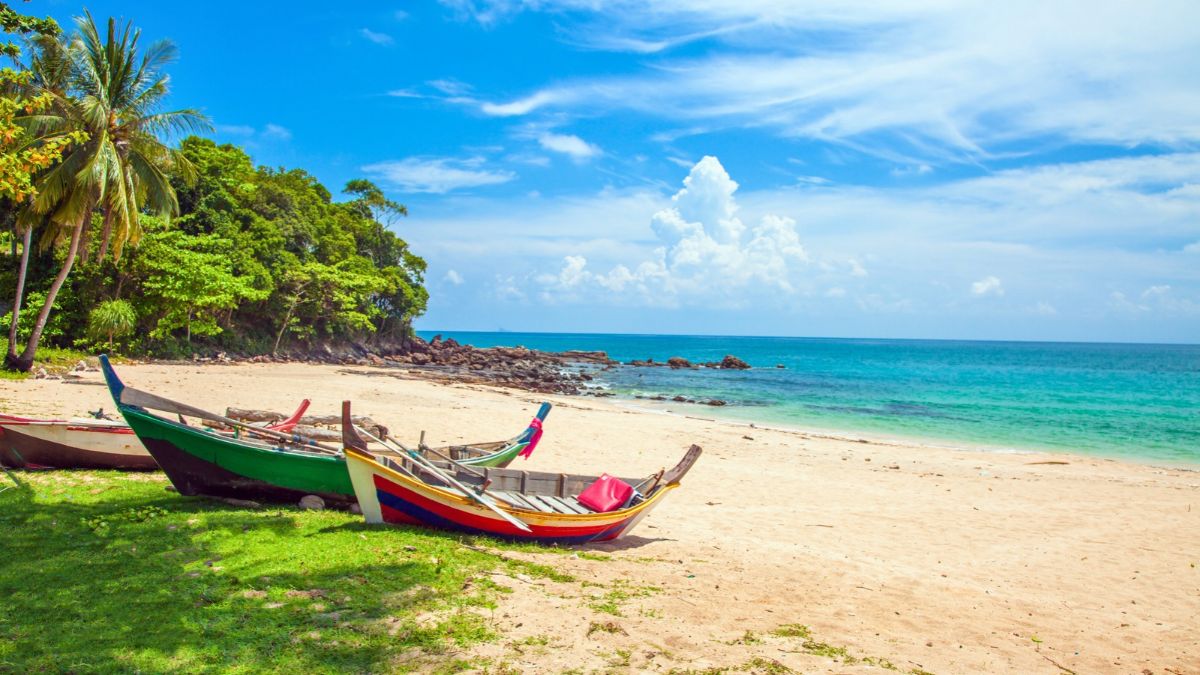
Koh Lanta Yai is not hidden, but it is one of the best independent-travel bases in Thailand. A paved road, clinics, banks, coworking spaces, dive shops, car ferries, and many restaurants reduce logistical pressure. Travel south from Saladan and development gradually thins toward Kantiang Bay and Mu Ko Lanta National Park.
Long Beach is convenient and sociable. Klong Nin offers a walkable middle-island base with restaurants and sunsets. Kantiang Bay and the far south suit travelers prioritizing landscape and quiet. Lanta Old Town on the east coast provides wooden waterfront houses, local food, and access to communities and boats, but it is not a west-coast swimming base.
Without a group tour, visitors can explore Old Town, mangroves, beaches, community businesses, and the national-park road. A private longtail can be arranged for quieter Trang-side islands or snorkelling, subject to park rules and seasonal closures. Koh Rok, Koh Haa, and several smaller Mu Ko Lanta islands commonly close in the monsoon, so no legitimate seller should promise access during an official closure.
Where to stay and eat on Koh Lanta
Choose Klong Nin for the strongest independent balance, Long Beach for range and convenience, Kantiang for a quieter premium stay, or Old Town for culture and east-coast atmosphere. Simple rooms begin around 600–1,200 THB, good mid-range accommodation commonly costs 1,500–3,500 THB, and beachfront villas rise sharply in late December and early January.
Try southern curries, khao yam rice salad, khua kling dry curry, grilled seafood, roti, massaman curry, and dishes from Thai Muslim and Chao Lay communities. Old Town and village markets are better places to look for regional food than international beach menus. Ask before photographing people or ceremonies in community areas.
Getting to and from Koh Lanta
Road transfers from Krabi use the mainland bridge and vehicle ferry system, while passenger boats reach Saladan in the high season. Krabi–Lanta passenger fares often fall around 350–500 THB before hotel transfer, and private road transfers cost more. From Lanta, seasonal boats continue south toward Koh Ngai, Koh Mook, Koh Kradan, Koh Bulon Le, and Koh Lipe.
Route 4: The Trang and Satun islands
The chain south of Koh Lanta is where Thailand island hopping becomes slower, smaller, and more dependent on season. Koh Ngai and Koh Kradan deliver startling water and resort-backed beaches. Koh Mook adds a village, local food, roads, and Emerald Cave. Koh Libong and Koh Sukorn replace the polished island fantasy with fishing communities, rubber plantations, birdlife, and long quiet coastlines. Koh Bulon Le creates a final pause before the much busier Koh Lipe.
A high-season speedboat network links many islands between Lanta and Lipe, but it is not a metro timetable. Services can call at several islands, change vessel, use floating pontoons or longtails, and run only from approximately November to April. In the wet season, some islands are reached from individual mainland piers rather than from one another; resorts may close completely.
Koh Ngai: beautiful, simple, and dependent on the resort strip
Koh Ngai—also spelled Koh Hai—is a small, mountainous island with its main accommodation beach on the east coast. Views extend toward limestone islets and the Trang mainland. There is no conventional village center and little public transport. The beach and resort become the traveler’s world.
Choose Koh Ngai for swimming, snorkelling close to shore when visibility and tide cooperate, reading, kayaking within safe limits, and taking a boat to nearby islands. Do not choose it for nightlife, markets, ATMs, or a broad restaurant choice. A two- or three-night stay is usually enough unless the goal is complete inactivity.
Rooms commonly start around 1,200–2,000 THB and rise to 3,000–6,000 THB for better beachfront accommodation. Food costs more because almost everything arrives by boat. Confirm drinking-water policy, included meals, card acceptance, park fees, and whether the transfer boat can land directly at the beach.
Koh Mook: the best Trang island for independent daily life
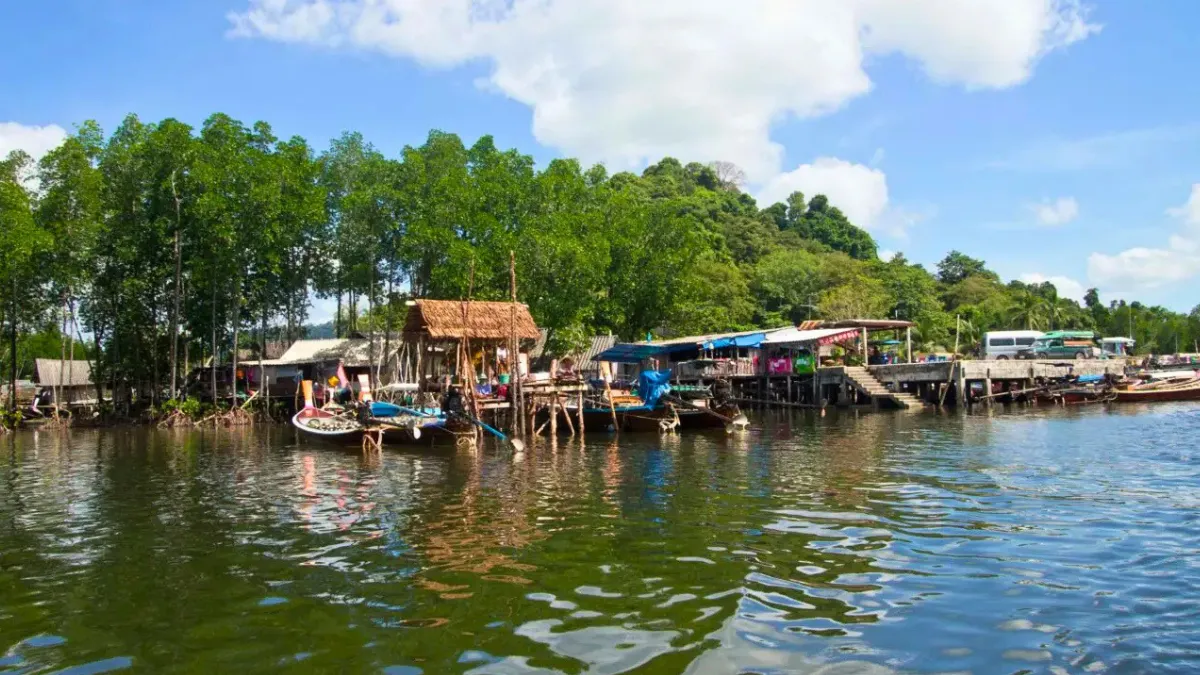
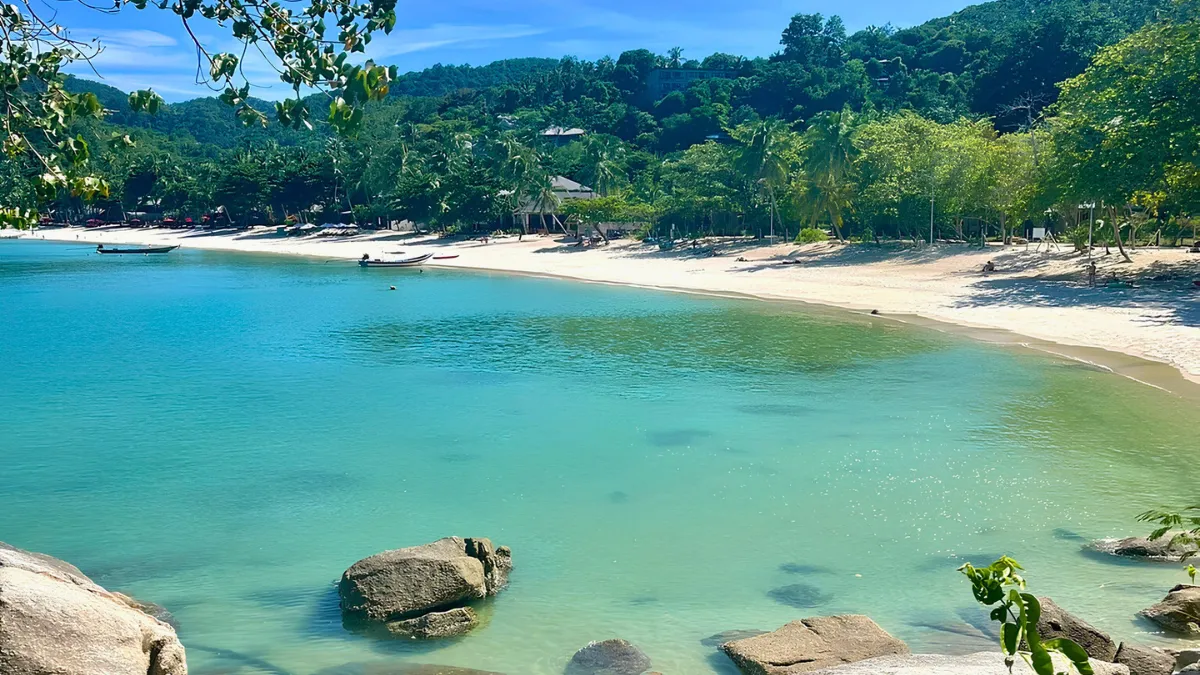
Koh Mook, or Koh Muk, offers the most complete independent base among the small Trang islands. Ban Koh Mook around the pier has local restaurants, shops, motorcycle taxis, and daily island life. Sivalai Beach curves around a white sand peninsula near the village. Charlie Beach, also known as Farang Beach or Haad Farang, faces west and is convenient for sunsets and boats.
Travelers can walk between parts of the island, use a local motorcycle taxi, eat in the village, kayak sheltered sections, and arrange a boat to Tham Morakot, the Emerald Cave. The cave’s dark tidal passage opens into a hidden lagoon, but conditions are time-sensitive. Current, wave action, poor light, and tour-boat congestion make an independent unsupervised swim irresponsible. Arrange an early local longtail and captain, wear a life jacket when advised, and follow park rules.
Where to stay and eat on Koh Mook
Stay near the village and Sivalai side for food, local life, and easy pier access. Choose Charlie Beach for sunset and a more conventional beach stay, accepting the transfer into town. Basic rooms often cost 600–1,200 THB, while comfortable bungalows range from about 1,500–3,500 THB. High-end beachfront accommodation can exceed this substantially.
Eat where residents eat: spicy curries over rice, grilled fish, squid, crab, fried chicken, roti, noodle soup, and seafood salads. Trang’s wider food culture includes dim sum breakfasts, sweet roasted pork, khanom chin rice noodles with southern curry, and strong coffee. A night in Trang town before or after the islands is worthwhile for food alone.
Getting to Koh Mook
Trang Airport and railway station connect by van toward Kuan Tung Ku Pier, followed by a short local boat. Combined transfers are often the simplest purchase. In high season, speedboats connect Koh Mook with Lanta, Koh Ngai, Koh Kradan, and islands farther south. Verify whether the ticket arrives at the village pier or transfers to a resort beach.
Koh Kradan: exceptional water with almost no village infrastructure
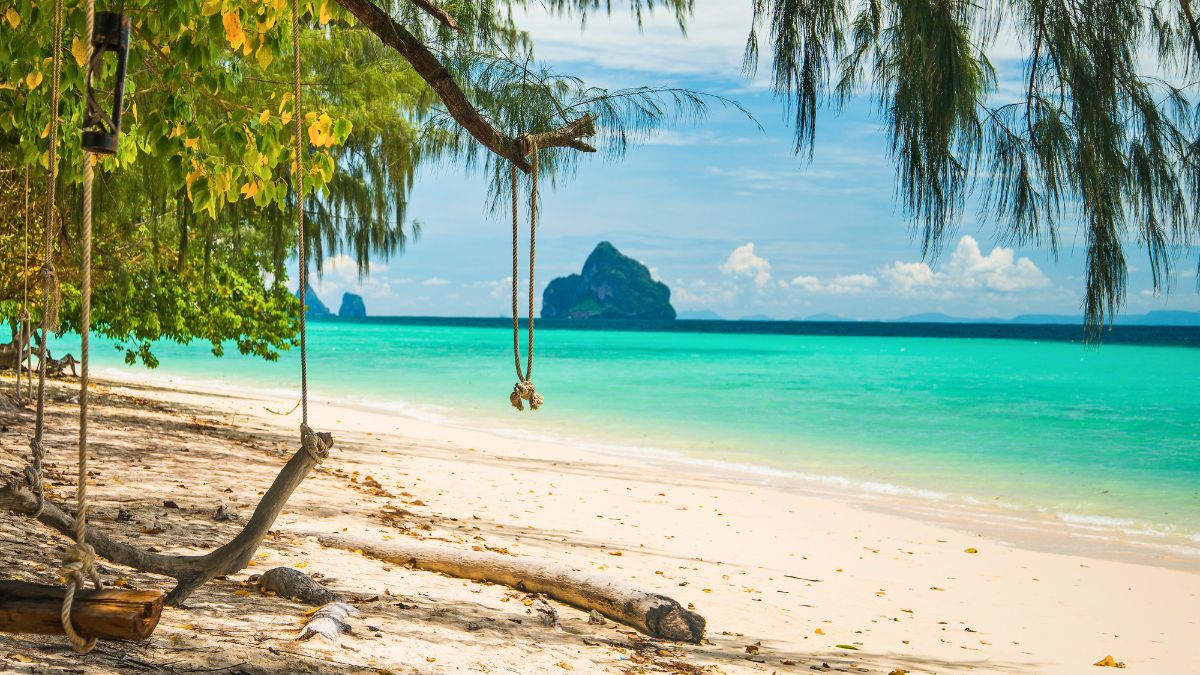
Koh Kradan is protected partly within Hat Chao Mai National Park and is famous for clear water, pale sand, and a reef accessible from the main east-coast beach. Its beauty is real, but so are its limits. Accommodation and restaurants are mostly attached to resorts, supplies are restricted, and day boats can transform the beach between late morning and mid-afternoon.
Stay overnight to experience the island before and after day visitors. Snorkel only when visibility, current, and marked areas make it safe; never stand on coral. Walk to Sunset Beach using the established path and return before dark. Two nights provide time for changing tides without turning a small island into a logistical trap.
Simple rooms are limited and may start around 1,500–2,500 THB, with beachfront comfort from roughly 3,000 THB upward. Carry cash, medicine, sun protection, and any specialist food. Ask whether meals, drinking water, national-park charges, and pier transfer are included.
Koh Libong: wildlife, community, and no need for a perfect beach
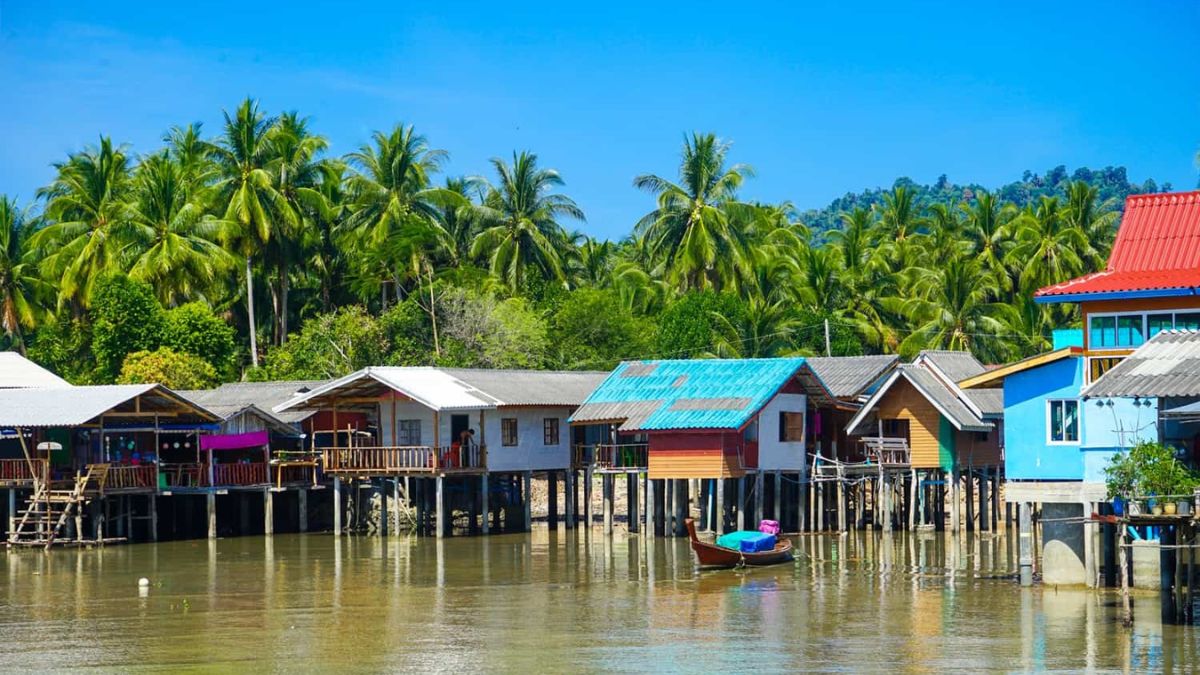
Koh Libong is Trang’s largest island and one of the most rewarding choices for travelers who value community and ecology over powdery sand. Seagrass meadows support dugongs, although sightings are never guaranteed and boats must keep a respectful distance. Villages, rubber plantations, mangroves, birdlife, and fishing shape the island.
Stay near Ban Phrao or another west-coast community accommodation for sunsets and access to local boats. Explore with a community driver or guide, visit viewpoints where officially open, and arrange ethical wildlife observation through a locally rooted operator. Never pressure a captain to chase, surround, or approach a dugong for a photograph.
Accommodation on Koh Libong is commonly simple, from roughly 700–1,500 THB for a homestay or bungalow and 1,500–3,000 THB for more comfort. Food centers on fish, crab, shellfish, curries, rice, and whatever is locally available. Alcohol may be absent in Muslim communities; modest dress in villages is appropriate.
Boats cross from Hat Yao Pier and other designated mainland points. Direct tourist speedboats between better-known islands may call only in high season. A route through the mainland is not a failure—it often creates a more reliable and locally useful journey.
Koh Sukorn: rural island life and empty horizons
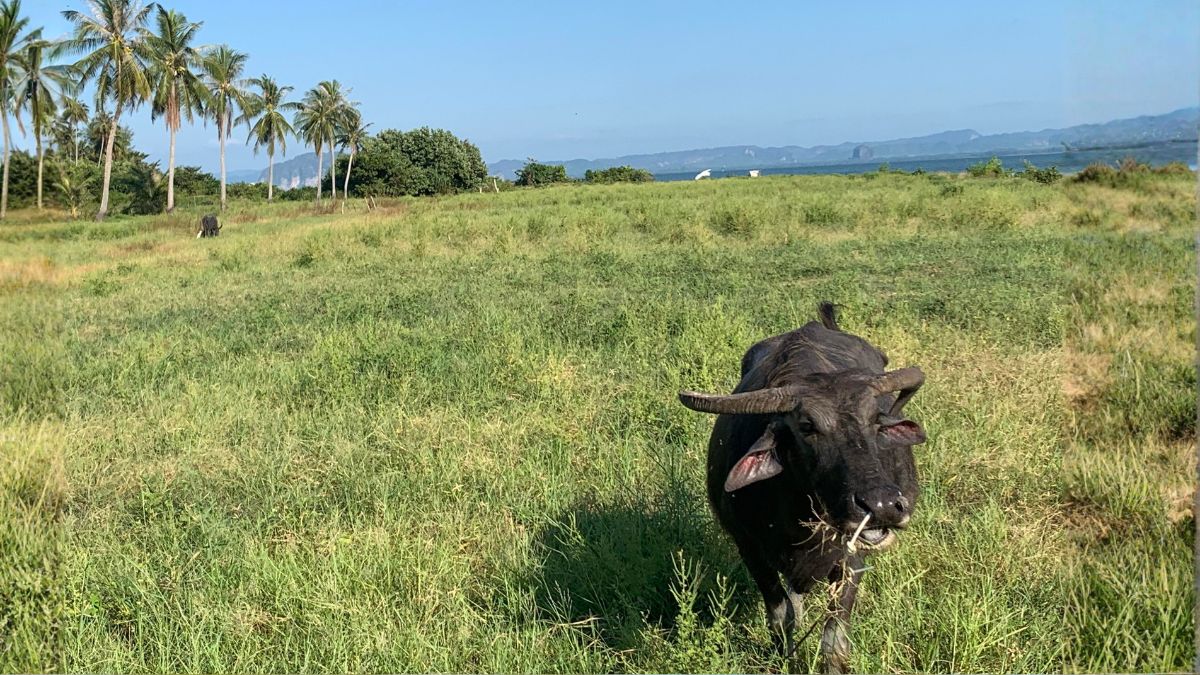
Koh Sukorn has dark-gold beaches rather than the white sand used to market tropical Thailand. That difference filters the audience. The island offers fishing villages, rice fields, watermelon farming, buffalo, rubber trees, and quiet coastal roads. It is for cycling, observing, eating, and slowing down rather than collecting famous viewpoints.
Small resorts and community stays sit mostly on the west coast. Rooms can begin around 700–1,200 THB and reach 2,000–3,500 THB for more comfort or included meals. Arrange pickup from the local pier because there is no dependable island taxi queue. Eat seafood, curries, fruit in season, and meals prepared by the host; advance notice matters for dietary restrictions.
Reach Koh Sukorn via Trang road transfer to Tasae or the current local pier, followed by a short longtail crossing. It may connect by charter or seasonal boat to neighboring islands, but mainland access is the dependable plan. This is a place to visit because it is itself, not because it forms the fastest line on a map.
Koh Bulon Le: a small-island pause before Koh Lipe
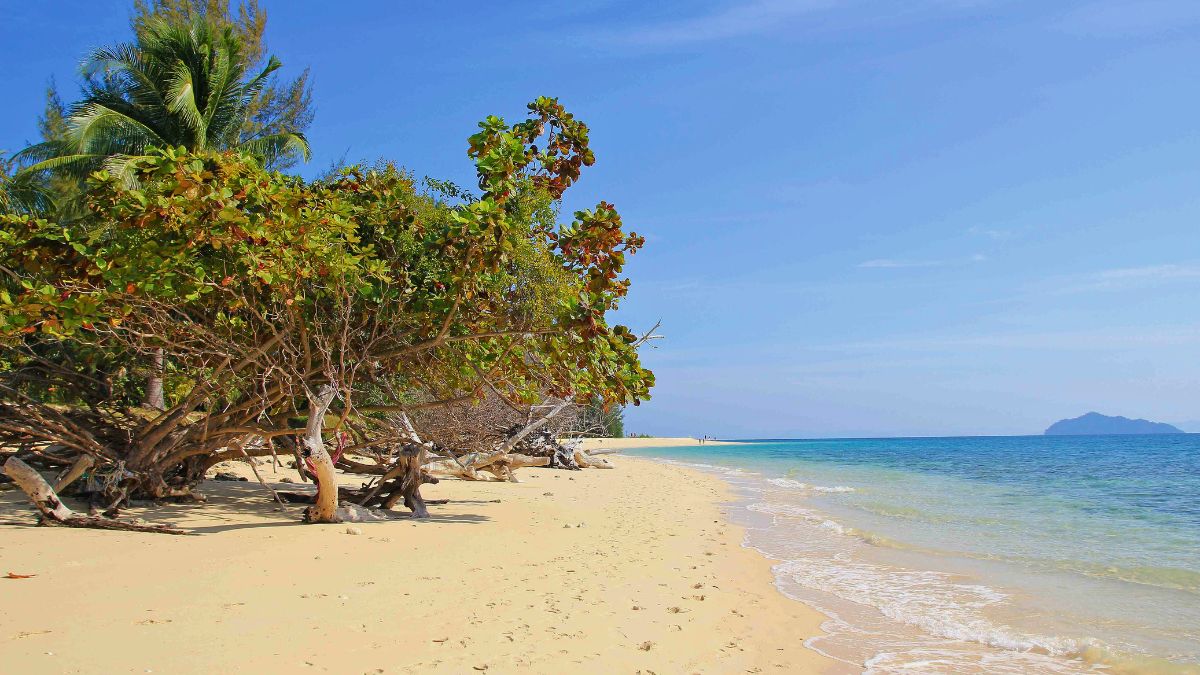
Koh Bulon Le sits off Satun between the Trang islands and Koh Lipe. There are no cars, no large town, limited electricity and cash facilities, a handful of resorts, a village, and clear-water beaches in the right season. It provides the sense of an older Andaman journey while remaining reachable by scheduled high-season boat.
Most accommodation lies around Panka Yai Bay and School Beach. Walk village paths, snorkel close to shore in approved conditions, kayak conservatively, and eat at resort or family restaurants. Two to four nights work well. Basic bungalows commonly begin near 800–1,500 THB, while comfortable beachfront rooms may cost 2,000–4,000 THB.
Speedboats call between Pak Bara, Trang/Lanta routes, and Koh Lipe during high season. Passengers may transfer by longtail because no deep-water pier reaches the beach. Waterproof valuables and wear footwear suitable for a wet landing.
Koh Lipe and Koh Adang: use the popular island to reach a wilder one
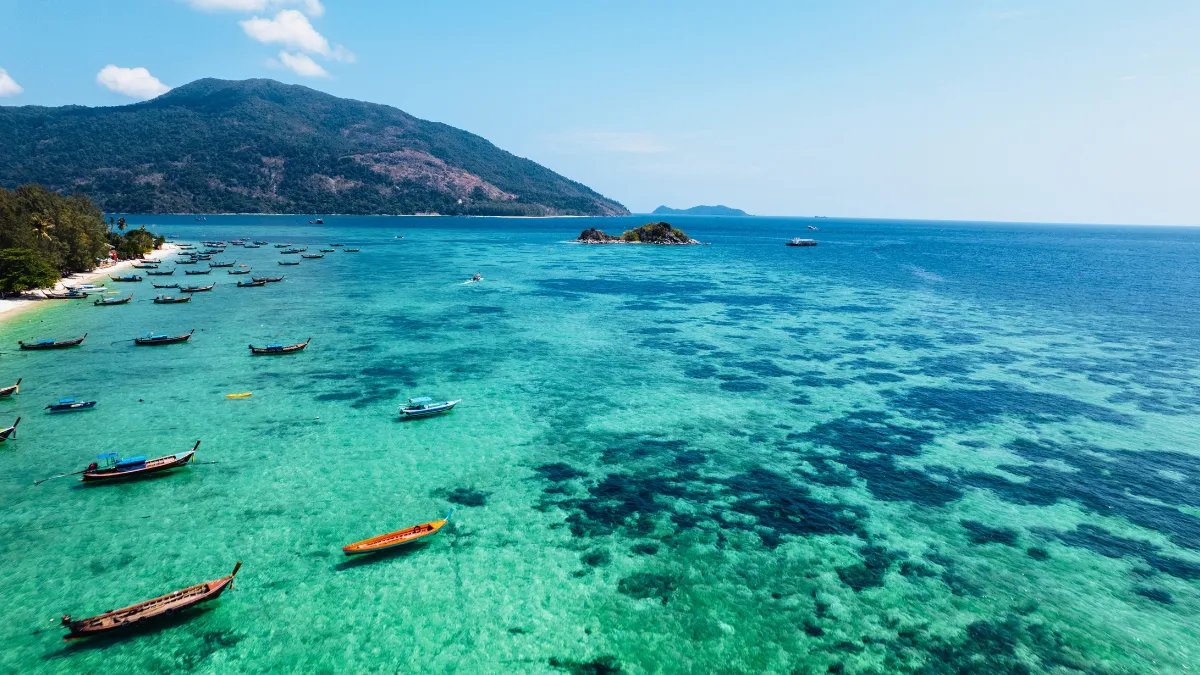
Koh Lipe is no longer off the beaten path. Walking Street, dense resort development, bars, dive shops, and speedboats fill a very small island. Yet it remains a useful southern hub and offers access to extraordinary water within Tarutao National Marine Park.
Sunrise Beach is the most practical long beach and faces Koh Adang. Sunset Beach is smaller and quieter. Pattaya Beach is the main arrival and nightlife zone in high season. Stay toward the ends of Sunrise Beach or near Sunset Beach to reduce noise while keeping access to food and boats.
The offbeat counterweight is Koh Adang, a much larger, forested national-park island across the channel. When the park area is open and accommodation or camping is authorized, travelers can use park facilities, hike established viewpoints, and experience a far less developed island. Access, accommodation, and closures change, so confirm directly with park authorities instead of assuming an old camping report remains valid.
Private and shared longtails can visit reefs and islands around Adang–Rawi. Agree on a route that respects closures, mooring rules, and weather. Koh Lipe sits within the Tarutao park system, and foreign visitors should currently budget about 200 THB for the park entry fee, retaining the ticket for checks during its validity period.
Where to stay and what to eat on Koh Lipe
Dorms and basic rooms can begin around 600–1,200 THB, but high-season beachfront rooms commonly cost 2,500–6,000 THB or more. Christmas and New Year can produce minimum stays and sharp price rises. Book early or stay elsewhere in the chain rather than accepting poor value.
Walking Street supplies every tourist cuisine, but better value often appears on side lanes and toward local residential areas. Try southern curries, grilled fish, roti, noodle soup, som tam, massaman, and Thai-Muslim dishes. Seafood sustainability matters in a protected archipelago: avoid endangered species, undersized catch, and restaurants advertising wildlife that should not be on a plate.
Getting to Koh Lipe
Pak Bara is the principal Thai mainland gateway, reached by road from Hat Yai, Trang, or Satun. Speedboat fares commonly sit around 600–900 THB from Pak Bara before transfer and park charges. High-season services continue north to Koh Bulon Le, the Trang islands, Koh Lanta, Koh Phi Phi, and Phuket, while international boats may operate to Langkawi when border services and immigration arrangements permit.
Long Andaman speedboat legs are physically demanding. An official operator currently indicates roughly 1,000–2,000 THB for Lanta–Lipe and two to two-and-a-half hours under normal conditions, but stops and sea state can extend the journey. Travelers with back problems, pregnancy, small children, or serious seasickness should discuss the vessel and consider breaking the route.
Route 5: Quiet Koh Phangan and Koh Tao, using Samui as a gateway
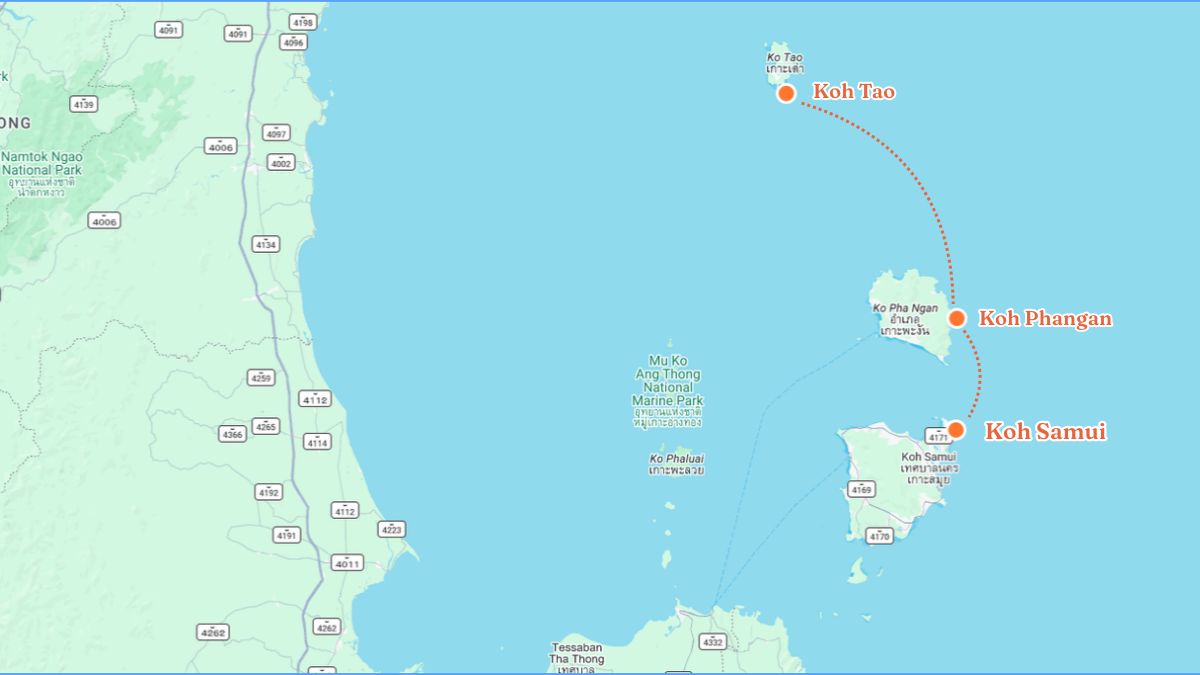
The Samui–Phangan–Tao corridor is Thailand’s easiest well-known island chain, but it can still reward travelers who stay away from the default districts. Samui provides the airport and broadest services. Phangan contains mountain roads, fishing villages, wellness communities, and remote northern beaches beyond the Full Moon Party. Tao combines a dense diving economy with bays that feel completely different from Sairee.
Catamarans, passenger ferries, and vehicle ferries connect the islands to one another and to Chumphon or Donsak. Ferry schedules are stronger than on the smallest Andaman islands, yet rough lower-Gulf weather in October–December can still cancel boats. Around Full Moon Party dates, boats and rooms fill even when the traveler has no intention of attending.
Koh Samui: treat the airport island as more than an airport
Samui is heavily developed, but quieter bases remain. Mae Nam offers a long north-coast beach and access to Pralarn Pier. Bang Por and Lipa Noi are calmer than Chaweng. Taling Ngam has sunsets and distance from the busy northeast, while southern communities around Thong Krut provide access to local fishing boats and views toward smaller islands.
Independent travelers can explore local markets, temples, waterfalls when water levels are safe, southern villages, and beaches using a legal rental car, driver, or public songthaew where practical. Samui’s ring road is busy, and the island’s size makes taxi costs significant. Renting a scooter merely because it is cheaper is not sensible for an inexperienced rider.
On Koh Samui Mae Nam is the best independent base for an onward ferry, Bophut for walking access to restaurants, and Lipa Noi or Taling Ngam for quiet. Budget rooms may start near 700–1,200 THB, mid-range accommodation around 1,500–4,000 THB, and polished beachfront resorts much higher. Samui is generally more expensive than Phangan for equivalent space.
Eat at markets and family restaurants for southern curry, khanom chin, grilled chicken, seafood, roti, and coconut-rich dishes. Surat Thani is known for oysters and coastal shellfish, while island kitchens serve everything from vegan wellness food to tasting menus. A market meal reveals more of Samui than another imported beachfront pizza.
Koh Phangan beyond Haad Rin
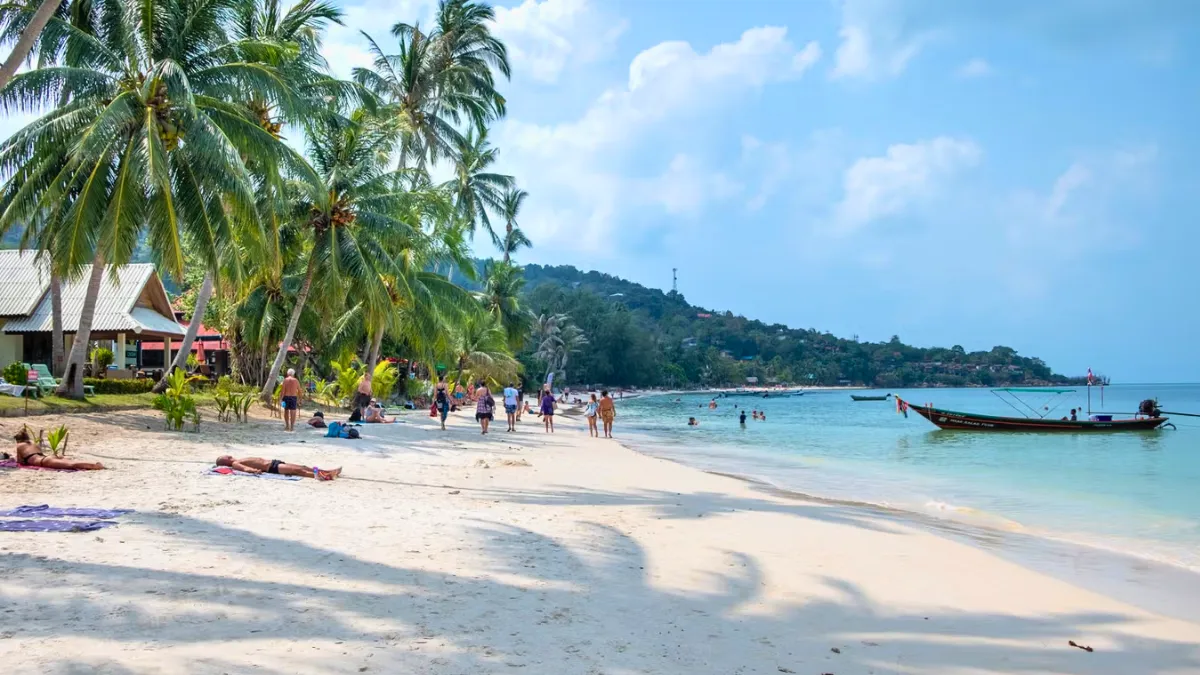
Koh Phangan’s reputation is compressed into one beach and one monthly event. The north and east of Koh Phangan tell a different story. Chaloklum remains a fishing village with seafood, boats, and a long bay. Haad Salad and Haad Yao offer accessible west-coast beach stays. Thong Nai Pan Noi and Yai sit behind the mountains in the northeast. Haad Yuan, Haad Tien, and other east-coast bays may depend on boat access or difficult roads.
Srithanu has yoga, wellness, cafes, and a large international community; it is no longer a hidden corner, but it is useful for longer stays. Travelers who prefer local atmosphere may choose Chaloklum or the less developed north. Bottle Beach can be approached by boat or trail, but route conditions, heat, and navigation make casual solo hiking risky. Ask locally before setting out and carry more water than seems necessary.
Rooms away from party dates can begin around 600–1,200 THB, with comfortable bungalows around 1,500–3,500 THB. Prices, minimum stays, road traffic, and ferry demand rise around the Full Moon Party. Check the event calendar even when avoiding it.
Eat seafood in Chaloklum, curries and rice dishes in local towns, market food in Thong Sala, and plant-based meals around Srithanu. Beach resorts charge for isolation. A room near a village creates more independent choice and keeps local transport costs manageable.
Koh Tao beyond Sairee Beach
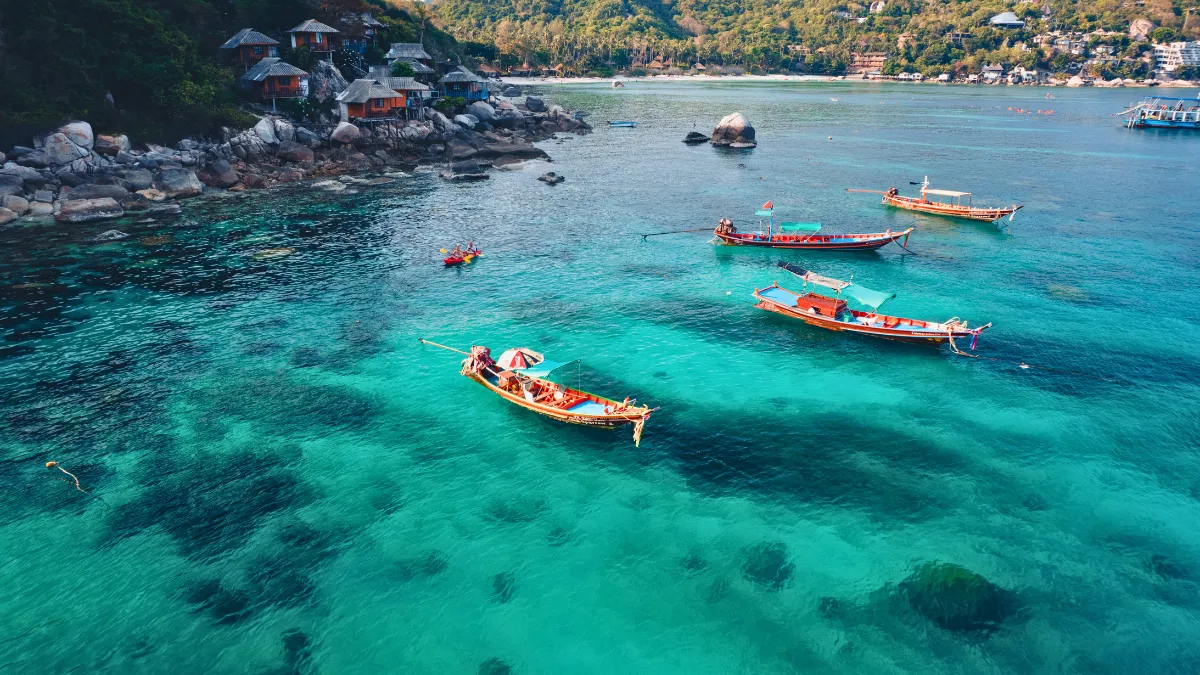
Koh Tao is Thailand’s best-known training ground for scuba diving. Independent travelers can book directly with a reputable dive school, but diving itself is never an unguided activity for an uncertified visitor. Compare safety culture, group size, equipment condition, instructor credentials, environmental practice, and emergency planning—not only the cheapest certification price.
Mae Haad is practical for ferries and services. Sairee is social, busy, and convenient. Chalok Baan Kao is calmer with local food and access to southern bays. Tanote Bay and Aow Leuk offer beautiful water but more isolation and steep approaches. Sai Daeng faces Shark Island and suits travelers who are comfortable relying on resort transport.
Snorkel from shore only in suitable weather, use reef-safe behavior, and stay outside boat lanes. Some bays charge access or restrict outside visitors. Koh Nang Yuan is privately managed and reached by boat, with its own rules and entrance charge. For a complete island circuit, hire a local boat with visible life jackets rather than attempting long exposed crossings by kayak.
Dorms and basic rooms can begin around 500–1,000 THB, while good private rooms commonly cost 1,500–3,500 THB. Dive-and-stay packages may reduce accommodation cost but should not decide the dive center. Food ranges from 70–150 THB local dishes to substantially higher beachfront and international meals.
Getting around the lower Gulf
Travelers can fly directly to Koh Samui, fly to Surat Thani and buy a bus-ferry combination, take a southern train to Surat Thani or Chumphon, or use a Bangkok bus-ferry service. Chumphon is geographically logical for Koh Tao; Donsak and Surat Thani serve Samui and Phangan.
As of 2026 travel planning guide, inter-island Gulf tickets commonly cost 250–750 THB depending on route, speed, and operator. Koh Tao–Phangan often begins around 450 THB on faster services, while Samui routes vary by pier. The ticket must name the exact Samui pier: Nathon, Pralarn/Mae Nam, Bangrak, and other terminals are not interchangeable.
Do not connect the first ferry to an international flight
Even a normally reliable Gulf ferry can be delayed by wind, mechanical issues, or pier congestion. Spend the final night on Samui if flying from USM, or on the mainland before a Surat Thani, Chumphon, Phuket, or Bangkok departure. Separate airlines and ferry companies will rarely protect one another’s missed connections.
Thailand island-hopping itineraries that work
The routes below assume that arrival day is a travel day and that ferry times will not always fit the ideal plan. They deliberately leave fewer islands and longer stays than many packaged itineraries. A traveler who gains time can add an island; removing a destination after prepaid bookings is more expensive.
7 days: Koh Mak and Koh Kood
- Day 1: Travel from Bangkok to Trat and sleep in Trat or continue to Koh Mak only if the confirmed boat connection is comfortable.
- Days 2–3: Stay on Koh Mak. Cycle plantation roads, kayak locally in safe conditions, and eat at independent island restaurants.
- Days 4–6: Continue to Koh Kood. Base around Klong Chao or Ao Tapao for waterfalls, beaches, kayaking, and fishing-village seafood.
- Day 7: Return to Laem Sok and sleep in Trat or Bangkok according to the next departure.
This itinerary avoids adding Koh Chang merely because it is famous. If seven days includes travel from another country, choose only Koh Kood or extend the trip.
10 days: Koh Yao Noi, Koh Jum, and Koh Lanta
- Days 1–3: Reach Koh Yao Noi from Phuket or Krabi. Explore by bicycle or local driver and arrange one local longtail day.
- Days 4–6: Travel through Krabi or use a confirmed seasonal service to Koh Jum. Leave the schedule deliberately light.
- Days 7–9: Continue to Koh Lanta. Stay at Klong Nin or farther south, visit Old Town, and choose a community or nature activity.
- Day 10: Return to Krabi and remain near the airport if flying internationally the next morning.
14 days: The quieter Trang islands
- Days 1–2: Arrive in Trang, eat a dim sum and roast-pork breakfast, and travel to Koh Mook.
- Days 3–5: Stay on Koh Mook, visit Emerald Cave early with a local captain, and spend time in the village.
- Days 6–7: Move to Koh Kradan for reef time and quiet evenings after day boats leave.
- Days 8–11: Return through the appropriate mainland pier and continue to Koh Libong or Koh Sukorn for community life and landscapes.
- Days 12–13: Return to Trang for food and a flexible weather buffer, or add Koh Ngai only when the seasonal boat runs cleanly.
- Day 14: Depart from Trang or Hat Yai.
This route may touch the mainland more than once. That is a strength, not a defect: local piers provide reliable access to islands that are not designed around a tourist speedboat chain.
14 days: Trat island chain
- Days 1–4: Koh Chang, based in Klong Prao, Bang Bao, or the southeast according to interests.
- Days 5–8: Koh Mak, with an unhurried cycling and beach rhythm.
- Days 9–13: Koh Kood, including one waterfall or river day and one complete rest day.
- Day 14: Return to Trat. Do not schedule a same-evening long-haul departure from Bangkok.
21 days: Southbound Andaman slow route
Begin with three nights on Koh Yao Noi, travel through Krabi for three nights on Koh Jum, and spend four nights on Koh Lanta. Continue for three nights on Koh Mook, two nights on Koh Kradan, three nights on Koh Bulon Le, and finish with three nights on Koh Lipe or Koh Adang when park accommodation is officially available. Remove one island to create a weather buffer and mainland night before departure.
This route works only when high-season boats are operating. Outside that period, break the journey into mainland-linked stays or choose the Gulf. A published ferry map is not proof that every line operates on the intended date.
10 days: quiet Gulf route
Use Samui as a one-night arrival base around Mae Nam, spend four nights in northern Koh Phangan around Chaloklum or Haad Salad, and continue for four nights to Chalok Baan Kao or Tanote Bay on Koh Tao. Return to Samui or Chumphon with a mainland buffer. Check Full Moon Party dates before booking because demand spreads across all three islands.
How much does Thailand island hopping cost?
A realistic 2026 budget for independent Thailand island hopping is approximately 1,500–2,300 THB per person per day for a careful budget traveler, 3,000–5,500 THB for comfortable mid-range travel, and 7,000 THB or more for boutique or private-boat travel. These figures exclude international flights and assume that two people share a private room. Solo travelers pay more per person because rooms, taxis, and private longtails are not halved.
The cheapest islands are not always the quietest. Remote accommodation can be inexpensive, but food, drinking water, boat transfers, electricity, and cash access cost more. Koh Kood, Koh Kradan, Koh Lipe, and Samui commonly cost more than mainland Thailand. Koh Phayam, Koh Jum, Koh Mook village, Koh Sukorn, and parts of Koh Phangan can deliver better value when booked outside holiday peaks.
| Expense | Budget planning range | Comfortable planning range | Often overlooked |
|---|---|---|---|
| Accommodation per room | 500–1,200 THB | 1,500–4,000 THB | Air-conditioning, breakfast, peak minimum stays, pier transfer, and taxes |
| Food per person per day | 350–700 THB | 800–1,500 THB | Resort-only dining and imported drinking water |
| Short ferry hop | 250–600 THB | 600–1,200 THB | Hotel pickup, longtail landing, baggage, and pier transfer |
| Long Andaman speedboat leg | 1,000–2,000 THB | 2,000–3,000 THB | Multiple stops, motion sickness, exposed luggage, and park fees |
| Local shared transport | 50–250 THB | 250–700 THB | Private pricing after dark or on islands without shared routes |
| Private longtail boat | 2,000–4,000 THB per boat | 4,000–8,000+ THB per boat | Fuel, route, park fees, food, life jackets, and waiting time |
| Marine national-park entry | About 200–500 THB | Same statutory fee | Different parks charge different foreign-adult rates; boat tours may exclude the fee |
| Diving or activity day | 800–2,500 THB | 2,500–5,000+ THB | Equipment, certification, park charge, insurance, and transfers |
A realistic two-week budget
A solo traveler using dorms or basic fan bungalows, local food, public boats, and mostly free activities should plan roughly 25,000–38,000 THB for two weeks after arriving at the regional gateway. A couple sharing simple private rooms may spend 45,000–70,000 THB together. Comfortable air-conditioned rooms, several speedboats, a dive day, private transfers, and restaurant meals can take a couple to 85,000–140,000 THB.
These are planning envelopes, not promises. Christmas–New Year, Songkran, Full Moon Party dates, and Thai long weekends raise prices. A late booking on a small island may leave only a luxury resort or a room far from food, making the apparent accommodation saving disappear into transport.
How to reduce costs without damaging the trip
- Stay longer on fewer islands and remove repeated pier transfers.
- Choose a village or walkable beach rather than an isolated discounted resort.
- Use a shared scheduled ferry instead of a private speedboat for long transfers.
- Split a local longtail with other travelers after agreeing on route and safety equipment.
- Eat breakfast and lunch at local markets or family restaurants, saving beachfront dining for selected evenings.
- Withdraw enough cash on the mainland to avoid repeated foreign-card ATM fees, while storing it securely in separate places.
- Book peak accommodation early but keep one weather-buffer night flexible.
- Compare the complete ticket, because a 500 THB ferry with hotel pickup may beat a 350 THB boat plus two taxis.
How to book ferries and transfers independently
Use official operators for current schedules whenever the website is functional. A comparison platform helps when several operators serve the same route or when the ticket combines a bus, van, hotel pickup, and boat. Local accommodation is often the most reliable source for small-island landings because staff know which vessel actually calls at their beach.
In high season, book long or capacity-limited routes several days ahead. Book much earlier for 20 December–5 January, Songkran, Full Moon Party dates, and Friday departures before Thai holidays. Short local ferries can often be bought one day ahead or at the pier, but “usually” is not a guarantee when there is only one boat.
Information every ferry ticket should provide
- The exact mainland or island pier, not only the town or island name.
- Check-in time and boat-departure time.
- Operator name and vessel type.
- Whether the service is direct or makes several stops.
- Whether hotel pickup or island drop-off is included.
- Checked and cabin luggage rules.
- National-park fees, pier fees, and longtail transfers that remain payable.
- Cancellation and rebooking rules for weather.
- A contact number that works on the travel day.
Ferry, speedboat, catamaran, or longtail?
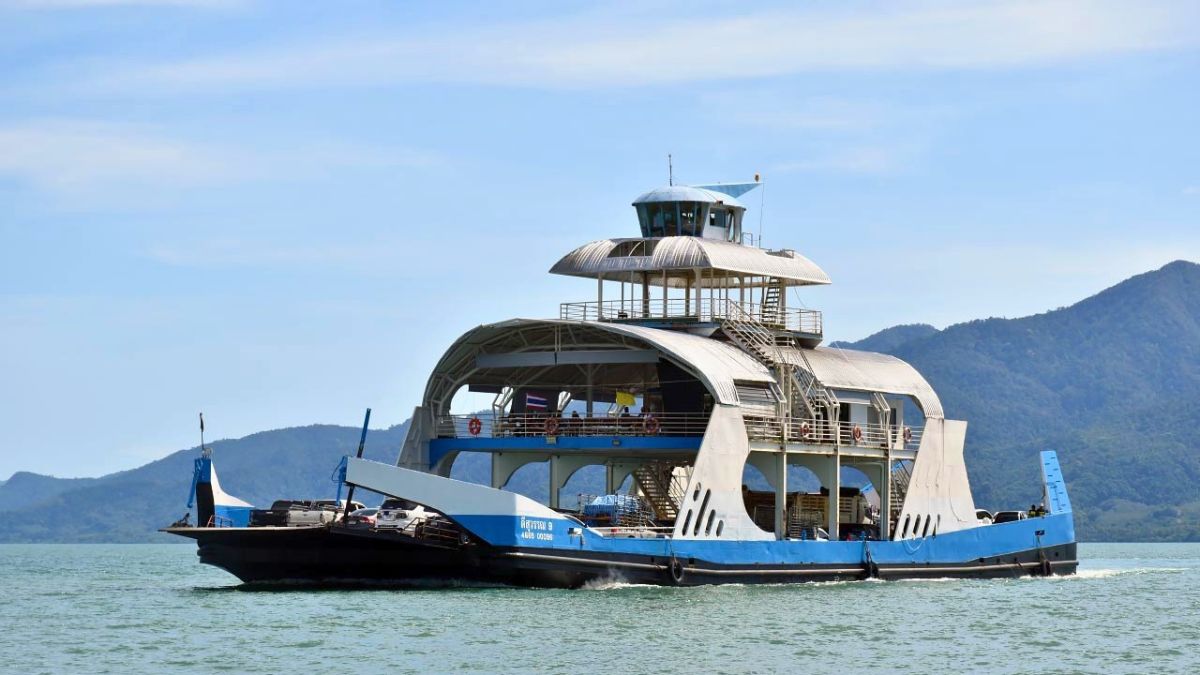
A larger ferry or catamaran is usually steadier, provides more protection for luggage, and suits families or travelers prone to seasickness. A speedboat is faster but can slam hard in chop, has limited dry storage, and requires more agility when boarding. A longtail is ideal for short local journeys, community boat hire, and shallow landings, but is exposed to sun, spray, noise, and changing weather.
Never choose a speedboat only because its timetable saves thirty minutes. Consider the sea, passenger health, luggage, and onward connection. If a small boat appears overloaded, lacks accessible life jackets, or departs against an official warning, decline to board and contact the operator.
Compare the complete island transfer
Check the operator, pier, vessel, luggage, pickup, park fee, and final island transfer before comparing the lowest fare.
Compare Thailand ferry and transfer routes
Where to stay when island hopping independently
The most beautiful resort is not always the best independent base. A remote beach can require a 500–1,000 THB taxi whenever the traveler wants dinner, an ATM, a pharmacy, or the departure pier. Before booking, map the accommodation against the arrival pier, village, swimmable beach, evening food, and the next departure.
Questions to ask a small-island property
- Which pier and boat should I use, and do you collect/pick up from that service?
- What does the pickup cost, and can it be arranged after dark?
- Can I walk to independent restaurants and a shop?
- Is the beach swimmable at both high and low tide?
- Does electricity operate 24 hours, and is air-conditioning available all night?
- Is drinking water included or refilled without single-use plastic?
- Are card payments accepted, and is there a surcharge?
- What happens if the ferry is canceled and I arrive one day late?
- Does the room have mosquito screens, a safe or lockbox, and secure doors?
- Can the property accommodate dietary, mobility, or medical needs?
Book the first and final nights more carefully
The first island night should match a ferry the traveler can realistically reach. The final island night should not sit immediately before an international flight. Book the middle with flexibility where possible, but secure rare rooms on Koh Kradan, Koh Bulon Le, Koh Sukorn, Koh Libong, and Koh Phayam before transport because alternatives are limited.
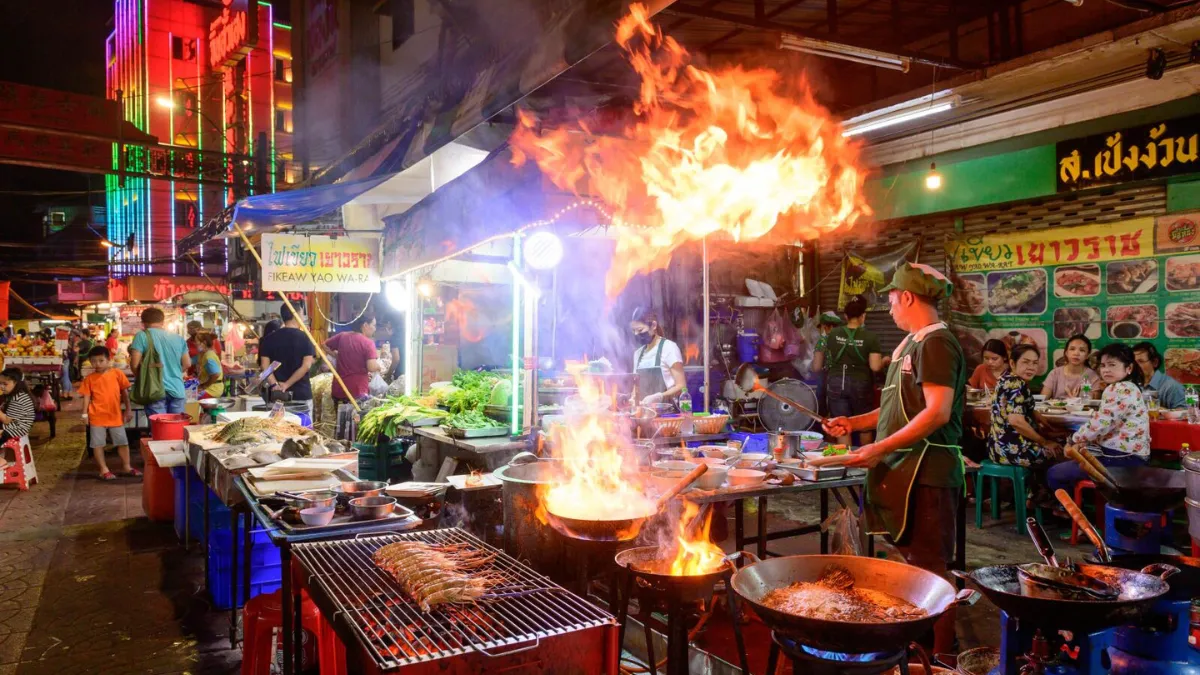
What to eat while island hopping in Thailand
Island food is not one cuisine. Trat’s eastern flavors differ from Muslim-influenced Satun, Chinese-influenced Trang breakfasts, Ranong’s Burmese connections, and Surat Thani’s oysters and southern curries. Eating locally is one of the easiest ways to make an island-hopping trip less generic.
| Region | Foods to look for | Where to find better value |
|---|---|---|
| Trat islands | Fresh crab, squid, grilled fish, chamuang-leaf pork or soup, tropical fruit, cashews | Fishing villages, Trat town, local roads away from resort beaches |
| Ranong and Koh Phayam | Cashew dishes, Burmese-style salads and curries, seafood, roti, noodles | Pier village, family kitchens, Ranong markets |
| Krabi and Koh Lanta | Khao yam, khua kling, massaman, roti, grilled fish, southern curry | Old Town, village markets, Muslim family restaurants |
| Trang islands | Dim sum breakfast, Trang roast pork, khanom chin curry noodles, seafood, strong coffee | Trang town and Koh Mook village |
| Satun and Koh Lipe | Thai-Muslim curries, roti, grilled seafood, rice dishes, spicy salads | Side streets, local residential areas, Pak Bara before departure |
| Lower Gulf | Surat Thani oysters, khanom chin, seafood, southern curries, coconut dishes | Thong Sala market, Chaloklum, Mae Haad, Samui markets |
Food and water precautions
Choose busy kitchens, freshly cooked food, and seafood kept properly chilled. A busy local restaurant is often safer than an empty resort buffet held warm for hours. Drink treated or sealed water, use refill stations where hygiene is clear, and carry oral rehydration salts. Travelers with allergies should save a Thai-language explanation offline; “vegetarian” may still include fish sauce, shrimp paste, or oyster sauce.
Getting around the islands without a tour
Transport changes from island to island. Koh Chang and Koh Lanta have shared songthaews on useful routes. Samui has public songthaews but prices and service patterns vary. Koh Mak is bicycle-friendly. Koh Phayam has motorbike taxis and narrow lanes but no conventional cars. Koh Kood, Koh Yao Yai, and remote Koh Phangan bases often require a driver, scooter, or accommodation transfer.
Songthaews and local taxis
A songthaew is a pickup-style passenger vehicle with bench seating. It may operate as shared transport on an informal route or as a privately hired taxi. Ask whether the quoted price is per person or for the vehicle and whether other passengers will be collected. After dark, shared pricing often becomes private pricing.
Bicycles
Koh Mak is the best island in this guide for casual cycling, followed by suitable parts of Koh Yao Noi, Koh Sukorn, and Koh Phayam. Heat, dogs, unlit roads, loose sand, and steep gradients remain hazards. Carry water, use lights, wear a helmet, and avoid remote roads after dark.
Scooters and motorbikes
A scooter rental shop does not decide whether a traveler is licensed. Thailand’s official guidance for foreign drivers recognizes eligible visitors with the required home licence and a valid International Driving Permit, while ASEAN licences have separate recognition. The licence and permit must cover motorcycles, not only cars. Insurance may reject a claim involving an unlicensed rider, excluded engine size, alcohol, or failure to wear a helmet.
Island roads combine steep hills, blind bends, sand, potholes, rain, dogs, pedestrians, and riders crossing the center line. Koh Tao, Koh Phangan, Samui, Koh Chang, and the hilly parts of Koh Kood are not training grounds. Inexperienced travelers should use taxis, local drivers, bicycles on genuinely easy terrain, or accommodation near the places they want to visit.
Never leave a passport as security. Use a documented cash or card deposit where possible, photograph every panel and wheel, test brakes and lights, and obtain a written contract. A 250 THB rental is not cheap when it invalidates medical and liability cover.
Private longtail boats
Hiring a boat directly is one of the best independent island experiences when handled well. Ask the accommodation, pier office, community group, or several captains for a clear quote. Record the boat name or number, captain contact, route, maximum passengers, duration, inclusions, weather policy, and life jackets. The cheapest beach approach should not replace basic accountability.
Thailand island-hopping safety
Most independent island trips are uneventful, but remoteness magnifies small problems. A cut that needs stitches, a broken phone, an empty ATM, a canceled ferry, or a lost room key is easier to solve on Samui than on Koh Bulon Le. Good planning is not anxious travel; it creates freedom to enjoy places with fewer services.
Boat and weather safety
- Check the Thai Meteorological Department’s marine forecast, not only a general weather app.
- Wear a life jacket throughout exposed or rough passages and insist that children have correctly fitting equipment.
- Do not board an overloaded vessel or one without accessible safety equipment.
- Keep passports, phones, medication, and electronics in a waterproof pouch attached to you.
- Take seasickness medication early enough to work after confirming it is medically suitable.
- Use shoes that tolerate wet pontoons, longtail transfers, and shallow-water landings.
- Never pressure a captain to depart during an official small-craft warning.
Swimming, snorkelling, and diving
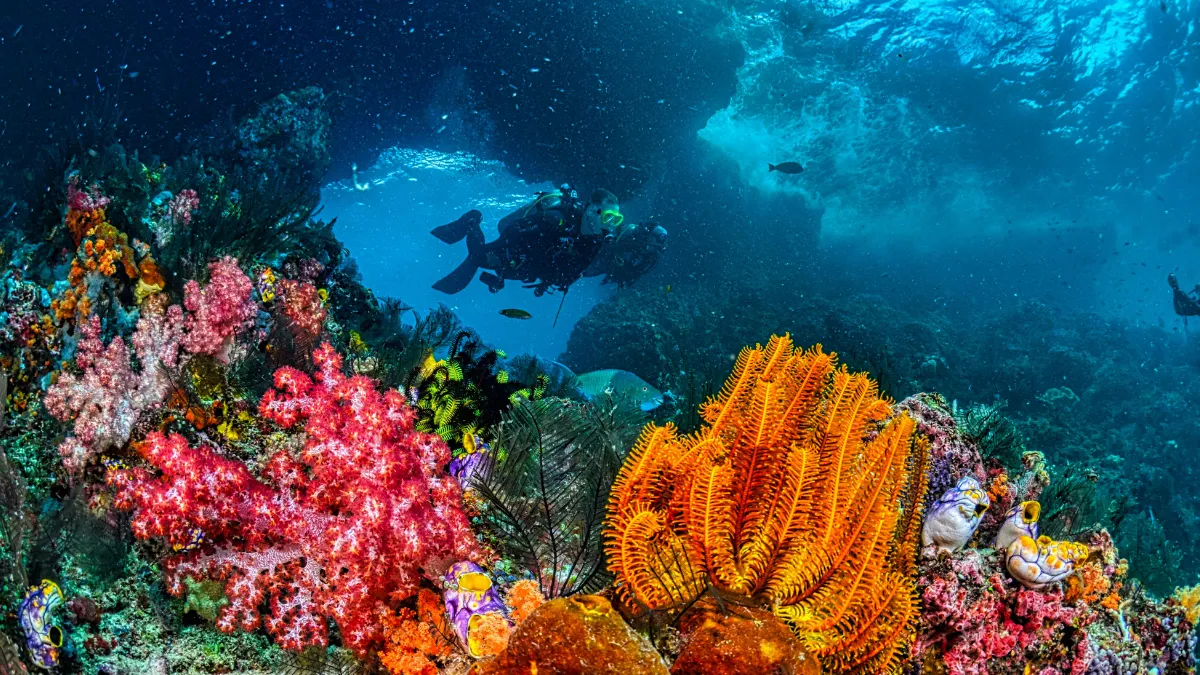
Tropical water is not automatically gentle. Currents, boat lanes, shore break, jellyfish, sea urchins, coral cuts, and heat exposure create risk. Ask locally about the beach that day, use a surface marker where appropriate, and never snorkel alone beyond a protected bay. Do not stand on coral or chase wildlife.
Choose a dive center for training standards, equipment condition, instructor ratios, oxygen and emergency procedures, and environmental behavior. Confirm that travel insurance covers scuba to the planned depth and any certification activity. Allow the recommended no-fly interval after diving.
Medical care and insurance
Large islands may have clinics or hospitals; small islands may have only a health post, pharmacy, or boat evacuation. Carry enough prescription medication for delays, a basic first-aid kit, oral rehydration salts, insect repellent, and sun protection. Insurance should cover marine transport, evacuation, diving or other activities, and legal motorcycle use if applicable.
Dengue occurs in Thailand, including on islands. Reduce mosquito bites during day and evening with repellent, clothing, screens, and air movement. Fever after or during travel warrants medical advice; avoid assuming every fever is a routine stomach bug.
Personal security and scams
Use accommodation safes carefully, split cash and cards, and keep passport copies offline. Record damage before any vehicle or kayak rental. Confirm the full taxi or boat price in writing. At parties, watch drinks, travel back with a trusted person, and do not swim while intoxicated. Quiet islands are not crime-free, and busy islands are not automatically dangerous; ordinary judgment still applies.
Emergency numbers
Thailand’s Tourist Police can be reached on 1155, police on 191, and emergency medical services on 1669. Save the accommodation, ferry operator, insurer, and a trusted contact offline. Mobile service can fade in bays, national parks, and during crossings.
How to make island hopping more responsible
Remote islands pay a high price for visitor convenience. Fresh water is finite, rubbish must be burned, buried, or shipped, electricity may come from diesel, and coral damage accumulates one fin kick at a time. Responsible travel is less about purchasing an “eco” label and more about reducing pressure through everyday choices.
- Refill water where treatment is trustworthy and carry a reusable bottle.
- Decline daily linen changes and switch off air-conditioning when leaving.
- Use reef-safe behavior: no touching, standing, feeding, collecting, or anchoring on coral.
- Choose operators using mooring buoys and following national-park closures.
- Do not buy shells, coral, starfish, or wildlife products.
- Spend in village restaurants, local boats, family stays, markets, and community enterprises.
- Dress appropriately in Muslim villages and ask permission before photographing residents.
- Avoid geotagging fragile, unmanaged sites that cannot absorb rapid visitor growth.
- Stay longer, make fewer transfers, and reduce the fuel used per day of experience.
- Take batteries, broken electronics, specialist plastics, and other difficult waste back to the mainland.
Wildlife is not a performance
Hornbills, dugongs, turtles, reef sharks, dolphins, and monitor lizards should change their behavior as little as possible because a traveler is present. Never feed wildlife, demand a guaranteed sighting, touch marine animals, or support a captain who chases them. A distant, brief encounter is more valuable than a photograph obtained by causing stress.
What to pack for Thailand island hopping
- A soft backpack or manageable wheeled bag rather than an oversized rigid suitcase.
- A small waterproof dry bag or pouch for passports, phones, and medicine.
- Quick-drying clothing, modest village clothing, and one light rain layer.
- Secure sandals or water shoes plus footwear suitable for walking.
- High-protection sunscreen, hat, sunglasses, and after-sun care.
- Mosquito repellent, basic first aid, oral rehydration salts, and personal medication.
- Reusable water bottle and compact reusable bag.
- Power bank and charging adapter; electricity may not be continuous.
- Offline maps, tickets, passport copy, insurance policy, and emergency contacts.
- Enough Thai baht for several days, divided securely, without carrying the entire trip budget in one place.
Pack so one person can lift the bag between a pier, speedboat, longtail, and beach. Crew may help, but independent travel works better when luggage does not require a team.
Thailand Island Hopping
Use our free instant travel packing list generator
Simply add your destination and dates of travel and receive a full and detailed travel packing list
Use the travel packing list generatorCommon Thailand island-hopping mistakes
- Trying to visit both coasts in ten days. The overland crossing consumes more time than the map suggests.
- Booking every island for two nights. A two-night stop usually provides only one complete day.
- Ignoring the monsoon. Low accommodation prices do not make a closed ferry route operate.
- Using the island name instead of the pier. Phuket, Samui, Lanta, and the mainland gateways have multiple terminals.
- Assuming the cheapest ferry includes transfers. Pier taxis and longtail landings can exceed the fare difference.
- Connecting a ferry directly to an expensive flight. Weather delays are normal operational risks.
- Renting a scooter without the correct licence or skill. Availability is not legality or competence.
- Expecting every beach to swim well at every tide. Reef flats, rocks, currents, and seasonal debris change conditions.
- Arriving without cash on a small island. An ATM can be absent, empty, offline, or expensive.
- Treating villages as scenery. Dress, noise, drones, alcohol, and photography affect real communities.
- Booking a remote resort without checking food and transport. Isolation has a daily price.
- Following an old blog instead of a live operator. Boats, park closures, piers, and fees change.
Thailand island-hopping planning checklist
- Choose one coast and verify that its season suits the travel month.
- Select two to four islands that connect in geographic order.
- Allow at least three nights on most inhabited islands.
- Confirm every ferry on the operator’s live system before booking accommodation.
- Record exact piers, check-in times, vessel types, and included transfers.
- Price the complete route in Thai baht, including park fees and island taxis.
- Choose accommodation within realistic reach of food and transport.
- Carry cash, waterproof essential documents, and save everything offline.
- Check licences and insurance before renting any motorcycle.
- Recheck marine weather and operator messages the day before travel.
- Leave one flexible night and stay off the final island before a major flight.
- Spend deliberately with local families, community boats, and independent restaurants.
Thailand island hopping: frequently asked questions
Can you go island hopping in Thailand without a tour?
Yes. Scheduled ferries, speedboats, public vans, and combined tickets make independent Thailand island hopping practical. Book accommodation and long transfers directly, confirm the exact pier, and use local captains for caves, remote reefs, and uninhabited marine-park islands where traveling alone would be unsafe or prohibited.
Which Thailand island-hopping route is best for avoiding crowds?
For easy logistics with quieter islands, choose Koh Chang, Koh Mak, and Koh Kood. For a slower Andaman trip, combine Koh Jum with Koh Mook, Koh Libong or Koh Sukorn, and Koh Bulon Le in high season. Koh Phayam is best for travelers who prefer one deeply relaxed island stay rather than constant hopping.
How many days do you need for island hopping in Thailand?
Seven days is enough for two nearby islands. Ten to fourteen days works well for three islands on one coast. Three weeks allows a slower regional chain. Stay at least three nights on most inhabited islands and add a mainland or gateway night before a major flight.
What is the best month for Thailand island hopping?
February is one of the strongest all-round months, with generally favorable conditions across many Andaman, Trat, and lower-Gulf routes. November to April usually offers the broadest Andaman network, while the Samui–Phangan–Tao corridor often works well from January through August. Check current marine forecasts because seasons vary.
Can you island hop in Thailand during July or August?
Yes, but route choice matters. Koh Samui, Koh Phangan, and Koh Tao are often the better starting point in July and August. The Andaman and Trat coasts can have rougher seas, reduced boats, closed resorts, and marine-park closures. Weather can still disrupt any coast, so retain flexibility.
How much does Thailand island hopping cost per day?
In 2026, budget approximately 1,500–2,300 THB per person per day for basic rooms, local food, and public boats. Comfortable mid-range travel commonly costs 3,000–5,500 THB per person per day. Solo travelers, private boats, diving, remote resorts, and peak dates increase the total.
Do Thailand ferries need to be booked in advance?
Book long and limited high-season routes several days ahead. Reserve earlier for Christmas–New Year, Songkran, Full Moon Party periods, and Thai holiday weekends. Short local routes can often be bought a day ahead, but confirm accommodation pickup and the exact pier before relying on a walk-up ticket.
Is it better to use ferries or speedboats in Thailand?
Larger ferries and catamarans are generally steadier and easier with luggage, children, or seasickness. Speedboats save time and reach smaller islands but can be wet, cramped, and physically harsh in chop. Choose according to sea conditions, passenger health, route, and luggage rather than speed alone.
Can you travel directly between the Andaman islands and Koh Samui?
No direct sea route crosses the Thai peninsula. Travel requires a domestic flight or a ferry combined with road transport through southern Thailand, often via Krabi, Phuket, Surat Thani, or Donsak. Treat it as a full travel day and avoid attempting both coasts on a short itinerary.
Which Thai islands are best without renting a scooter?
Koh Mak suits bicycles, while Koh Mook village, Koh Kradan, Koh Ngai, Koh Bulon Le, central Koh Lipe, and carefully chosen Koh Lanta or Koh Phangan bases can work on foot with local taxis or boats. Koh Kood, Koh Yao Yai, and remote parts of larger islands require more deliberate accommodation and transfer planning.
Is Thailand island hopping safe for solo travelers?
It is generally practical for solo travelers using reputable ferries, legal transport, well-reviewed accommodation, and normal personal-security precautions. Share private-boat details, avoid isolated arrivals after dark, keep valuables with you, and do not swim, hike, kayak, or ride beyond your experience merely because no tour group is present.
Which is the best off-the-beaten-path island in Thailand?
Koh Sukorn is excellent for rural landscapes and community life, Koh Libong for ecology and fishing villages, Koh Phayam for a relaxed car-free-feeling stay, and Koh Jum for simple Andaman beaches. The best choice depends on season and whether the traveler values swimming, food choice, wildlife, comfort, or isolation.
Do you need cash on Thailand’s smaller islands?
Yes. Carry enough Thai baht for accommodation balances, food, local taxis, park fees, and an emergency return. ATMs and card terminals may be absent, offline, or empty, and foreign-card withdrawals usually incur fees. Divide cash securely rather than keeping it all in one wallet.
Thailand Island Hopping
Use our free digital travel planner and itinerary builder
Choose one of our itinerary templates to crerate a fully planned, costed and booked itinerary with full logistics and budget. Easy, simple, and fully detailed.
Use the travel planning itinerary toolThe best island-hopping trip leaves room for the islands
Thailand’s most rewarding island journey is rarely the one with the most ferry tickets. It is the route that fits one coast, the right season, and the traveler’s actual interests. Koh Mak rewards a bicycle and an empty afternoon. Koh Phayam needs time for the island’s pace to replace the mainland’s. Koh Mook becomes more than Emerald Cave when visitors eat in the village. Koh Libong and Koh Sukorn ask travelers to value community and ecology as highly as white sand.
Plan the difficult transfers, but do not schedule every hour. Use public ferries where they work, hire local captains where the sea demands knowledge, and accept a mainland connection when it is safer and more reliable. Spend longer, carry less, follow closures, and keep the final night away from a weather-dependent boat. That is how Thailand island hopping becomes an independent journey rather than a self-managed package tour.
Official information and live planning sources
- Tourism Authority of Thailand destination information
- Tourism Authority of Thailand: Koh Chang
- Tourism Authority of Thailand: Koh Kood
- Tourism Authority of Thailand: Koh Lanta
- Tourism Authority of Thailand: Ranong and Koh Phayam
- Tourism Authority of Thailand: Surat Thani islands
- Thai Meteorological Department forecasts and marine warnings
- Department of National Parks, Wildlife and Plant Conservation
- 2026 Similan and Surin seasonal-closure report
- Boonsiri Ferry official Trat island routes
- Tigerline Ferry official Andaman route information
- Lomprayah official Gulf ferry information
- Official foreign-driving licence and International Driving Permit guidance
- The Transport Company official intercity bus booking
- State Railway of Thailand D-Ticket