

Malaysia travel costs are excellent when compared to many international destinations. For years Malaysia had a reputation for enabling an “easy, cheap” stop on a Southeast Asia itinerary — better roads and infrastructure than Thailand or Indonesia, English widely spoken, and a lower cost of living than Singapore next door. That reputation is broadly fair, but it hides a wide range.
A week spent on trains and buses between Kuala Lumpur, Melaka and Penang can run on a genuinely tight budget. The same week spent chasing orangutans in Sabah, diving Sipadan, and island-hopping off the east coast turns into a different financial trip entirely, because Malaysian Borneo, dive permits, and mandatory-guide mountain climbs are priced nothing like a plate of char kway teow.
This guide is built for independent travelers, not package-tour guests. It separates Peninsular Malaysia from Malaysian Borneo (Sabah and Sarawak), because the cost gap between them is one of the biggest planning surprises in the country. It also flags the fees that rarely make it into a “Malaysia is so cheap!” post: the tourism tax now stacked with a service tax on every hotel bill, the 2026 price hike on Kuala Lumpur’s tourist transit pass, and the fact that you cannot simply buy a ticket and climb Mount Kinabalu — you buy a package, whether you want to or not.
Costs accurate and updated: September 2026
Malaysia travel costs in 2026: the quick answer
A realistic 2026 starting point for one independent traveler is RM120–210 ($29–$50) per day for backpacker travel, RM250–420 ($60–$100) for a good-value independent trip, RM460–780 ($110–$186) for a mid-range trip, or RM850–1,700+ ($200–$400+) for an upmarket independent trip. These figures cover daily living costs only — accommodation, food, local transport, and an ordinary allowance for attractions — and exclude the international flight, domestic flights or ferries between destinations, and one-off costs like a Mount Kinabalu climb or a Sipadan dive permit.
| Travel style | Daily budget (RM) | Approx. USD at RM4.20/$1 | What it normally covers |
|---|---|---|---|
| Backpacker | RM120–210 | $29–$50 | Dorm beds or fan rooms, hawker food, public transport, mostly free attractions |
| Good-value independent | RM250–420 | $60–$100 | Private air-con room, mixed hawker/restaurant food, Grab rides, selected paid activities |
| Mid-range | RM460–780 | $110–$186 | 3–4 star hotel, restaurant meals, regular Grab use, day tours |
| Upmarket independent | RM850–1,700+ | $200–$400+ | Resorts or boutique hotels, fine dining, private transfers, premium experiences |
I use RM4.20 to $1 throughout this guide.
The ringgit was trading close to 0.237 USD (roughly RM4.22 to the dollar) in early September 2026, after strengthening noticeably against the dollar over the previous twelve months. That’s a meaningfully stronger ringgit than the RM4.60–4.70 rates seen through much of 2024, so anyone budgeting off an older article is probably overestimating what their dollars will buy. Recheck the rate close to departure rather than trusting any fixed number in an article, including this one.

What’s included in a realistic Malaysia daily budget
A useful daily figure covers accommodation, three ordinary meals, non-alcoholic drinks, local transport, a fair allowance for attractions, and small costs like laundry, water, and tips. It does not cover the international flight, domestic flights or ferries between destinations, travel insurance, a Mount Kinabalu climb, a Sipadan diving permit, alcohol (which is taxed heavily and can quietly become one of the largest line items for travelers who drink regularly), or shopping.
Split your trip into three layers before you price anything:
- Pre-trip costs: international flights, insurance, gear, any vaccinations.
- Route costs: domestic flights, trains, long-distance buses, ferries between islands, and — specific to Malaysia — the cost and hassle of moving between Peninsular Malaysia and Borneo, which is fly-only.
- Daily costs: room, food, local transport, attractions, and ordinary daily spending within one destination.
Peninsular Malaysia (Kuala Lumpur, Melaka, Penang, Ipoh, the Cameron Highlands, Langkawi) is where the “Malaysia is cheap” reputation comes from. Malaysian Borneo (Kota Kinabalu, Sandakan, Kuching, Sipadan) is a different cost tier — wildlife tours, national park fees, and remoteness push daily and route costs up noticeably, even though it’s the same country and currency.
How these 2026 estimates were calculated
These ranges combine current official fares (KTM rail, Rapid KL transit, Sabah Parks fees) with realistic market ranges for hotels, hawker and restaurant meals, Grab rides, and tours. They’re planning figures, not guaranteed quotes — hotel rates swing with school holidays and festivals, and ferry and domestic flight prices change with fuel costs and season. They assume ordinary independent travel: not hunting for the cheapest dorm bed in the city, but not booking a beachfront villa either.
Add a 10% contingency for a straightforward Peninsular Malaysia itinerary, and 15–20% for a trip that mixes islands, Borneo, monsoon-season travel, or tightly timed ferry and flight connections. Malaysia’s east-coast islands close to boat traffic for roughly four months a year (more below), and that kind of disruption is exactly what a reserve is for.

International flights from the United States
There’s no nonstop flight from the US mainland to Kuala Lumpur, so every itinerary connects through Asia, the Middle East, or occasionally Europe. A realistic planning range for a round-trip economy ticket from a major US gateway is roughly $900–$1,800, with fares from the West Coast (via a Northeast Asian or Gulf hub) usually cheaper than from the East Coast, and summer, Christmas/New Year, and Hari Raya travel periods pushing well above that range.
Carriers like ANA, JAL, Qatar Airways, Emirates, and Cathay Pacific regularly show competitive one-stop fares; the cheapest ticket on paper isn’t always the cheapest usable one once you weigh a long overnight layover (which can mean an airport hotel) against a pricier, shorter connection. Malaysia Airlines and AirAsia X can be useful for the final leg into KL or a Malaysian gateway city, but check whether your inbound and onward tickets are on one reservation — a delayed first flight is a bigger problem on separate bookings with separate airlines.
For excellent priced flights with some of the best discounts available you can use our booking system found at book.destinationsuncovered.com. Read our latest guide on how to get around Malaysia.
Entry requirements and the Digital Arrival Card
US citizens (and most Western passport holders) can enter Malaysia visa-free for tourism stays of up to 90 days. Nearly all foreign visitors — with narrow exceptions for Singapore citizens, diplomats, and a few cross-border pass holders — must also complete the Malaysia Digital Arrival Card (MDAC) online within three days of arrival. It’s free and submitted only through the official portal (imigresen-online.imi.gov.my). Malaysian authorities have repeatedly warned about fraudulent copycat sites charging up to roughly $80 for what is a free form, so don’t complete it through a link in a search ad or an unofficial travel-agency page.
The MDAC is not a visa. If your nationality requires a visa for Malaysia, or if you’re staying longer than the visa-free allowance, that’s a separate process and separate cost — check the Malaysian High Commission or Embassy for your nationality’s current requirement rather than relying on an old blog post, since Malaysia’s entry rules have shifted more than once in recent years.
KLIA airport transfer costs
Kuala Lumpur International Airport (KLIA) sits about 55 km south of the city center, split across two terminals — KLIA (full-service airlines) and klia2 (AirAsia and other budget carriers) — connected by a free shuttle.
- KLIA Ekspres: the fastest option, a nonstop 28-minute run to KL Sentral for RM55 one way (about 10% cheaper booked online or through the app in advance).
- KLIA Transit: same line, three intermediate stops, roughly 35–40 minutes, same RM55 fare, useful if your hotel is near one of those stops.
- Airport taxi: a fixed-price coupon bought at an arrivals counter, typically RM75–100 into central KL depending on zone.
- Grab: usually the cheapest door-to-door option at roughly RM60–90, but prices surge during rain and rush hour, and availability drops late at night.
Unlike Bangkok, KL doesn’t have two geographically separate international airports serving different halves of the country, so this is a simpler calculation than the Thailand equivalent — but don’t assume a hotel that looks close to KL Sentral on a map is walkable with luggage; budget an extra RM10–25 for a connecting Grab or rail ride if you’re not staying right at the transit hub.
Long-distance transport within Malaysia
Trains (KTM)
The electrified ETS service is the practical way to move around Peninsular Malaysia. It runs the KL–Ipoh–Butterworth (Penang)–Padang Besar corridor and the Gemas–Johor Bahru line. Fares follow a flexi-fare system — the earlier you book, the cheaper the seat — and vary by service tier:
| Route | Silver/Gold | Platinum | Express |
|---|---|---|---|
| KL Sentral–Ipoh | RM25–36 | RM46 | RM50 |
| KL Sentral–Butterworth (Penang) | RM59 | RM78–79 | RM85–86 |
Book at least a few weeks ahead for weekend and holiday travel, when trains genuinely sell out. There is no direct rail line to Langkawi, Melaka, the Cameron Highlands, or anywhere in Borneo — trains only serve part of the peninsula.
Long-distance buses
Malaysia’s express bus network is extensive, comfortable, and often the cheapest way between two points — a KL–Penang bus can run from as little as RM30, well under the train fare, and buses reach Melaka, the Cameron Highlands, and the Perhentian jetty at Kuala Besut, none of which the train serves directly. Standards vary by operator; VIP and executive coaches with wider seats cost more than standard service.
You can find the best priced bus, train, ferry and taxi tickets and costs using our ticket serach and book widget below. Not only will you have all your tickets sorted and ready before you leave home, you will also pay the local price meaning great savings with no tourist markup!
Domestic flights
AirAsia dominates Malaysia’s domestic network. Peninsular routes (KL–Penang, KL–Langkawi) can be found from roughly RM100–250 one way in a reasonable booking window, sale fares lower. Routes to and from Borneo (KL–Kota Kinabalu, KL–Kuching) typically run RM150–450+ one way, and last-minute or peak-season fares go considerably higher. As with any budget carrier, the advertised fare is base-only: checked baggage, seat selection, and card fees are added at booking, and it’s cheaper to add baggage in advance than at the airport counter.
There is no land or rail connection between Peninsular Malaysia and Borneo. Every Peninsular–Borneo leg of a trip is a flight (or, much more slowly, a multi-day ferry/bus combination via Brunei that almost no independent traveler actually uses). Budget this as a real line item, not an afterthought — it’s the single biggest reason a “two-region” Malaysia trip costs meaningfully more than a Peninsular-only one.
Ferries to the islands
Popular island routes — Kuala Besut to the Perhentian Islands, the mainland to Redang, Mersing to Tioman, Kuala Kedah or Penang to Langkawi — typically run RM70–150 return for a foot passenger, more for speedboats or peak-season demand. Prices and schedules shift by operator and season, and are worth confirming close to travel.
The east-coast islands close for the monsoon. Perhentian, Redang, and Tioman effectively shut down to tourism from roughly November through February, when the South China Sea side of the peninsula gets the bulk of its rain and rough seas make the crossing unsafe or simply unavailable. This is different from Thailand’s split coastline, where at least one side is usually open — in Malaysia, if you’re planning an east-coast island trip, the low season isn’t just cheaper, it may mean the resort you want is closed and the ferry isn’t running at all. Langkawi, on the west coast, runs on a different, generally gentler weather pattern and stays open through most of the year.
Renting a car
A small rental car may advertise from RM70 per day, but RM100–180 per day is a safer allowance once a realistic vehicle, tax and insurance are considered. Automatic transmission, one-way rental, airport location, younger-driver fees, child seats, excess reduction and holiday demand can raise it further. Properties in heritage centres may not include parking.
Foreign visitors should not budget fuel at Malaysia’s subsidised RM1.99 RON95 rate, which is for eligible citizens under the subsidy system. Non-citizens pay the unsubsidised market rate, updated regularly. In late August 2026, general-market RON95 was reported at RM3.82 per litre amid unusually high global oil prices. Check the live weekly fuel price before departure rather than using an old blog estimate. Tolls, parking, fuel and the rental deposit belong outside the headline daily rental rate.
Scooters and motorcycles
A cheap scooter is not a budget saving if the rider lacks the correct licence, accepted international driving permit, helmet or insurance cover. Rental prices, deposits and practices vary widely, and damage disputes can become expensive. Confirm that the home licence covers the motorcycle class, that the international permit is valid for Malaysia, and that the travel-insurance policy covers the engine size and riding circumstances. Ride-hailing or a shared car may cost more per day but carry much less financial exposure.
Local transportation
Kuala Lumpur
KL’s rail network (branded Rapid KL) — LRT, MRT, monorail, and KTM Komuter — covers most of the city center and inner suburbs, with single-journey fares from roughly 70 sen up to around RM5 depending on distance. A Touch ‘n Go card is the easiest way to pay across all of these systems plus most buses.
A price hike worth knowing about: from 1 January 2026, the old RM10 unlimited-travel tourist pass (MyCity) was discontinued and replaced by the Rapid Kembara pass at RM25 — a 150% increase for foreign visitors. If you were budgeting off an older guide quoting RM10 for a day of unlimited KL transit, that number is now wrong. Foreigners can still buy ordinary single-journey tickets at the old per-ride rates if a day pass doesn’t pencil out for their itinerary.
Grab is widely used and generally cheaper and more transparent than a metered taxi for cross-town trips, though KL traffic and rain both trigger surge pricing. Budget roughly RM150–300 for a day mixing rail with occasional short Grab rides, more if you rely on Grab for everything.
Elsewhere
Georgetown (Penang) is compact and walkable, with Grab and trishaws filling the gaps. The Cameron Highlands and rural Sabah/Sarawak destinations often require a private van, tour transport, or a rented car, since public transport thins out fast once you leave the main towns — factor this into a Borneo or highlands itinerary rather than assuming city-level transport costs will hold.
Accommodation costs
Prices below are realistic per-night planning figures. Hostel figures are per bed; everything else is per room, generally for one or two people, before the government tourism tax and service charge described in the hidden-costs section below.
| Destination | Hostel dorm bed | Budget private room | Mid-range hotel | Boutique/resort |
|---|---|---|---|---|
| Kuala Lumpur | RM20–55 | RM70–150 | RM180–380 | RM450–1,200+ |
| Penang (Georgetown) | RM25–55 | RM80–160 | RM180–400 | RM450–1,000+ |
| Melaka | RM20–50 | RM70–140 | RM160–350 | RM400–900+ |
| Cameron Highlands | RM25–55 | RM80–170 | RM180–400 | RM400–900+ |
| Langkawi | RM30–60 | RM100–220 | RM250–550 | RM600–2,000+ |
| Kota Kinabalu | RM30–60 | RM90–200 | RM220–500 | RM500–1,500+ |
| Kuching | RM25–55 | RM80–170 | RM180–420 | RM450–1,000+ |
Kuala Lumpur, Georgetown, and Melaka offer exceptional value for the region — a clean, air-conditioned private room well under $30 a night is genuinely normal. Langkawi and the resort end of Kota Kinabalu run closer to island-Thailand pricing, for the same reasons: land, imported goods, and demand concentration around beaches.
Malaysia Travel Costs by City and Region
The most useful way to budget Malaysia is by route rather than by national average. The following ranges are per traveler, per day, and include lodging, meals, local transport, ordinary sightseeing and the RM10 tourism tax where applicable. “Solo private” assumes one person pays for a private room. “Backpacker” assumes a dorm or very basic room, while “comfortable” assumes a well-reviewed mid-range hotel and more paid activities.
| Destination or trip type | Backpacker | Solo private | Comfortable | Main cost pressure |
|---|---|---|---|---|
| Kuala Lumpur | RM150–230 | RM280–480 | RM550–950 | Central hotels, airport transfer, rooftop venues and major observation decks |
| George Town and Penang | RM140–220 | RM260–450 | RM500–850 | Weekend rooms, Penang Hill, cafés and beach-area transport |
| Melaka or Ipoh | RM125–200 | RM230–390 | RM450–750 | Weekend demand, local lodging levy and frequent short Grab trips |
| Cameron Highlands | RM150–240 | RM270–450 | RM500–850 | Tours or taxis needed for dispersed farms and trailheads |
| Taman Negara | RM180–290 | RM320–550 | RM600–1,000 | Long transfers, boats, permits and guided forest activities |
| Langkawi | RM200–330 | RM350–620 | RM650–1,150 | Island transport, resort pricing and boat activities |
| Perhentian or Tioman | RM250–420 | RM450–800 | RM850–1,500+ | Seasonal rooms, mainland transfer, boat fare, diving and limited food competition |
| Kuching | RM150–240 | RM270–450 | RM500–850 | Day trips to parks, longhouses and wildlife centres |
| Kota Kinabalu | RM165–260 | RM290–490 | RM550–950 | Island boats, seafood, tours and onward transport across Sabah |
| Borneo wildlife or remote-park day | RM400–750 | RM700–1,500 | RM1,500–3,000+ | Guides, boats, permits, remote accommodation and included meals |
Kuala Lumpur: affordable daily life, expensive headline attractions
Kuala Lumpur is one of Malaysia’s easiest places to control spending. Hostel dorms frequently start around RM35–60, simple private rooms around RM80–160 and reliable central hotels around RM180–350, although the best locations and event dates cost more. An inexpensive local meal may be RM10–20, and the integrated rail and bus network keeps ordinary transport cheap. Foreign visitors can buy the Rapid Kembara pass for RM25 for one day or RM55 for three days; the card and minimum stored value are additional.
The first budget shock can happen before reaching the city. The KLIA Ekspres costs RM55 one way or RM100 return, while airport buses are commonly around RM15. A Grab car may be roughly RM75–120 plus tolls depending on time, traffic and vehicle demand. The train makes sense for one traveler prioritising speed; a car may be competitive when two to four people share it, especially for a hotel not beside KL Sentral.
Many of the city’s best experiences—street food districts, mosques, temples, public parks and neighbourhood walks—cost little or nothing. The Petronas Twin Towers observation experience, however, needs a planning allowance of roughly RM100–170 depending on the ticket and session, and should be checked on the official ticket calendar. The Islamic Arts Museum Malaysia is a much lower-cost paid attraction at RM20 for an adult. A realistic KL budget combines one expensive landmark with several low-cost cultural days instead of repeating a full attraction allowance every day.
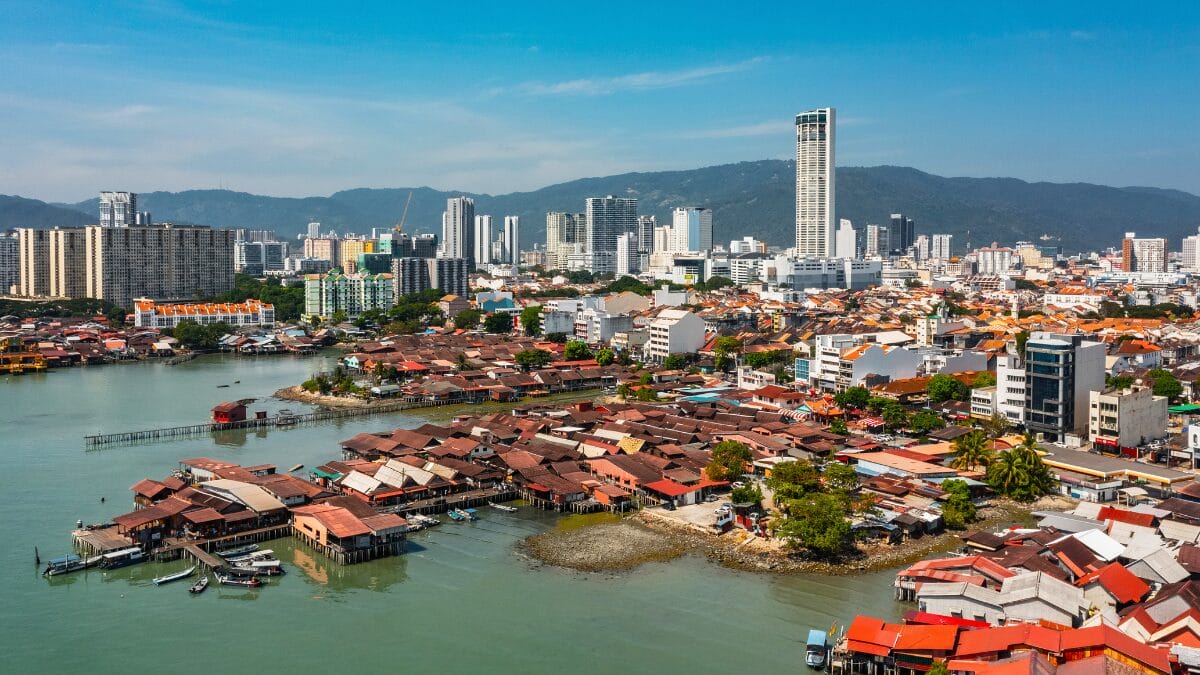
George Town and Penang: superb food value, variable weekend rooms
George Town can be slightly cheaper than Kuala Lumpur for local food, with hawker dishes often RM6–15 and an ordinary inexpensive restaurant meal around RM14–25. Dorms usually fall near RM40–70 and basic private rooms near RM90–170; attractive heritage properties and good hotels commonly begin around RM180–350. Friday and Saturday nights can cost noticeably more, so travelers with flexible schedules save money by placing their longer stay during the week.
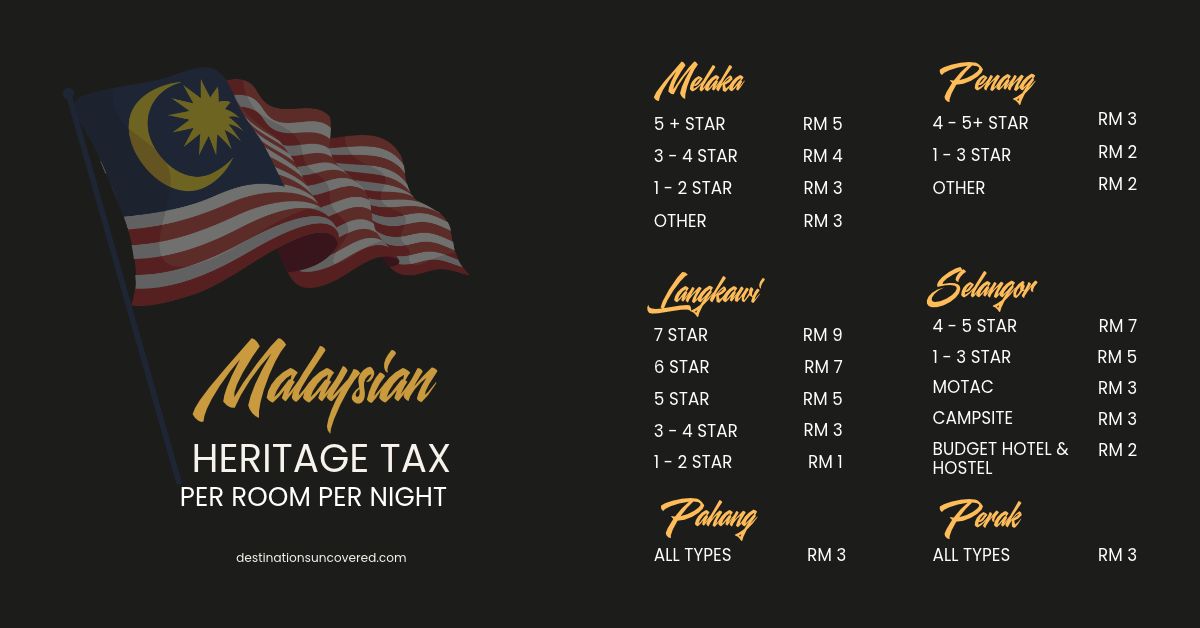
Central George Town is walkable, but Penang’s useful sights are spread across the island. Rapid Penang buses are inexpensive, whereas several Grab rides to beaches, temples and trailheads can add RM40–100 to a sightseeing day. Penang Hill’s standard return funicular fare for an adult visitor is RM40, or RM80 for the fast-lane option. A local government hotel fee can also be charged per room per night, currently commonly reported as RM2 for lower-category properties and RM3 for higher-category hotels, in addition to the federal tourism tax. Confirm the final booking breakdown because collection practices vary.
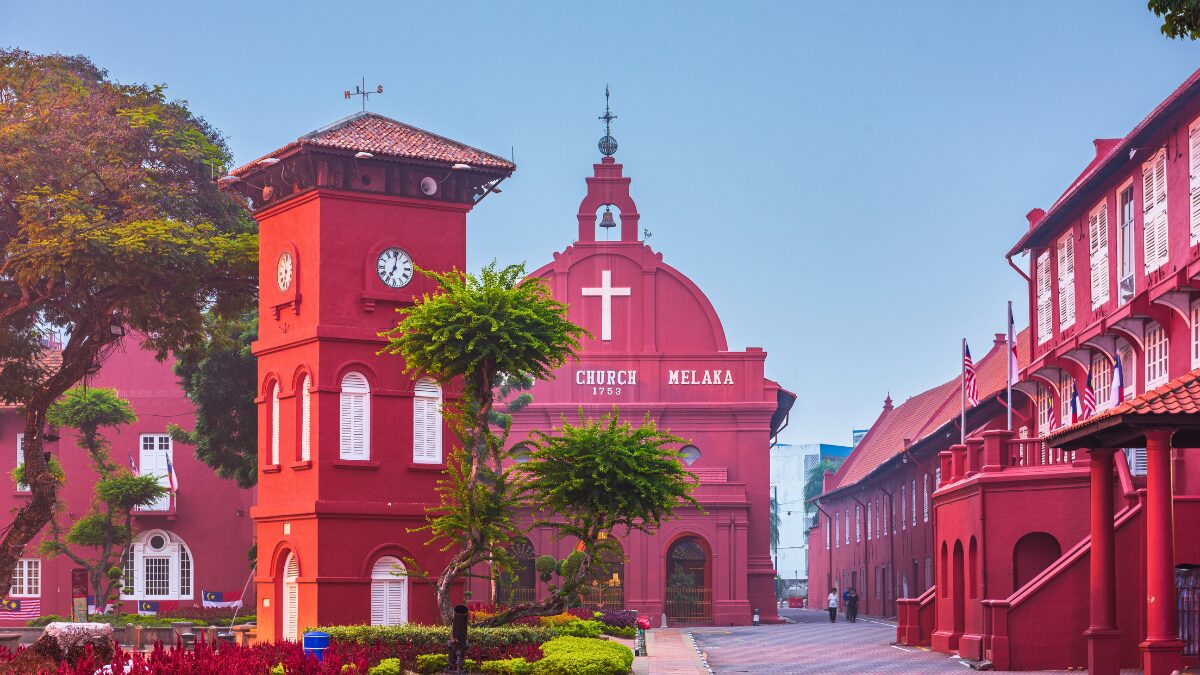
Melaka and Ipoh: lower room costs with weekend and local-tax exceptions
Melaka and Ipoh reward slower travelers. Good local food, compact historic areas and generally moderate rooms make RM230–390 a credible private-room daily range. The catch is concentration of demand: weekend visitors can lift rates sharply in Melaka, while a property on the edge of either city may turn an apparent room bargain into repeated car fares. Melaka’s river cruise is around RM50 for a foreign adult, making it a relatively substantial item within an otherwise inexpensive day.
Melaka properties collect a state heritage charge in addition to the RM10 federal tourism tax; the amount varies by hotel class and can reach RM5 per room per night at high-category hotels. Johor introduced a RM3 nightly state hotel levy in 2026. Similar state or local sustainability charges may appear elsewhere, so the national tourism tax should never be assumed to be the only compulsory amount due at the property.
Cameron Highlands and Taman Negara: room prices hide mobility costs
Basic beds in the Cameron Highlands can be inexpensive—roughly RM55 for a hostel bed and RM100 or more for a simple private room—but the tea estates, farms, viewpoints and forest areas are dispersed. Public buses do not create a convenient sightseeing network. A shared half-day excursion may be economical for one person, while a taxi or private car is better value for a small group. Add RM50–150 for an organised sightseeing day rather than budgeting only for the bus into Tanah Rata.
Taman Negara is more costly to reach and explore than a city because the journey may combine bus, minivan and riverboat. Small permits are not the main expense; guided night walks, river trips, rapid shooting, hides and longer treks are. Some routes and camps are seasonally inaccessible, especially during wetter periods. A sensible plan keeps RM150–350 for a day of guided or boat activities and a separate reserve for a delayed departure.
Langkawi: accommodation ranges from cheap guesthouses to luxury resorts
Langkawi has unusually wide price variation. A basic guesthouse may start near RM60–120, a conventional three-star hotel around RM150–250, a four-star property around RM300–500 and a luxury beach resort from RM800 to well over RM2,000. Budget travelers should check whether a low room price is actually within walking distance of food and a usable beach. The island’s limited public transport means an isolated bargain can create a daily dependence on Grab or a rental vehicle.
The SkyCab cable-car experience starts around RM85 for many international-adult ticket combinations, but bundles and premium lanes cost more. Boat trips, mangrove excursions, jet skis and sunset cruises add quickly. Langkawi is duty-free, yet that does not automatically make restaurants or beachfront bars cheap; duty savings apply mainly to particular retail products. Budget RM350–620 per day for a solo private-room trip with mixed activities, plus the flight or ferry used to reach the island.
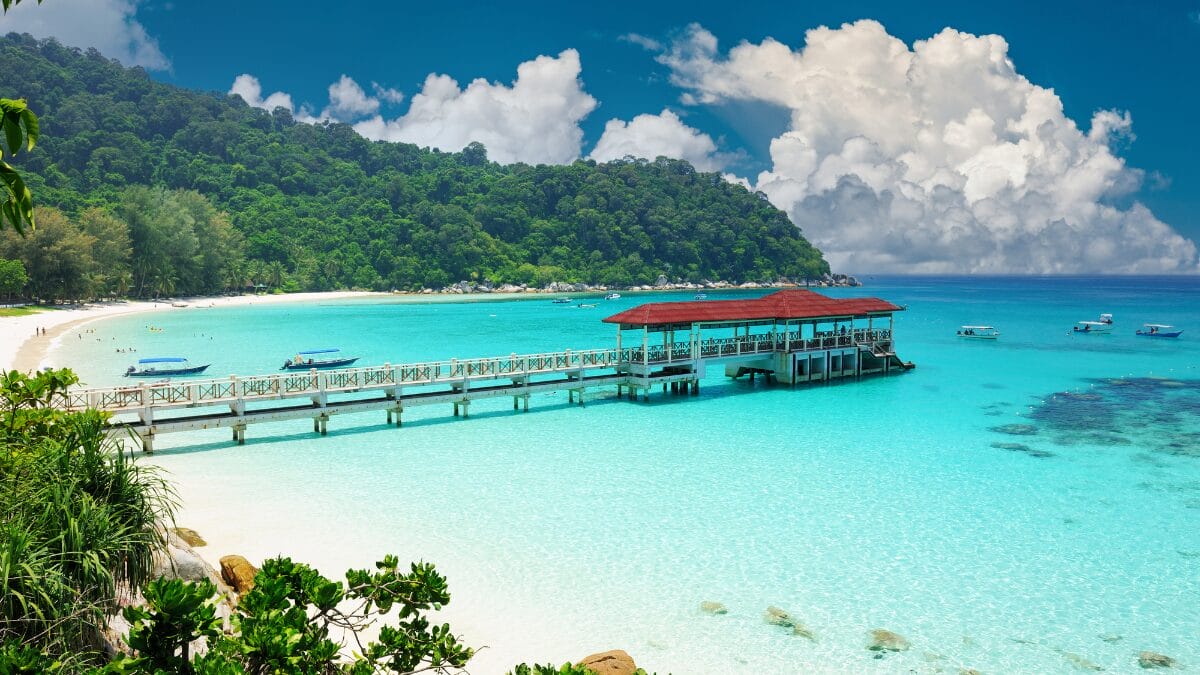
Perhentian Islands and Tioman: seasonal supply changes the calculation
On the east-coast islands, the simple room is often the expensive part. During operating season, a basic Perhentian Island chalet may cost RM180–350, a comfortable room RM350–750 and an upscale beachfront property RM800 or more. Electricity, hot water, air-conditioning and reliable Wi-Fi cannot be assumed at the lowest level. Food also costs more in the Perhentain Islands than on the mainland because supplies arrive by boat and there are fewer competing restaurants.
The mainland gateway transfer, island speedboat, marine-park conservation charge, and possibly a small boat from the arrival point to a particular beach must all be added. The official foreign-adult marine-park fee is RM30, while Perhentian speedboats are commonly below RM50 each way and return tickets often cost around RM80–90. Tioman’s scheduled ferries are tide-dependent, can operate only a few times daily and commonly cost around RM60–85 each way before the marine-park fee. Late arrival may therefore cause an unplanned mainland hotel night.
Tioman’s main visitor season is roughly March to October. On Terengganu’s resort islands, facilities and boat or dive services reduce sharply or close after October. A cheap off-season hotel listing is not useful if the ferry or chosen resort is not operating. Travelers should budget with the coast’s actual season, not Malaysia’s national annual average.
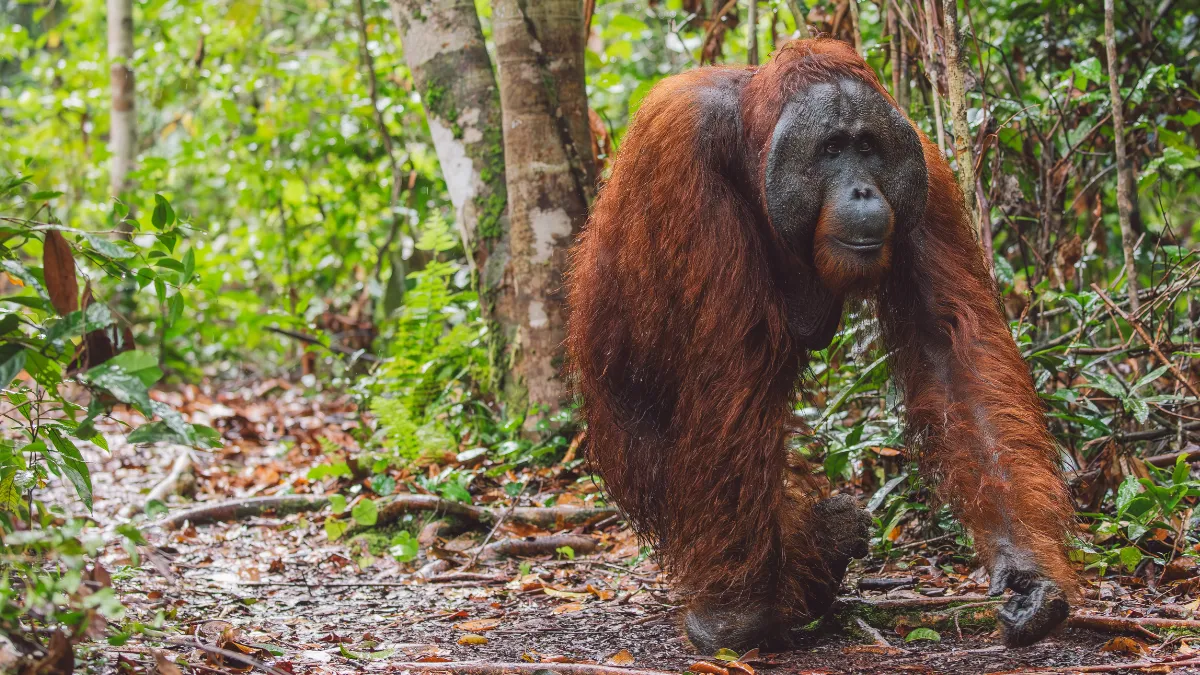
Kuching and Sarawak: inexpensive base, paid nature days
Kuching itself is affordable, with dorms around RM35–65, basic private rooms around RM90–170 and solid mid-range hotels around RM180–350. Food is good value, especially at kopitiams and local food courts. The real trip cost lies beyond the Sarawak waterfront: Semenggoh, Bako National Park, cultural sites and longhouse experiences require buses, ride-hailing, vans, boats or guides.
Bako’s official international-adult admission is RM20, but the boat from the gateway village is separate. A shared boat may add only a modest per-person amount, while a solo charter is far more expensive. Ask the ticket office whether another visitor wants to share and agree on the return time. Gunung Mulu is another cost model entirely: the conservation fee is RM20 from February 2026, but accommodation, domestic flights, guided cave tours and river transport create the real total. A basic Deer and Lang Caves guided tour is RM35, while longer trips can reach hundreds or thousands of ringgit.
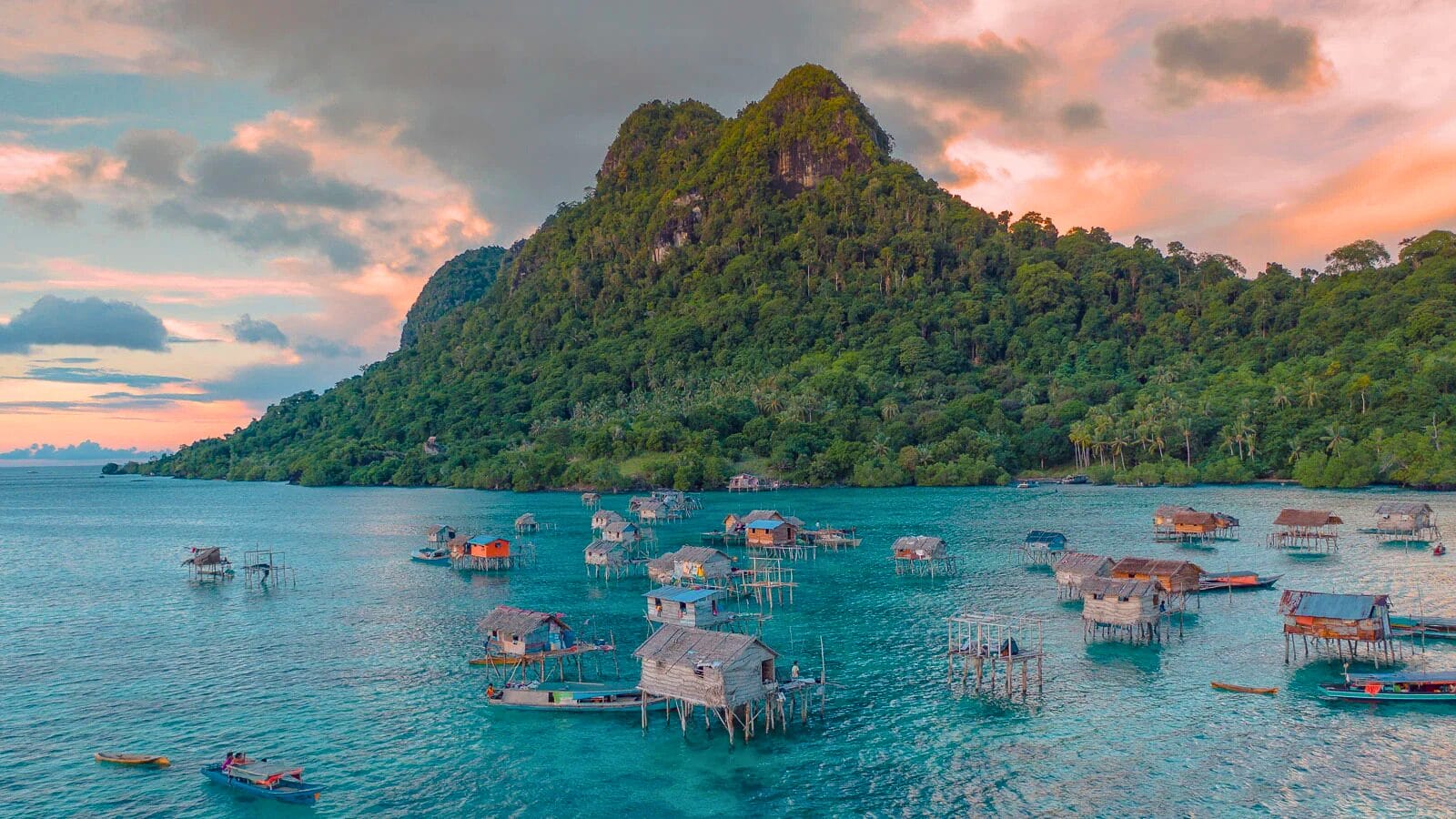
Kota Kinabalu and Sabah: the gateway is affordable; the expedition is not
Kota Kinabalu room and food prices resemble those in Kuching, but a Sabah itinerary usually contains more expensive excursions. Tunku Abdul Rahman Park charges RM25 entry for a foreign adult, then travelers add the island boat, terminal charges, equipment rental and food. Mount Kinabalu has a foreign-adult conservation fee of RM50, but climbing is not a RM50 activity. The climb adds a RM400 permit, compulsory guide, insurance, accommodation, meals, transfers and often a packaged booking, making a total of roughly RM2,000–3,500 or more much more realistic.
A Kinabatangan River stay is usually sold as a two- or three-night package because the lodges arrange transfers, cruises, meals and guides. For a 3-day/2-night experience, budget approximately RM650–1,400 for basic to better-value packages, with private rooms, smaller groups and premium lodges costing more. Sipadan diving, Danum Valley and remote island resorts belong in a separate expedition budget that can exceed RM1,000–3,000 per day.
Safety planning also affects the route. Government travel advisories continue to warn of kidnapping risk in parts of coastal eastern Sabah, including some islands, boats and dive sites, and local water-travel curfews may apply. Check the latest advisory from your own government, the operator’s route and insurance coverage before paying a non-refundable deposit. Choosing a reputable operator and compliant transfer is a safety expense, not an optional luxury.
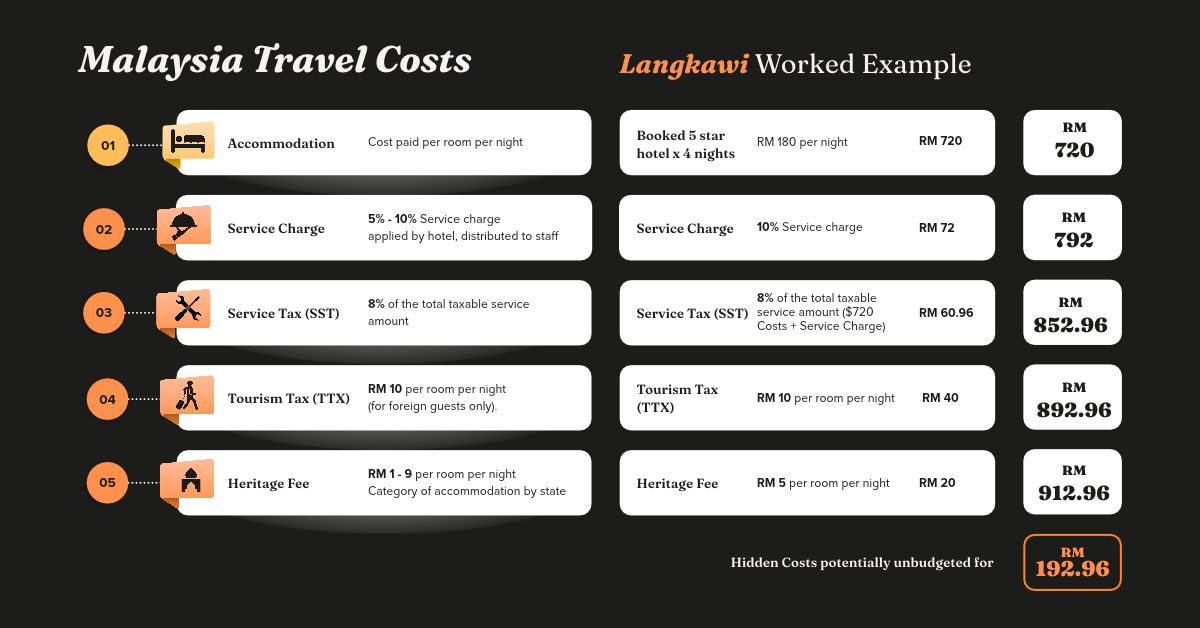
Food and drink costs
This is where Malaysia’s value proposition is strongest. Hawker food is cheap, excellent, and everywhere.
| Food or drink | Typical price (RM) | What changes the cost |
|---|---|---|
| Nasi lemak (hawker/kopitiam) | RM4–8 | Tourist zones and add-ons (fried chicken, extra sambal) push it toward RM12–15 |
| Roti canai | RM1.50–3 | Curry dips, egg or cheese versions cost more |
| Char kway teow / fried noodles | RM6–12 | Seafood versions and Penang tourist stalls cost more |
| Chicken rice plate | RM6–10 | |
| Full meal, simple local restaurant | RM10–20 | |
| Mid-range restaurant meal | RM20–45 | Shared dishes lower the per-person cost |
| Western/international restaurant meal | RM30–70 | Hotel and mall locations cost more |
| Specialty coffee | RM8–16 | |
| Teh tarik / kopi | RM2–5 | |
| Fresh fruit juice | RM5–10 | |
| Bottled water | RM1–3 | |
| Local beer | RM12–20 | See note on alcohol below |
| Cocktail | RM25–45+ | Rooftop bars and resort areas can run well above this |
A disciplined backpacker eating mostly hawker food can manage RM35–55 a day. A traveler mixing hawker stalls, cafés, and the occasional sit-down restaurant should budget RM60–110. Regular Western dining, hotel breakfasts, and cocktails push daily food-and-drink spending past RM150.
Seafood, alcohol and café habits
Seafood is sometimes priced by weight rather than by plate. Ask the price per 100 grams or kilogram, have the fish weighed before cooking and confirm whether preparation costs extra. This matters particularly in Kota Kinabalu, resort zones and tourist-facing seafood restaurants. A cheap-looking menu price may refer to the weight unit, not the whole fish.
Alcohol is meaningfully more expensive than in neighboring Thailand or Vietnam. Malaysia levies high excise duty on alcohol, partly reflecting its status as a majority-Muslim country, and this shows up directly in bar and restaurant prices — a local beer at a hawker centre is reasonable, but the same beer at a bar, and any imported spirit or wine, carries a noticeably heavier markup than elsewhere in the region. Travelers who plan to drink regularly should budget for it as its own line item rather than folding it into an ordinary food estimate.
Specialty coffee, brunch and imported Western food create a quieter form of budget drift. A RM15 coffee and RM30 café breakfast every day adds RM1,350 over 30 days before lunch or dinner. Mixing café visits with local breakfasts preserves the experience without pretending that every meal costs RM8.
Attractions, activities, and tours
Markets, temples, mosques, most beaches, and walkable heritage neighborhoods (Georgetown’s street art and shophouses, Melaka’s Jonker Street) are free or nearly free. The gap between two travelers on the same budget usually comes down to paid activities — and Malaysia has some genuinely expensive ones that don’t exist in most of the rest of Southeast Asia.
| Activity | Realistic planning range | Notes |
|---|---|---|
| Petronas Twin Towers (Skybridge + Observation Deck) | RM98 foreign adult | Malaysian residents pay RM35 — a roughly 3x local/foreign price gap. Timed-entry tickets sell out; book ahead. |
| Batu Caves (main temple) | Free | The separate, ecologically protected Dark Cave requires a paid guided tour, booked in advance |
| Langkawi SkyCab cable car | RM93–133 | SkyBridge-only access is cheaper, around RM35 |
| National park entry (Peninsular parks, e.g. Taman Negara) | RM1–20 | Nominal — the real cost is the transport and guided add-ons to reach and explore the park |
| Taman Negara day tour from KL (transport, guide, canopy walk, boat) | RM650–1,000+ | The park fee itself is trivial; the four-hour transfer and boat access are what you’re actually paying for |
| Cooking class | RM120–250 | |
| Island-hopping day tour | RM100–250 | Park/marine fees, boat, and lunch inclusion vary — ask explicitly |
| Introductory scuba dive | RM300–550 | |
| Mount Kinabalu climb (2D1N, shared package) | RM2,190–3,240+ per person (international climber rate) | Cannot be done independently — see below |
| Sipadan diving (permit only, per day) | RM450 official fee; resorts often charge RM800–900+ | Strict daily quota — see below |
Mount Kinabalu: you cannot just show up and climb
Unlike most trekking peaks in the region, Mount Kinabalu in Sabah cannot be climbed independently. Sabah Parks requires every climber to book a package that bundles the climbing permit, mandatory travel insurance, a mountain guide, and a bed at the Laban Rata/Panalaban base camp — there is no self-guided option and no way to pay only the bare permit fee and walk up on your own.
Even the cheapest shared 2D1N package for international (non-Malaysian) climbers runs from roughly RM2,190 per person in a group of eight to ten, rising toward RM3,000–4,300+ for smaller groups, private rooms, or longer itineraries with extra nights at Kinabalu Park or Poring Hot Springs. Malaysian citizens pay noticeably less across every package tier. Slots are limited and sell out weeks in advance during peak months, so this needs to be booked early, not decided on the ground in Kota Kinabalu.
Sipadan: a legally capped, artificially scarce dive site
Sipadan Island, one of the best dive sites in the world, permits only 252 visitors a day, split across 42 licensed operators — meaning each operator gets a handful of slots regardless of demand. The official government fee (conservation plus diving permit) is around RM450 per person per day, but because slots are scarce and allocated on a rotating, first-come basis, many resorts and dive operators charge a premium on top — commonly RM800–900+ per person per day — just to source a permit for their guests, with no guarantee of success during peak season. Budget for this as a genuinely expensive, quota-limited add-on, not a standard diving day trip, and book your resort stay well in advance if Sipadan is the priority.
The hidden Malaysia travel costs most budgets miss
The hotel bill isn’t the hotel bill
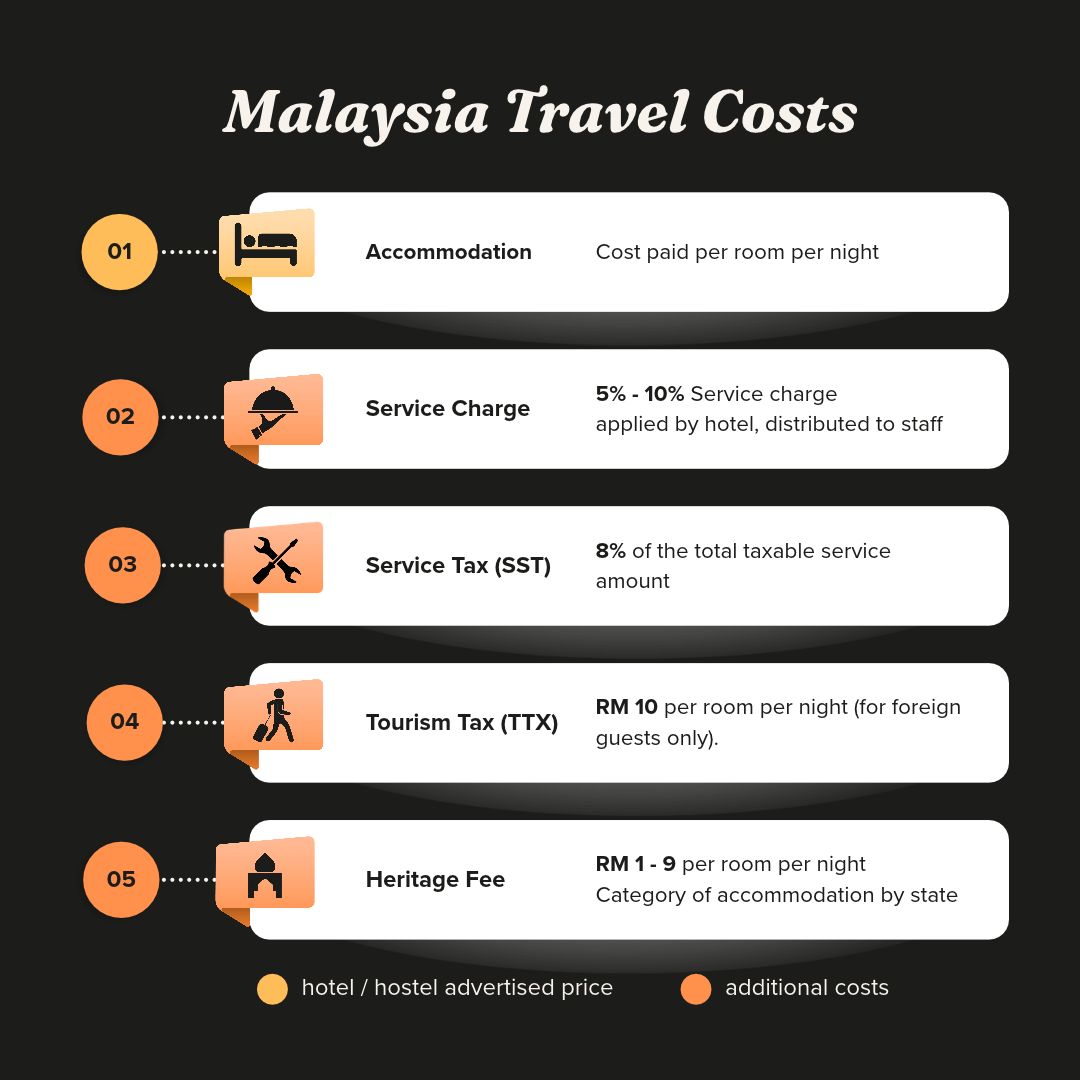
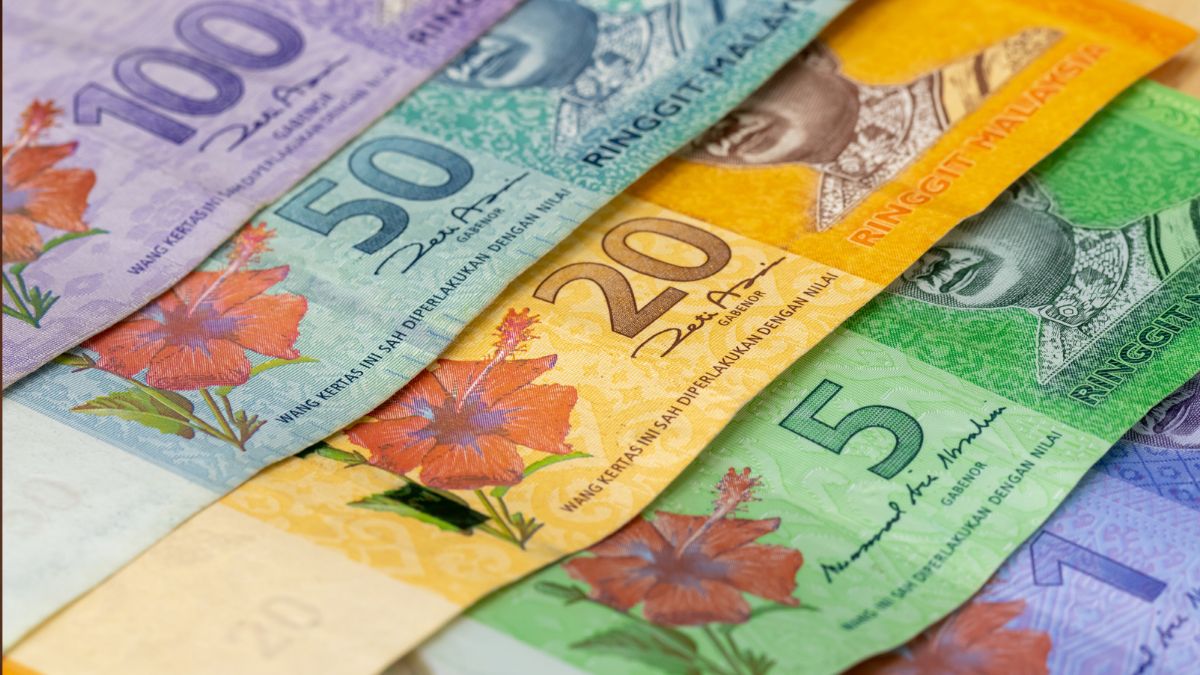
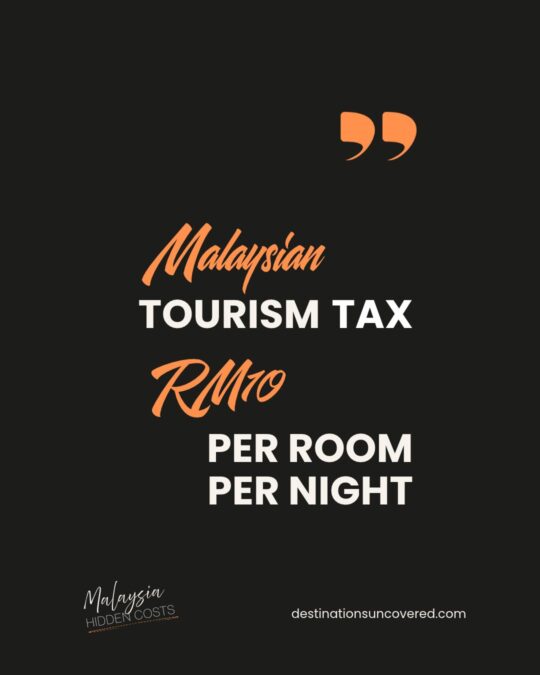
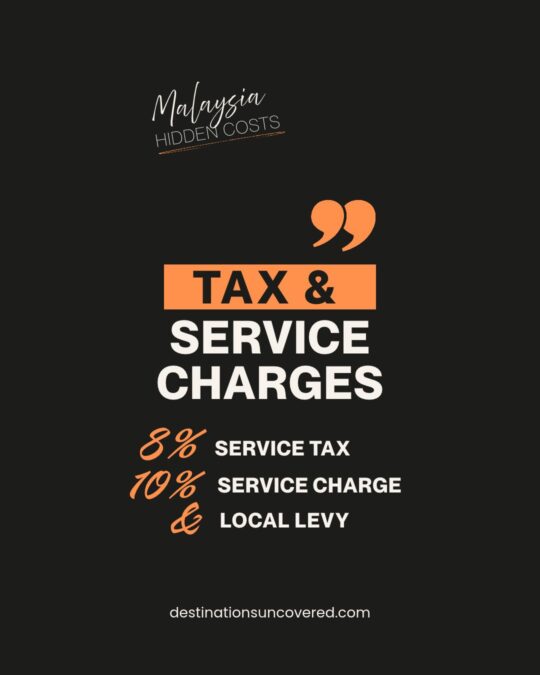
Malaysia charges a flat RM10 per room per night tourism tax on foreign guests at registered accommodation (Malaysians are exempt), on top of which many hotels add a roughly 8% government service tax (SST) and, at mid-range and upmarket properties, a further service charge — so a quoted rate can look noticeably different by the time you check out. Read the final total at checkout, not just the headline nightly rate.
The different taxes/charges to be aware of are
- Malaysian Tourism Tax (TTX) – RM10 per room per night
- Heritage Fee – depending on the state is between RM1 and RM20 per room per night
- Service charge – hotels will add between 5% to 10% charge
- Service Tax – government tax adds 8% on top of room charge and service charge
The KL transit tourist pass got a lot more expensive in 2026
As covered above, the unlimited-travel tourist pass jumped from RM10 to RM25 — a 150% increase — from 1 January 2026. If any pre-trip research you’ve done quotes RM10, it’s now out of date.
Mount Kinabalu and Sipadan are not “budget add-ons”
Both are covered in detail above, but the summary is: if either is on your itinerary, they deserve their own dedicated line item, not a slice of your general activities allowance. A single Mount Kinabalu climb can cost more than several days of ordinary Malaysia travel, and Sipadan diving is capped by government quota, not just price.
MDAC scam sites
The Digital Arrival Card is free and only submitted through the official Immigration Department portal. Third-party sites that look official have charged travelers up to roughly $80 for the same free form — search results and ads for “Malaysia arrival card” don’t reliably lead to the government site.
Borneo is not priced like the Peninsula
The same nightly hotel rate and food budget that works comfortably in Kuala Lumpur or Melaka gets tighter in Sabah and Sarawak, where wildlife tours (orangutan sanctuaries, river cruises for proboscis monkeys, national park entries), remoteness, and the mandatory flight to get there all add up. Price Borneo separately rather than assuming a flat national daily budget.
Same country, separate immigration
Sabah and Sarawak maintain their own immigration controls, distinct from Peninsular Malaysia, even though all three are part of the same country. Foreign visitors flying between Peninsular Malaysia and either Bornean state — or between Sabah and Sarawak — typically go through a passport check and get a fresh entry stamp with its own permitted-stay clock, even on a fully domestic-feeling flight. This isn’t usually a direct cost, but it’s a genuine logistics surprise: keep your passport accessible rather than packed away, and don’t assume a Peninsular Malaysia visa-free clock and a Sabah/Sarawak one are the same countdown.
Sabah immigration information – https://sabahguide.com/laws/sabah-immigration/
Sarawak Immigration Information – https://genesis.sarawak.gov.my/EXPRT/e-tools/visa-with-reference
ATM fees: the one place Malaysia beats Thailand
Unlike Thailand’s near-universal foreign-card ATM surcharge, most Malaysian bank ATMs (Maybank, Hong Leong, and others are frequently reported fee-free) don’t charge foreign cardholders an access fee at all — some do, typically RM10–12, and it’s always disclosed on screen before you confirm. Your home bank’s foreign transaction fee is a separate matter and worth checking before you go, but the “ATM tax” that eats into small Southeast Asia withdrawals elsewhere is less of an issue here. Always decline dynamic currency conversion and withdraw in ringgit.
SIM cards and eSIMs
A tourist SIM or eSIM with enough data for a short trip runs roughly RM12–60, with unlimited-data tourist passes clustering around RM25–40 for a week or two. Coverage is strong across Peninsular Malaysia and the main Borneo towns; expect gaps in remote national parks and on some smaller islands.
Baggage fees on AirAsia
As with any budget carrier, the advertised domestic fare rarely includes checked luggage. Adding baggage during booking is meaningfully cheaper than adding it at the airport counter, and weight limits are enforced — weigh your bag before every domestic flight, especially if you’re carrying dive gear or hiking equipment for Sipadan or Kinabalu.
Deposits and card holds
Hotels, scooter and car rentals, and some tour operators may request a cash deposit or card pre-authorization. It’s usually refundable, but the hold can sit on your card for several days after checkout — factor it into your available cash flow, not your final spending total. If you plan to drive, an International Driving Permit alongside your home license is generally required; don’t assume a rental counter’s willingness to hand over keys means you’re properly licensed and insured.
Realistic daily budgets by travel style
Backpacker: RM120–210 per day
| Category | Lower estimate | Upper estimate |
|---|---|---|
| Dorm bed or fan room | RM30 | RM55 |
| Food and non-alcoholic drinks | RM30 | RM55 |
| Local transport | RM15 | RM25 |
| Attractions and activities | RM20 | RM40 |
| Laundry, water, small costs | RM15 | RM25 |
| Total | RM120 | RM210 |
This level works well in Kuala Lumpur, Melaka, Georgetown, and the Cameron Highlands. It’s tighter on Langkawi and in Borneo, where accommodation and activity costs run higher across the board.
Good-value independent: RM250–420 per day
| Category | Lower estimate | Upper estimate |
|---|---|---|
| Private air-con room | RM100 | RM180 |
| Food and drinks | RM60 | RM110 |
| Local transport (mixed rail/Grab) | RM30 | RM55 |
| Attractions and activities | RM40 | RM70 |
| Laundry, tips, small costs | RM20 | RM30 |
| Total | RM250 | RM420 |
This is the most useful range for most independent adult travelers on the Peninsula. In Borneo, or on an island-heavy itinerary, expect to sit at the top of this range or drift into mid-range.
Mid-range: RM460–780 per day
| Category | Lower estimate | Upper estimate |
|---|---|---|
| 3–4 star hotel | RM220 | RM380 |
| Food and drinks | RM110 | RM190 |
| Local transport (regular Grab use) | RM50 | RM90 |
| Attractions and activities | RM60 | RM100 |
| Tips, laundry, small costs | RM20 | RM30 |
| Total | RM460 | RM780 |
Upmarket independent: RM850–1,700+ per day
| Category | Lower estimate | Upper estimate |
|---|---|---|
| Boutique hotel or resort | RM450 | RM900 |
| Food and drinks | RM200 | RM400 |
| Private transport | RM100 | RM200 |
| Activities, spa, premium tours | RM100 | RM200 |
| Total | RM850 | RM1,700+ |
A high-end Langkawi overwater villa, a private Kinabalu expedition, or a liveaboard dive trip around Sipadan can push a single day well past this range — price known signature bookings directly rather than trying to fit them into the daily average.
Malaysia trip cost for 7, 14, and 30 days
Daily costs only, multiplied out — excluding flights, ferries, domestic legs, insurance, and one-off items like Kinabalu or Sipadan. When you begin planning your Malaysian getaway, having a well throught through itinerary with associated costs is a must. Break down what each day will cover, and how much it equates to for each person. For those wanting a good template we have a digital travel planning tool that you can use. Just enter the activities and budget into and it will keep a running tally of costs and dates. You can access our itineraray and travel cost templates at Build My Trip.
| Travel style | 7 days | 14 days | 30 days |
|---|---|---|---|
| Backpacker | RM840–1,470 ($200–$350) | RM1,680–2,940 ($400–$700) | RM3,600–6,300 ($857–$1,500) |
| Good-value independent | RM1,750–2,940 ($417–$700) | RM3,500–5,880 ($833–$1,400) | RM7,500–12,600 ($1,786–$3,000) |
| Mid-range | RM3,220–5,460 ($767–$1,300) | RM6,440–10,920 ($1,533–$2,600) | RM13,800–23,400 ($3,286–$5,571) |
| Upmarket independent | RM5,950–11,900+ ($1,417–$2,833+) | RM11,900–23,800+ ($2,833–$5,667+) | RM25,500–51,000+ ($6,071–$12,143+) |
Two route-based examples
7 days: Kuala Lumpur, Melaka, and Penang (Peninsula only)
A good-value solo traveler splitting three nights in KL, two in Melaka, and two in Georgetown, connecting by train and bus:
- Daily costs: roughly RM1,750–2,940
- Intercity transport (KL–Melaka bus, Melaka–Penang bus/train combo): roughly RM150–300
- Local transfers and station/airport transport: roughly RM100–200
In-country total: roughly RM2,000–3,440 ($476–$819) before the international flight and insurance — genuinely affordable, and representative of why Malaysia’s reputation for value is well earned on a Peninsula-only route.
14 days: Peninsula plus Borneo (Kuala Lumpur, Penang, Kota Kinabalu, Sipadan-area diving)
This is where the “Malaysia is cheap” reputation breaks down, and where under-budgeting is most common:
- Daily costs (good-value tier, weighted toward the upper range for Borneo): roughly RM4,500–6,500
- Domestic flight, KL–Kota Kinabalu return: roughly RM400–900
- Sipadan-area diving (permit plus operator premium, 2–3 days of diving): roughly RM1,800–3,000
- Local Borneo transport and park fees: roughly RM300–600
- Contingency (15%, given the flight and permit dependencies): roughly RM1,050–1,650
In-country total: roughly RM8,050–12,650 ($1,917–$3,012) before the international flight and insurance — two to three times the cost of a comparable Peninsula-only two-week trip, almost entirely because of the flight to Borneo and the Sipadan permit premium.
How costs change for solo travelers, couples, and families
Solo travelers
Malaysia is easy to travel alone, but private accommodation creates a measurable solo premium. A RM220 room plus RM10 tourism tax costs one person RM230, while two people sharing pay RM115 each. A solo traveler can reduce this through dorms, single rooms, social hostels, shared park boats and scheduled group tours. It is usually more effective to share high-fixed-cost items than to economise on food or safety.
For a month-long solo traveler using private rooms, add RM2,000–4,000 above a dorm-based plan depending on destination. Islands and remote lodges widen the difference. A solo supplement quoted by a tour company should be compared with the cost of a scheduled shared departure, not accepted automatically.
Couples and friends
Two people sharing a room, Grab, car rental and private boat can travel at a noticeably lower per-person rate. Couples get the strongest per-person value from sharing a private room — the jump from a dorm bed to a shared double room is often only a few tens of ringgit more per person, for considerably more privacy and comfort. Flights, ferries, park fees, diving, and most tours are priced per person regardless, so calculate those separately.
Food, admission, domestic flights and most packages remain per-person expenses. A realistic couple budget is therefore not simply one solo budget doubled; it is commonly around 1.6–1.8 times the solo total at the same comfort level, depending on how many shareable transfers the route contains.
Families
Families should price the exact room configuration. A “family room” can be cheaper than two rooms, but fire rules, bed size and maximum occupancy differ. A child may receive reduced admission at parks or attractions but require a full airline seat, boat space and breakfast charge. Child seats are not guaranteed in ride-hailing cars or rentals and may need advance arrangement.
For a family of four, build the budget from one or two actual room quotes, four transport seats and age-specific attraction fees rather than multiplying a vague per-person figure. Mount Kinabalu has a minimum climbing age (typically 10, with climbers under 16 treated as children requiring a separate guide), and some dive operators set minimum ages or certification requirements for Sipadan, so verify family-specific rules well before booking rather than assuming a standard adult itinerary scales down.
Cheapest and most expensive parts of Malaysia
Best value: Kuala Lumpur (outside the most central hotel districts), Melaka, Ipoh, and Georgetown offer the strongest combination of low costs and high quality — excellent, cheap food, walkable heritage cores, and hotel rates that undercut most of Southeast Asia’s better-known cities.
Higher cost: Langkawi (particularly beachfront Pantai Cenang and resort properties), Malaysian Borneo generally, and anything built around Mount Kinabalu or Sipadan. None of these are “expensive” by global standards, but they’re a clear step up from Peninsular mainland pricing, for the same reasons Phuket costs more than Chiang Mai: land, imports, remoteness, and concentrated demand.
When is Malaysia cheapest to visit?
Malaysia doesn’t have one nationwide low season, and — unlike Thailand — its two coasts don’t offset each other neatly. The east coast (Perhentian, Redang, Tioman) is effectively closed to tourism from November to February due to the northeast monsoon; hotel rates there are low mostly because operators are shut, not because it’s a viable budget window. The west coast and Langkawi run on a gentler pattern and stay largely open year-round, with their wetter stretch roughly April to October. Peninsular interior destinations like the Cameron Highlands and Taman Negara are workable most of the year, with heavier rain typically from October to February island-side and a hotter, more humid stretch from roughly March to August inland.
Chinese New Year, Hari Raya (dates shift yearly on the Islamic calendar), and school holiday periods all raise hotel and domestic flight prices nationwide, regardless of weather.

How to save money in Malaysia without cutting corners on safety
- Treat Peninsular Malaysia and Borneo as two separate budgets, and price the Borneo flight and any Sipadan/Kinabalu costs explicitly rather than folding them into a national daily average.
- Use the train or bus for Peninsular travel where the journey itself has value, and fly only when the time saved is worth the fare difference.
- Book Mount Kinabalu and Sipadan well in advance — both are quota- or slot-limited, and last-minute availability usually means a worse package at a higher price, not a better deal.
- Add domestic flight baggage during booking, not at the airport counter.
- Decline dynamic currency conversion at ATMs and card terminals, and withdraw in ringgit.
- Mix hawker food with the occasional sit-down meal rather than treating every meal as either the cheapest option or a splurge — Malaysia’s hawker food is good enough that this isn’t really a sacrifice.
- If alcohol matters to your budget, price it separately; it’s taxed well above regional norms and can otherwise blow out an accurate food estimate.
- Check the final accommodation checkout total, not the headline room rate, for the tourism tax, SST, hertitage fee, and any service charge.
A practical Malaysia budget formula
Total Malaysia trip cost = international flights + travel insurance + accommodation + food and drinks + local transport + intercity/interstate transport (including any Peninsula–Borneo flight) + activities and tours (priced separately for Kinabalu/Sipadan if applicable) + SIM/data + laundry and personal expenses + shopping + contingency reserve.
Work through it in this order: list every night and destination, including whether it’s Peninsula or Borneo; price the international flight and its baggage; price accommodation using the final post-tax rate; set a food, transport, and activity allowance per destination rather than one national figure; add every domestic flight, train, bus, and ferry separately, including the Borneo leg if relevant; price Kinabalu and/or Sipadan explicitly if either is on the itinerary, since they don’t fit inside an ordinary activities allowance; add insurance, data, and small daily costs; then add a 10% reserve for a Peninsula-only trip or 15–20% for anything involving islands, monsoon-season travel, or Borneo connections.
Malaysia travel cost FAQ
How much money do I need per day in Malaysia in 2026?
A backpacker using dorms and local food should plan RM150–230 per day. A solo traveler who wants a private room and regular paid activities should allow RM300–500. Comfortable independent travel generally starts around RM600 per day. Island and Borneo nature days can cost RM700–3,000 or more because boats, guides, permits and remote lodging are involved.
Is Malaysia cheaper than Thailand?
For a Peninsula-only trip, generally yes for accommodation and street food, and roughly comparable for transport. Once Malaysian Borneo, Mount Kinabalu, or Sipadan enter the itinerary, Malaysia can end up more expensive than an equivalent Thailand trip, because those experiences carry mandatory guide fees and quota-driven permit costs that don’t have a direct Thai equivalent.
Can I travel Malaysia for $30 a day?
Yes, on the Peninsula, with dorms or basic fan rooms, hawker food, public transport, and free attractions — it’s near the lower end of the backpacker range above. It’s not realistic in Langkawi or Borneo, or on any day involving Kinabalu or Sipadan.
Is $100 a day enough for Malaysia?
For most independent travelers on the Peninsula, yes — it sits comfortably in the good-value independent range and covers a private room, varied food, and a reasonable activity allowance. It gets tighter in Borneo and on island-heavy days.
Do I need to budget separately for Mount Kinabalu or Sipadan?
Yes. Both are effectively fixed-cost, advance-booked packages rather than activities you can slot into a daily allowance — treat them the way you’d treat a flight, not the way you’d treat a city tour.
Is tipping expected in Malaysia?
Not in the US sense. Rounding up or leaving small change is appreciated but not obligatory. Check the bill first — many hotels and mid-range-to-upmarket restaurants already add a service charge.
Is it cheaper to use cash or cards?
Cards are widely accepted in cities, malls, and hotels; cash still matters for hawker stalls, markets, and rural areas. Malaysia’s lighter ATM fees (relative to some neighbors) make sensible cash withdrawals less costly than in much of the region — just decline currency conversion and withdraw in ringgit.
How much should I set aside as an emergency reserve?
For a Peninsula-only trip, 10% of your planned in-country spending is reasonable. For anything involving islands, Borneo, or monsoon-season timing, 15–20% is safer, given how weather and limited transport can force last-minute, pricier alternatives. Travel insurance remains necessary regardless — no cash reserve substitutes for medical evacuation cover.
Is the Malaysia Digital Arrival Card free?
Yes. The official MDAC submission is free and is normally completed within the three days before arrival by foreign travelers who are not exempt. It is an arrival declaration rather than a visa. Use the link from the Malaysian Immigration Department because commercial lookalike services may charge an avoidable fee.
Do tourists need a visa for Malaysia?
Many nationalities receive visa-free entry for a limited visit, but eligibility and duration depend on the passport and sometimes the method of arrival. Check Malaysia’s official visa-requirement list for the travel date. Travelers who need a visa should use the official eVISA portal or relevant Malaysian mission and budget the published fee plus any legitimate payment charge.
What hotel taxes do foreign visitors pay in Malaysia?
The federal tourism tax is RM10 per room per night from 15 December 2025. Accommodation can also carry 8% service tax, a commercial service charge and a state or local hotel levy. The tourism tax may be collected online or at the property, so compare the complete checkout total and retain proof of payment.
Is food expensive in Malaysia?
Local food remains very good value. A hawker dish often costs RM6–15 and an inexpensive meal around RM15–30. A realistic local-food day is RM35–60, while mixed café and restaurant eating is RM70–130. Alcohol, imported food, hotel restaurants and island locations increase the total substantially.
What is the cheapest way from Kuala Lumpur airport to the city?
Airport buses, commonly around RM15 to KL Sentral, are usually the cheapest straightforward option. KLIA Ekspres costs RM55 one way or RM100 return and is faster. A Grab car can be competitive for a group but may cost roughly RM75–120 plus tolls depending on destination and demand.
Are domestic flights cheap in Malaysia?
Base fares can be cheap, especially when booked ahead, but the real cost includes baggage, seat or booking options, possible fuel surcharges and transport to both airports. For planning, RM150–450 one way is more realistic than building a route around a rare promotional fare. Peak dates and Borneo routes can cost more.
Final answer: what should you budget for Malaysia in 2026?
For an independent trip in 2026, budget RM120–210 ($29–$50) per person per day for backpacker travel, RM250–420 ($60–$100) for a good-value private-room trip, RM460–780 ($110–$186) for mid-range travel, or RM850–1,700+ ($200–$400+) for an upmarket trip. Then add international airfare, insurance, any Peninsula–Borneo flight, ferries, and — if they’re on your list — Mount Kinabalu and Sipadan as their own dedicated costs, not line items inside your daily average.
The route matters more than the country-wide reputation. Kuala Lumpur, Melaka, and Georgetown can fit a genuinely modest budget while delivering some of the best food value anywhere in Asia. Langkawi, Sabah, and Sarawak — and especially a Kinabalu climb or a Sipadan dive permit — require real, separately budgeted money. Price the two halves of Malaysia separately, and the “hidden costs” in this guide stop being hidden.
Official Sources for Rechecking Time-Sensitive Malaysia Travel Costs
Prices were checked for publication on 3 September 2026. Government fees and published operator fares are current on that date; dynamic accommodation, flights and ride-hailing prices are planning ranges rather than guaranteed quotes. Readers should recheck time-sensitive requirements and reservations immediately before payment.
- Bank Negara Malaysia exchange rates
- Malaysian Immigration visa requirements by country
- Malaysian Immigration MDAC information
- Tourism Tax (Rate of Tax) Order 2025
- Royal Malaysian Customs service-tax information
- KLIA Ekspres official fares
- Rapid Kembara visitor pass
- KTM ETS information
- AirAsia domestic fees and charges
- Department of Fisheries marine-park conservation charges
- Sabah Parks: Kinabalu Park
- Sabah Parks: Tunku Abdul Rahman Park
- Gunung Mulu National Park planning information
- New Zealand SafeTravel Malaysia advice
- Australian Smartraveller Malaysia advice
13 Works Cited
Grab. Download the Grab App Now! 2026, www.grab.com/my/download/.
Jeffery Jimit, J. EASTERN SABAH SECURITY COMMAND (ESSCOM). 2026, sabahtourism.com/advisory/.
SabahParks. Kinabalu Park – The Official Sabah Parks Website. SabahParks, 2026, www.sabahparks.org.my/kinabalu-park.
KLIAEkspres. Get 30% off KLIA Ekspres. 2026, www.kliaekspres.com/.
KLIATransit. KLIA TRANSIT Seamless Travel for All Your Needs. 2026, www.kliaekspres.com/products-fares/klia-transit/.
ktmb.com.my. MTMB Electric Train Service. 2026, www.ktmb.com.my/ETS.html.
—. Train Timetable. 2026, www.ktmb.com.my/.
ImigresenMalaysia. Malaysia Digital Arrival Card – MDAC. ImigresenMalaysia, 2026, imigresen-online.imi.gov.my/mdac/main.
MalaysiaAirports. Getting to KLIA Terminal 1 and 2. 2026, www.malaysiaairports.com.my/en/klia1/air-travel/public-transport.
myrapid. Rapid Kembara. 2026, myrapid.com.my/our-products/rapidkembarapass/.
MyRapid. Welcome to MyRapid Journey Planner. 2026, myrapid.com.my/.
PetronasTwinTowers. ADMISSION & TICKETING. 2026, www.petronastwintowers.com.my/plan-your-visit/admission-ticketing/.
USDepartmentofState. State Department Travel Advisory Malaysia. 2026, travel.state.gov/en/international-travel/travel-advisories/malaysia.html.